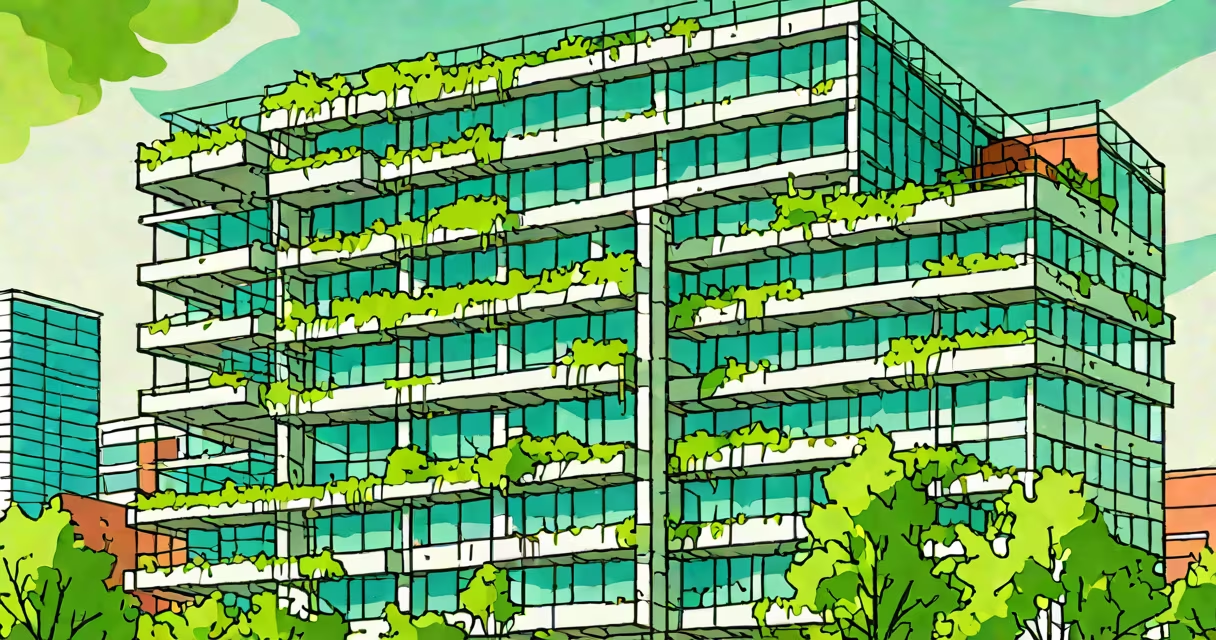
LEED certified buildings are constructed and operated to meet specific environmental performance standards established by the U.S. Green Building Council. These standards cover energy efficiency, water conservation, indoor air quality, and sustainable site development. Certification is awarded based on a point system across categories like location, materials, and operational practices.
LEED stands for Leadership in Energy and Environmental Design. It is a globally recognized rating system used to evaluate the sustainability of buildings. Projects earn points by meeting criteria in areas such as energy use reduction, renewable energy integration, stormwater management, and access to public transit. A building must achieve a minimum score threshold to qualify for certification, which ranges from Certified to Platinum.
The system applies to new construction, major renovations, existing buildings, and entire neighborhoods. Each project undergoes third-party review by a qualified professional to verify compliance. The process helps claims about environmental performance are independently validated. This prevents greenwashing and gives stakeholders confidence in the building's actual impact.
Projects begin by registering with the Green Business Certification Inc. (GBCI), the organization that administers LEED. They select a rating system based on building type-such as LEED BD+C for new construction or LEED O+M for existing operations. Each system contains credit categories with measurable requirements.
For example, a commercial office building aiming for LEED Gold must earn at least 60 points out of 110. Points come from actions like installing low-emitting materials, using 30% less water than baseline standards, and sourcing 20% of materials from within 500 miles of the site. Projects submit documentation showing compliance, then undergo technical review.
Once approved, the project receives a certificate and a unique ID. The building is listed in the LEED Online database. Recertification is required every five years for ongoing compliance, especially for buildings under the O+M category. This ensures long-term performance rather than one-time achievement.
LEED offers several rating systems tailored to different building types and phases. The most common are:
| Rating System | Use Case | Minimum Points for Certification |
|---|---|---|
| LEED BD+C: New Construction | New commercial buildings | 40 points (Certified) |
| LEED BD+C: Core & Shell | Partially completed buildings | 40 points (Certified) |
| LEED O+M: Existing Buildings | Operational facilities | 40 points (Certified) |
| LEED BD+C: Schools | K-12 and higher education facilities | 40 points (Certified) |
| LEED ND: Neighborhood Development | Master-planned communities | 40 points (Certified) |
Each rating system adjusts point thresholds and credit availability to reflect real-world constraints. For instance, schools have credits focused on student health and daylight access, while core and shell projects prioritize structural sustainability during early construction stages.
There are four levels of certification: Certified (40-49 points), Silver (50-59), Gold (60-79), and Platinum (80+). Higher levels require more stringent performance in energy modeling, waste diversion, and community engagement. A building cannot skip levels-each requires incremental improvements.
Many assume that LEED certification means a building is completely carbon-neutral or powered entirely by renewables. That is incorrect. LEED evaluates environmental performance, not absolute net-zero status. A building can be LEED Platinum while still relying on grid electricity.
Another misunderstanding is that LEED is only about energy savings. While energy efficiency is a major component, the system also prioritizes human health. Indoor air quality, access to natural light, and acoustic comfort are weighted heavily. Studies show occupants in LEED-certified offices report 26% fewer sick days and 15% higher productivity, according to research from the Harvard T.H. Chan School of Public Health.
A lesser-known fact: LEED does not mandate on-site renewable energy. A building can earn points for purchasing renewable energy credits (RECs) instead of installing solar panels. This allows flexibility but can lead to lower local environmental benefit. Some critics argue this weakens the standard's regional relevance.
The Edge, a corporate headquarters in Amsterdam, holds the highest LEED score ever recorded-94 out of 110 points. It achieved LEED Platinum certification through a combination of smart design and automation. The building uses 70% less electricity than comparable structures.
Key features include:
Employees receive personalized dashboards showing their individual energy consumption and workspace preferences. The building's AI optimizes HVAC and lighting in real time. Despite being located in a dense urban area, it achieved high biodiversity scores due to rooftop gardens and native plant landscaping.
This project demonstrates that LEED certified buildings are not just about compliance-they enable innovation. The Edge reduced operational costs by 30% over five years and improved employee satisfaction scores by 40% compared to industry averages.
LEED certified buildings often command higher rental rates and lower vacancy. A 2021 study by the U.S. Department of Energy found that LEED-certified office spaces leased at 7% above market rate on average. Tenants value the lower utility bills and healthier environments.
Public agencies frequently require LEED certification for new construction. The U.S. General Services Administration mandates LEED Gold or higher for federal buildings. Cities like New York and San Francisco have adopted policies requiring LEED certification for large-scale developments.
On a personal note, I once visited a LEED Gold-certified school in Portland. The classrooms had operable windows, natural wood finishes, and daylight harvesting systems. Teachers reported students were more attentive during morning hours when sunlight was maximized. The building's indoor air quality sensors showed CO₂ levels consistently below 800 ppm-well under the recommended limit of 1,000 ppm.
LEED certified buildings are not a trend. They represent a proven structure for reducing environmental harm while improving human well-being. The system continues to evolve, with recent updates emphasizing equity, climate resilience, and life-cycle assessment. As of 2023, over 100,000 projects worldwide have earned LEED certification, including more than 1,500 in the United States.
Understanding what are LEED certified buildings reveals a commitment to measurable sustainability. These structures go beyond aesthetics or marketing-they deliver verified environmental and social benefits. For those seeking long-term value, durability, and responsible design, LEED certification remains a trusted benchmark.