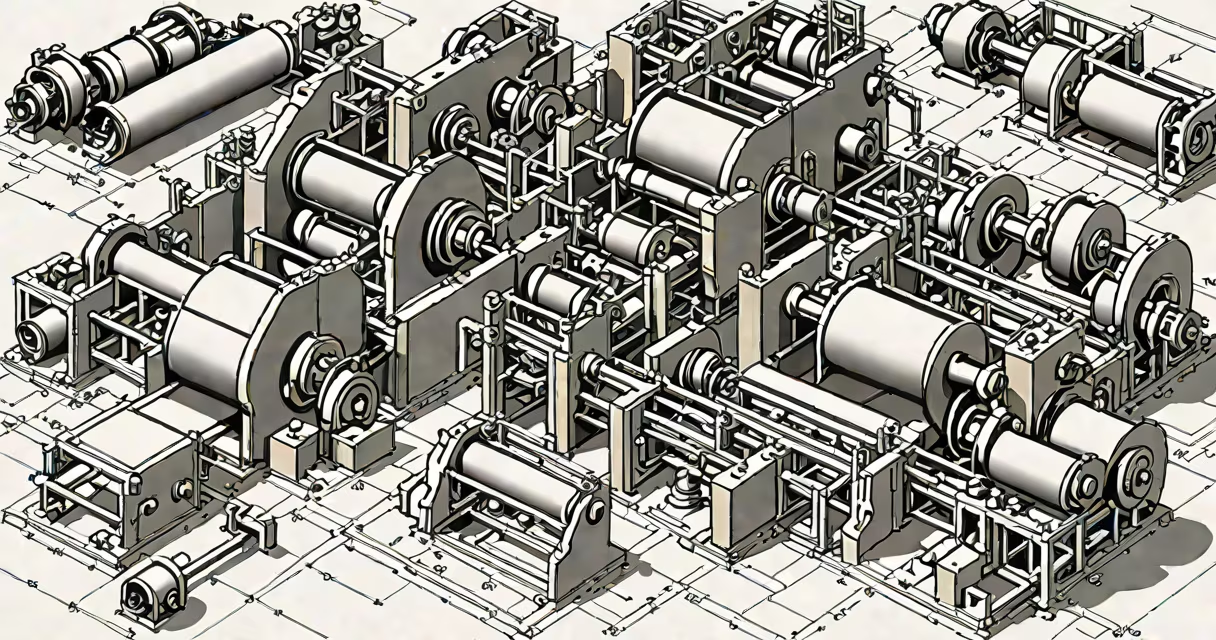
Rolling mills are industrial machines that reduce the thickness of metal stock by passing it through a series of rotating rollers under high pressure. This process shapes metal into standardized forms such as sheets, plates, bars, and coils used in construction, automotive, and appliance manufacturing.
These machines operate by compressing metal between two or more rollers set at precise distances. As the metal passes through, it elongates and thins uniformly. The process can occur at high temperatures (hot rolling) or near room temperature (cold rolling), depending on the desired properties and material.
Rolling mills are central to modern metal production. A single continuous caster line at a steel plant may feed directly into a tandem rolling mill capable of processing 2,000 tons of steel per hour. The output includes flat-rolled products used in everything from car bodies to refrigerators.
Rolling mills function through controlled deformation. When metal enters the mill, it's gripped by the rollers, which rotate in opposite directions. Friction pulls the material through the gap, reducing its thickness while increasing its length. The reduction ratio-the difference between input and output thickness-is carefully managed to avoid cracking or warping.
Each pass through the rollers reduces the thickness incrementally. For example, a 100 mm thick steel slab entering a hot strip mill may exit at 25 mm after the first pass, then 10 mm after the second, and finally 3 mm after multiple stages. This staged approach prevents excessive strain on the metal or equipment.
Temperature control is critical. Hot rolling occurs above the recrystallization temperature of the metal-around 1,200°C for carbon steel-allowing atoms to rearrange easily. Cold rolling happens below that threshold, resulting in stronger, harder materials but requiring more energy and careful handling to prevent work hardening.
Rolling mills are categorized by their configuration, application, and operating temperature. The most common types include:
| Type | Configuration | Use Case | Example Output |
|---|---|---|---|
| Two-high | Two rollers stacked vertically | Simple shaping, low-volume production | Steel bars, rails |
| Four-high | Small work rolls supported by larger backup rolls | High-precision thin-sheet production | Aluminum foil, thin steel sheets |
| Tandem | Multiple stands in sequence | High-speed continuous rolling | Hot-rolled steel coils, cold-rolled strips |
| Continuous | Long line of stands feeding into one another | Mass production of uniform sheet metal | Automotive panels, appliance parts |
Four-high mills are especially effective for thin materials because the small work rolls allow fine thickness control, while the large backup rolls prevent deflection under load. This design enables tolerances within ±0.02 mm for precision applications like aerospace components.
Rolling mills are used across heavy industry. Steel plants rely on them to convert molten steel into usable forms. A typical integrated steel mill produces over 1 million tons of steel annually, with rolling mills handling 80% of the final shaping.
For example, at Nucor's steel facility in Crawfordsville, Indiana, a 200-meter-long tandem hot strip mill processes 1.5 million tons of steel per year. The mill runs continuously, with sensors monitoring roll alignment and metal temperature in real time to maintain consistency.
Cold rolling mills are common in aluminum and specialty steel production. They improve surface finish and mechanical strength. A 0.5 mm thick aluminum sheet used in aircraft skin requires cold rolling to achieve the necessary tensile strength-over 300 MPa-and surface smoothness suitable for bonding with composite layers.
Rolling mills are often mistaken for forging presses or extrusion machines. While all three shape metal, they do so differently. Forging applies localized force via impact or compression, typically at high heat, to deform metal into complex shapes. Extrusion forces metal through a die to create long profiles like window frames or tubing.
Rolling mills differ in that they apply continuous, distributed pressure across a wide area. This allows for uniform thickness and large-scale production. A forged part may have internal grain flow aligned with stress points, but rolling preserves directional grain structure across the entire piece-ideal for structural applications.
A lesser-known fact: modern rolling mills use computerized feedback systems to adjust roller gaps during operation. At ArcelorMittal's plant in Ghent, Belgium, AI-driven models predict thickness deviations based on incoming billet temperature and composition. These systems reduce scrap rates from 6% to under 1.5% in real-world use.
Another correction: rolling mills don't create new material-they reshape existing stock. The chemical composition remains unchanged. Only physical form and microstructure are altered. This means a 1018 steel billet rolled into a 3 mm plate still contains the same carbon content (0.18%) and mechanical behavior profile, though with improved ductility due to plastic deformation.
I once visited a cold rolling mill in Ohio where a technician adjusted the gap between two 1.2-meter-diameter rollers using hydraulic actuators. The machine was running at 120 meters per minute, producing 0.8 mm thick steel strips. The noise was intense-over 90 dB-but the precision was visible: a sample strip measured 0.801 mm at both ends and the center, with no visible waviness.
This level of consistency is why rolling mills are indispensable. Without them, mass-produced metal goods would be prohibitively expensive or structurally unreliable.
Rolling mills are not just machines-they are the core of metal fabrication. From the steel beams in skyscrapers to the aluminum cans in grocery stores, what are rolling mills? They are the industrial engines that turn raw metal into the structured materials that build modern life.