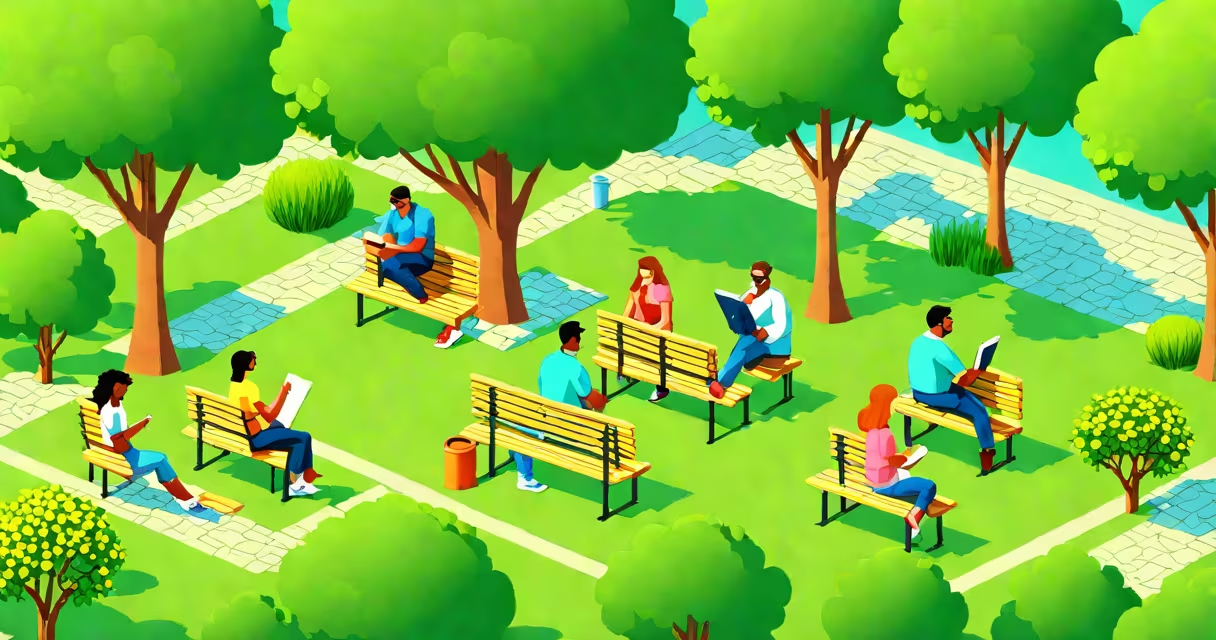
Third spaces are informal public areas where people gather outside their homes and workplaces. These spaces build spontaneous interaction, strengthen community ties, and support mental well-being in urban environments.
Unlike first spaces (home) and second spaces (work), third spaces aren't tied to ownership or obligation. They're accessible to everyone, designed for rest, conversation, and shared experience. Think of a neighborhood coffee shop, a public library reading room, or a tree-lined park bench.
Urban designers and sociologists emphasize third spaces as essential infrastructure for healthy cities. Research from the American Psychological Association notes that regular access to such environments reduces stress and increases feelings of safety and inclusion among residents.
These spaces function through low barriers to entry and minimal rules. You don't need to buy something to sit. You don't have to show ID. You just show up. That simplicity enables diversity in who uses them and how.
They operate on principles of ambient sociability-small, quiet interactions that build familiarity without pressure. A barista remembering your name, a dog walker saying "good morning," a musician playing guitar near a fountain. These moments accumulate into a sense of place.
Third spaces thrive on passive surveillance. When many people move through an area, even briefly, it deters crime and signals that the space belongs to the community. This concept, known as "eyes on the street," was popularized by Jane Jacobs in *The Death and Life of Great American Cities* (1961).
Third spaces come in many forms, shaped by culture, climate, and local priorities. The following table outlines common categories and real-world instances:
| Type | Features | Real Example |
|---|---|---|
| Cafés and bakeries | Warm lighting, seating, free Wi-Fi, casual atmosphere | La Colombe in Philadelphia - known for community art displays and weekend poetry readings |
| Parks and plazas | Open green space, benches, shade trees, playgrounds | High Line in New York City - repurposed rail line turned elevated park with seating and events |
| Libraries | Quiet zones, free books, free internet, meeting rooms | Central Library in Seattle - hosts free workshops, youth programs, and cultural exhibitions |
| Community centers | Programs, classes, volunteer opportunities, multi-use rooms | South Side Community Art Center in Chicago - offers artist residencies and public lectures |
Each of these functions as a third space because they allow people to stay longer than transit time, engage in non-commercial interaction, and feel welcome regardless of income or status.
As remote work grows, the line between home and work blurs. Without intentional third spaces, people lose natural points of contact. Studies from the University of California, Berkeley show that neighborhoods with high densities of third spaces report 23% higher levels of perceived social cohesion.
During the pandemic, cities that had invested in third spaces saw faster recovery in civic engagement. For example, Portland's "Pivot to Parks" initiative converted 15 downtown streets into pedestrian-only zones with seating and pop-up activities. Within six months, foot traffic increased by 40%, and local business revenue rebounded faster than in comparable cities.
A lesser-known fact: third spaces often emerge organically. They're not always planned. A vacant lot becomes a community garden. A sidewalk café appears during summer. These grassroots adaptations prove that people instinctively seek places to connect.
People often confuse third spaces with commercial venues like malls or restaurants. But while those may host gatherings, they're not neutral. Malls require shopping to justify presence. Restaurants charge for seating. Third spaces don't.
Another mistake is assuming third spaces must be large or expensive. The smallest third space can be a single bench in a median strip. In Tokyo, the "kōhaku" benches-simple wooden seats placed along train tracks-have become unofficial meeting spots for commuters, especially elderly residents who use them daily for quiet reflection.
Some assume third spaces are only for leisure. But they serve practical roles too. A public library branch in Detroit hosts job fairs, resume workshops, and free computer access. Over 60% of users cite it as their primary digital access point.
I once spent a week observing a single bench in a small town square in Vermont. It faced a crosswalk and overlooked a flower market. No signage. No maintenance crew. Just wood, weathered paint, and a view.
Every day, different people sat there. A woman read novels while her child played nearby. An older man napped in the sun. Two students studied together. A couple argued quietly, then held hands. No one asked permission. No one enforced rules.
By the end of the week, I noticed patterns: people returned to the same spot. They'd nod at others who'd been there before. One man brought a thermos of tea and left it on the seat for someone else. It wasn't grand. But it was real. That bench was a third space-not because of design, but because of use.
Third spaces are not luxuries. They are foundational elements of resilient communities. They reduce isolation, support mental health, and create conditions where neighbors recognize one another.
When cities prioritize third spaces, they invest in social infrastructure-the invisible network that holds communities together. As urban planner Jan Gehl wrote in *Cities for People* (2010), "The quality of life in a city is measured not by its tallest building, but by how comfortable it feels to walk through it."
Understanding what are third spaces reveals how urban design shapes human connection. They are not just places to sit-they are places to belong.