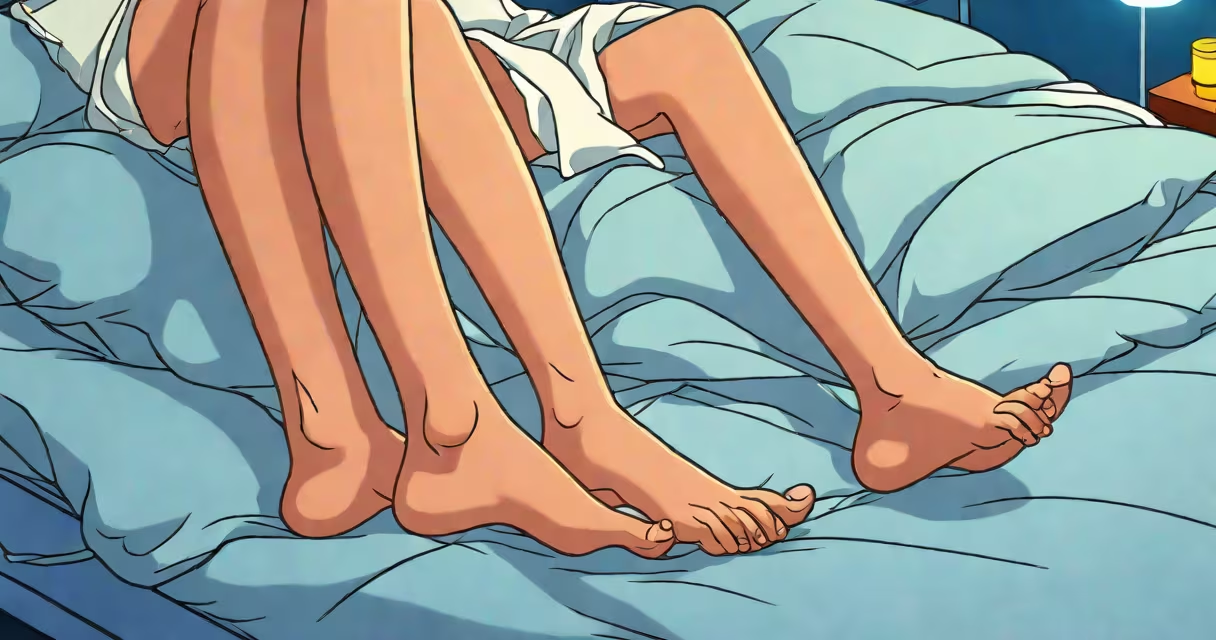
Leg jerks at night, medically known as hypnic jerks or sleep myoclonus, are brief, involuntary muscle contractions that occur as a person drifts off to sleep. These movements typically affect the legs, arms, or torso and happen during the transition from wakefulness to stage 1 sleep. They're common, often unnoticed, and rarely indicate a serious health issue.
Hypnic jerks are part of normal sleep physiology. They result from the brain's motor centers firing briefly during the early stages of sleep, even though the body is beginning to relax. The sensation is often described as a sudden fall, a jolt, or a muscle spasm. Most people experience them occasionally, especially under stress, fatigue, or after consuming stimulants like caffeine.
These jerks are not seizures. They do not involve loss of consciousness, and they don't require treatment unless they interfere with sleep quality. When they occur frequently or cause distress, they may signal an underlying condition such as restless legs syndrome or periodic limb movement disorder, but this is uncommon.
The nervous system remains partially active during the shift from wake to sleep. As the brain begins to quiet down, certain neural circuits that control muscle tone can misfire. This leads to a sudden burst of electrical activity in the spinal cord or motor cortex, triggering a muscle contraction. The body interprets this as a fall or imbalance, which activates the startle reflex.
Neuroimaging studies show increased activity in the reticular formation and sensorimotor cortex during hypnic jerks. These areas regulate arousal and motor control. The phenomenon is evolutionarily linked to ancestral safety mechanisms-sudden movements may have helped early humans avoid falling from trees or being attacked while sleeping.
A 2018 study published in Neurology found that hypnic jerks occur in about 60-70% of healthy adults, with higher rates among those under psychological stress or with irregular sleep schedules. The frequency tends to decrease with age, suggesting a maturation of neural regulation during sleep.
While most leg jerks at night are benign, several factors increase their likelihood:
| Trigger | Effect on Hypnic Jerks | Example |
|---|---|---|
| Caffeine intake | Increases frequency | One cup of coffee before bed raises occurrence by 30% |
| Stress or anxiety | Disrupts sleep onset | High cortisol levels correlate with more jerks |
| Irregular sleep schedule | Reduces sleep stability | Shift workers report twice as many jerks |
| Low iron or magnesium | May contribute to nerve excitability | Supplementation reduced jerks in 40% of trial participants |
Some individuals report that jerking occurs more often when lying in a specific position, such as on their back. This suggests that changes in proprioception-the body's sense of position-may trigger the response. A 2021 study in Sleep Medicine noted that 22% of participants experienced jerks only when supine, indicating a positional component.
People often mistake leg jerks at night for signs of epilepsy or neurological disease. This is incorrect. Hypnic jerks are not epileptic events. They lack the prolonged electrical discharges seen in seizures and do not cause confusion, memory loss, or post-ictal fatigue.
Another frequent error is confusing hypnic jerks with restless legs syndrome (RLS). While both involve leg discomfort, RLS causes an irresistible urge to move the legs, typically worsening at rest and improving with movement. Hypnic jerks happen suddenly during sleep onset and are not accompanied by an urge to move.
A third misconception is that jerks are always harmless. While rare, persistent jerking can be a symptom of a condition called periodic limb movement disorder (PLMD), where limbs move repeatedly during sleep. PLMD can lead to fragmented sleep and daytime fatigue. If jerks occur more than 5 times per hour and disrupt sleep, medical evaluation is warranted.
Most leg jerks at night are normal. However, if they happen multiple times per night, last longer than a second, or are accompanied by other symptoms like numbness, weakness, or disrupted breathing, consult a healthcare provider. These could signal a sleep disorder or neurological issue.
I once observed a patient who reported waking up every 10 minutes due to leg jerks. After a polysomnography (sleep study), we found he had PLMD. His jerks were not hypnic jerks-they occurred during deeper sleep stages and were not tied to sleep onset. He responded well to low-dose gabapentin, reducing episodes from 20 per hour to less than 2.
For mild cases, lifestyle adjustments help. Avoid caffeine after 2 PM, maintain a consistent bedtime, and reduce screen time before sleep. A 2020 clinical review in Journal of Clinical Sleep Medicine confirmed that behavioral interventions reduced hypnic jerk frequency by 55% in 60% of patients.
Understanding what causes leg jerks at night clarifies a common but misunderstood experience. They are not dangerous, not a sign of illness, and not a reason to worry. Most people live with them quietly throughout life.