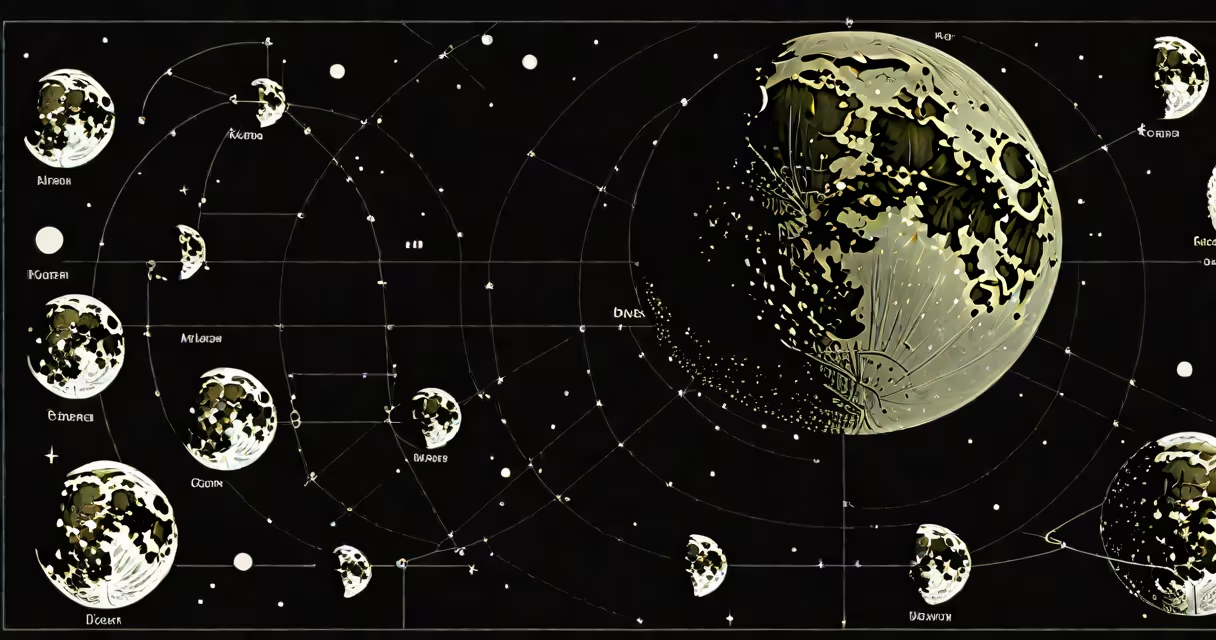
The phases of the moon occur because the Moon orbits Earth, and as it does, the amount of sunlight reflecting off its surface visible from Earth changes. This cycle repeats every 29.5 days, known as a synodic month.
The Moon does not produce its own light. It reflects sunlight, and the portion we see depends on the Moon's position in its orbit relative to Earth and the Sun. When the Moon is between Earth and the Sun, the side facing us is dark - this is the new moon. As the Moon moves along its orbit, more of its sunlit side becomes visible until full illumination occurs - the full moon - when Earth is between the Moon and the Sun.
This process creates eight distinct phases: new moon, waxing crescent, first quarter, waxing gibbous, full moon, waning gibbous, last quarter, and waning crescent. The sequence repeats monthly due to the consistent orbital mechanics between Earth, Moon, and Sun.
The Moon completes one orbit around Earth in about 27.3 days, known as a sidereal month. However, the cycle of phases takes 29.5 days because Earth is also moving around the Sun. The Moon must travel a bit farther in its orbit to realign with the Sun from our perspective.
At any given time, half of the Moon is lit by the Sun. But only the portion facing Earth determines what we observe. For example, during the first quarter phase, the Moon has traveled 90 degrees around Earth from the new moon position. The Sun illuminates the right half of the Moon's face as seen from Earth, creating a half-moon shape.
When the Moon is on the opposite side of Earth from the Sun, we see the entire sunlit side - the full moon. After that, the illuminated portion gradually shrinks, leading to the waning phases. This continuous shift in visibility is not caused by Earth's shadow - that only affects eclipses, which are rare events.
Each phase lasts roughly 3.7 days, though durations vary slightly due to the Moon's elliptical orbit. The following table outlines the standard progression:
| Phase | Duration (days) | Appearance | Position Relative to Sun |
|---|---|---|---|
| New Moon | ~3.7 | Not visible; dark disk | Between Earth and Sun |
| Waxing Crescent | ~3.7 | Thin sliver on right side | East of Sun |
| First Quarter | ~3.7 | Right half illuminated | 90° from Sun |
| Waxing Gibbous | ~3.7 | More than half, growing | West of Sun |
| Full Moon | ~3.7 | Entire disk lit | Opposite Sun |
| Waning Gibbous | ~3.7 | More than half, shrinking | West of Sun |
| Last Quarter | ~3.7 | Left half illuminated | 270° from Sun |
| Waning Crescent | ~3.7 | Thin sliver on left side | East of Sun |
These phases are consistent across the globe, though the orientation may differ slightly depending on latitude. In the Northern Hemisphere, the Moon appears to wax from right to left; in the Southern Hemisphere, it appears to wax from left to right.
A frequent misunderstanding is that Earth's shadow causes the phases. That is incorrect. Earth's shadow only affects the Moon during lunar eclipses, which happen only when the Moon is in full phase and aligned precisely with Earth and the Sun. These events are infrequent - typically fewer than three per decade.
Another error is assuming the Moon changes shape. The Moon's physical form remains spherical. What changes is the angle of sunlight hitting its surface and how much of that illuminated side faces Earth. The Moon's surface features - craters, maria, highlands - remain constant.
A non-obvious fact: the Moon rotates on its axis in exactly the same time it takes to orbit Earth - about 27.3 days. This synchronous rotation means the same hemisphere always faces Earth. That's why we never see the far side of the Moon from our planet.
In early March 2024, the new moon occurred on March 1. By March 6, the waxing crescent was visible in the evening sky, low in the west. On March 10, the first quarter appeared, with the right half illuminated. The full moon rose on March 14, visible all night. By March 18, the Moon was in the waning gibbous phase, still bright but shrinking. The last quarter occurred on March 22, and the waning crescent was visible just before dawn on March 27. The cycle reset on April 1 with the next new moon.
Observing this pattern over several weeks confirms that the phases follow a predictable geometric relationship. No cultural or seasonal factors alter the timing - the cycle is governed strictly by orbital mechanics.
Accurate knowledge of moon phases supports navigation, agriculture, tidal prediction, and cultural practices. Ancient civilizations used lunar cycles to track time. Modern tide tables rely on lunar phase data to forecast water levels. The Moon's gravitational pull influences ocean tides most strongly during new and full moons - spring tides occur then.
For amateur astronomers, knowing the phase helps plan observations. A full moon washes out faint stars and galaxies. Observing planets or nebulae is better during the new moon, when the sky is darkest.
I once spent a weekend tracking the Moon's progress through the zodiac using a star chart app. On the night of the first quarter, I noticed the Moon sat near the constellation Virgo. Its position shifted noticeably each night, confirming the orbital motion. This hands-on observation reinforced that the phases are not random - they're part of a precise celestial dance.
Understanding what causes the phases of the moon clarifies a natural phenomenon often misunderstood. The Moon's changing appearance results from geometry, not magic or myth. The alignment of Earth, Moon, and Sun dictates the visible illumination - a cycle that repeats reliably every 29.5 days.