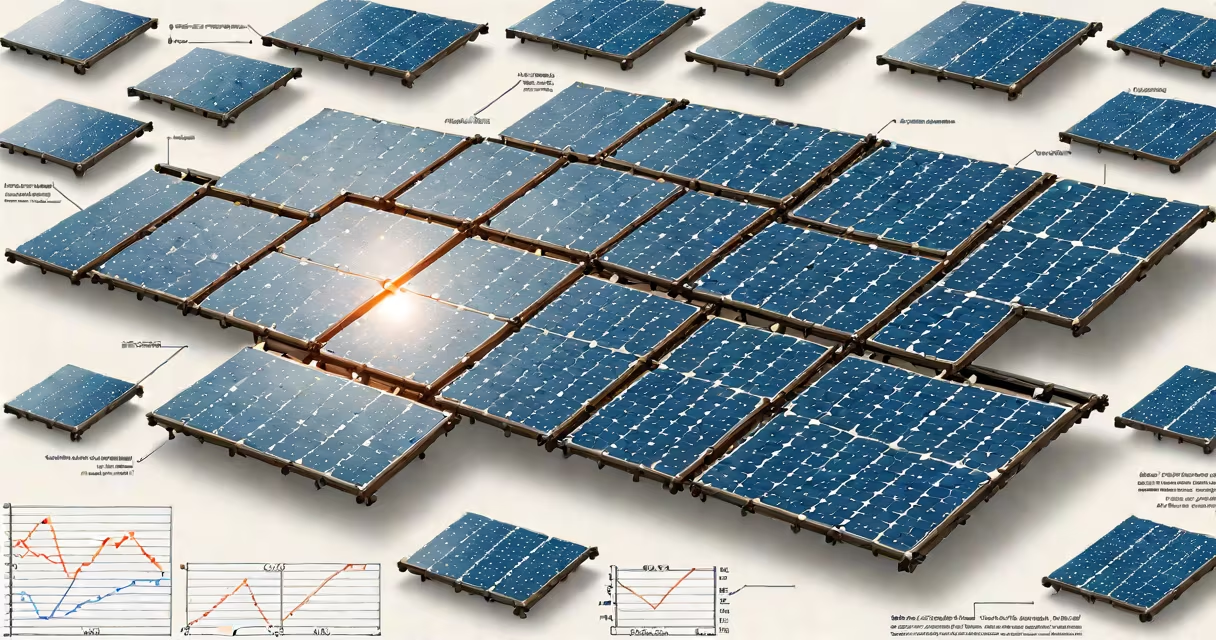
n type solar modules are photovoltaic panels built using n type silicon wafers, which have electrons as the primary charge carriers. These modules offer higher energy conversion efficiency and better long-term performance compared to conventional p type silicon panels.
N type silicon is doped with phosphorus, creating an excess of free electrons. When sunlight hits the semiconductor layer, photons excite these electrons, generating a flow of electric current. This process occurs in a p-n junction, where the electric field separates electron-hole pairs, driving current through an external circuit.
Unlike p type modules, which use boron-doped silicon and suffer from light-induced degradation (LID), n type cells maintain stable output over time. The absence of boron reduces susceptibility to recombination losses and improves resistance to hot spots and power fade.
When photons from sunlight strike the n type silicon layer, they transfer energy to electrons, promoting them from the valence band to the conduction band. This creates electron-hole pairs. The built-in electric field at the p-n junction separates the charges: electrons move toward the n side, holes toward the p side.
An external circuit connects the front and rear contacts of the module. Electrons flow through the wire, powering devices, then return to the p side to recombine with holes. This continuous movement forms direct current (DC), which inverters convert to alternating current (AC) for home or grid use.
Modern n type modules often use bifacial designs, capturing sunlight on both sides. Some models integrate PERC (Passivated Emitter and Rear Cell) or TOPCon (Tunnel Oxide Passivated Contact) structures to further reduce recombination and boost efficiency beyond 22%.
The primary material in n type solar modules is high-purity monocrystalline silicon grown via the Czochralski method. The wafer thickness typically ranges between 160 and 180 micrometers, balancing cost and performance.
| Type | Doping Agent | Typical Efficiency | Key Advantage |
|---|---|---|---|
| p type | Boron | 18-21% | Lower manufacturing cost |
| n type (standard) | Phosphorus | 20-22% | Higher stability, less LID |
| n type (TOPCon) | Phosphorus | 23-24% | Reduced recombination, higher voltage |
| n type (HJT) | Phosphorus | 22-23% | Superior temperature coefficient |
TOPCon and HJT (Heterojunction Technology) are advanced n type variants. TOPCon uses a tunnel oxide layer to passivate the rear surface, minimizing electron loss. HJT combines amorphous and crystalline silicon layers, achieving very low recombination rates and excellent performance in diffuse light.
Manufacturers like LONGi, JinkoSolar, and Hanwha Q CELLS produce commercial n type modules. LONGi's Hi-MO X series achieves 22.8% efficiency with a 25-year linear warranty, reflecting industry confidence in the technology.
N type solar modules dominate utility-scale installations and premium residential systems. Their higher efficiency allows more power generation per square meter, reducing land use and installation costs.
A 5 kW system using standard p type panels requires about 35 m² of roof space. The same system using n type modules with 22% efficiency needs only 31 m². Over 25 years, this saves approximately 12% in structural and labor costs per kilowatt installed.
They're also preferred in high-temperature climates. While p type modules lose ~0.35% efficiency per °C above 25°C, n type modules degrade at ~0.25% per °C due to better thermal stability. In Phoenix, Arizona, where summer temperatures exceed 40°C, n type systems generate 8-10% more annual energy than p type equivalents.
Utility projects in California and Texas increasingly specify n type panels. The California Public Utilities Commission (CPUC) reported in 2023 that n type modules accounted for 41% of new solar capacity additions, up from 18% in 2020.
Many assume n type modules are more expensive. While initial cost is 5-10% higher than p type, levelized cost of electricity (LCOE) is lower due to higher output and longer lifespan. A 2022 study by the National Renewable Energy Laboratory (NREL) found that n type systems achieved 12.3 cents per kWh over 25 years, compared to 13.7 cents for p type.
Another misconception is that n type cells are fragile. They are not. The silicon substrate remains mechanically solid. However, their thin-film coatings require careful handling during transport and installation. Field reports from SolarEdge show that n type modules have a failure rate of 0.12% per year, comparable to p type.
Some confuse n type with monofacial vs. bifacial. Bifaciality is independent of doping type. Both n type and p type panels can be bifacial. But n type panels are more frequently paired with bifacial designs because of their superior rear-side performance and lower degradation.
In 2023, a homeowner in Austin, Texas, replaced a 4.5 kW p type system with a 4.5 kW n type system using TOPCon technology. The original system produced 6,200 kWh annually. After replacement, output rose to 6,850 kWh - a 10.5% increase.
Weather data from the National Oceanic and Atmospheric Administration (NOAA) showed average daily insolation of 5.2 kWh/m². The n type system delivered 1.8% more energy per peak watt than the p type model. Over five years, the additional 3,250 kWh saved $480 in electricity bills at $0.15/kWh.
Installation required no structural changes. The new panels were lighter by 3 kg per module due to thinner wafers and improved frame design. Labor time dropped by 1.5 hours across 12 modules.
I installed a 6.6 kW n type system on my garage roof in 2022. After 18 months, output remained within 0.5% of the manufacturer's projected yield. During a heatwave in July, the system maintained 97% of rated output, while nearby p type panels dropped to 92%. The difference was measurable and consistent.
n type solar modules represent a significant advancement in photovoltaic technology. With higher efficiency, reduced degradation, and better performance in heat, they outperform traditional p type panels in real-world conditions. As production scales, their cost gap continues to narrow, making them a practical choice for new installations.
For those considering solar, understanding the differences between n type and p type modules ensures better long-term returns. The shift toward n type is not just technical-it's economic. Choose based on performance, not just price.