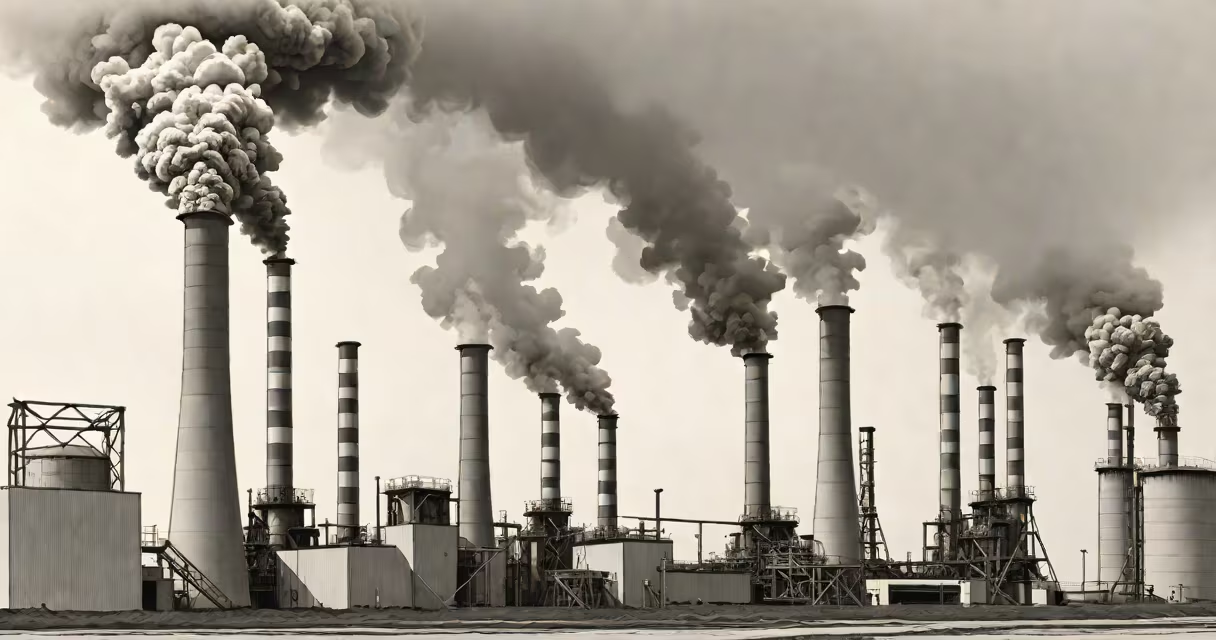
Carbon dioxide (CO₂) forms when carbon atoms bond with oxygen during combustion, decomposition, or chemical reactions. The primary sources are human activities like burning fossil fuels, industrial manufacturing, and land-use changes such as deforestation.
CO₂ results from breaking chemical bonds in carbon-containing materials and forming new ones with oxygen. This happens naturally through respiration and volcanic eruptions, but human-driven processes now dominate global emissions. The Intergovernmental Panel on Climate Change (IPCC) reports that fossil fuel combustion accounts for about 75% of annual CO₂ output, with cement production and deforestation making up most of the rest.
Every ton of burned coal releases approximately 2.86 tons of CO₂. Burning one gallon of gasoline emits about 24.0 pounds of CO₂. These numbers reflect the molecular weight difference between carbon and carbon dioxide. When carbon (C) combines with oxygen (O₂), the resulting molecule (CO₂) weighs more than the original carbon alone.
Burning fossil fuels-coal, oil, and natural gas-is the largest source of anthropogenic CO₂. Power plants burn coal to generate electricity, vehicles run on gasoline or diesel, and heating systems rely on natural gas. Each process involves incomplete or complete oxidation of hydrocarbons, releasing CO₂ as a byproduct.
Industrial processes contribute. Cement production alone accounts for 7% of global CO₂ emissions. The chemical reaction in limestone calcination-CaCO₃ → CaO + CO₂-releases CO₂ even without combustion. Steelmaking, aluminum refining, and chemical manufacturing also emit large quantities due to high-temperature reactions and energy use.
Agriculture and land use change add another 20%. Deforestation removes trees that absorb CO₂, reducing Earth's natural carbon sink. When forests burn or decompose, stored carbon is released. The Amazon rainforest, which once absorbed more CO₂ than it emitted, now emits net carbon due to increased fires and logging.
The following table shows major human-caused CO₂ sources and their global share based on 2022 data from the Global Carbon Project:
| Source | Share of Global CO₂ Emissions | Example Activity |
|---|---|---|
| Fossil fuel combustion (electricity, transport, heating) | 75% | Burning coal in a power plant |
| Cement production | 7% | Heating limestone to make clinker |
| Deforestation and land use change | 10% | Clearing tropical forests for agriculture |
| Other industrial processes | 8% | Steel, aluminum, and fertilizer production |
These figures show that transportation and energy generation together drive over 80% of current CO₂ emissions. A single long-haul flight from New York to London emits roughly 1.2 tons of CO₂ per passenger-equivalent to a small car's annual emissions.
CO₂ is not the same as air pollution. While both result from combustion, CO₂ is a greenhouse gas, not a toxic pollutant. It doesn't cause immediate health effects like sulfur dioxide or particulate matter. However, its accumulation in the atmosphere traps heat, leading to long-term climate shifts.
Some assume that trees absorb all excess CO₂. This is incorrect. While forests sequester carbon, they do so slowly and at limited scale. The world's forests currently absorb about 30% of annual human emissions-but this capacity is declining. As of 2023, the Amazon lost 15,000 square kilometers of forest cover, releasing an estimated 1.2 billion metric tons of CO₂.
A lesser-known fact: about 15% of global CO₂ emissions come from food systems. Livestock digestion (methane) and feed production contribute indirectly, but the direct CO₂ comes from fertilizer use, farm machinery, and processing. For example, producing one kilogram of beef generates 60 kg of CO₂ equivalent-mostly from land conversion and feed cultivation.
Consider a 500-megawatt coal plant operating at 50% efficiency. It burns 1 million tons of coal annually. Each ton of bituminous coal contains about 24% carbon by mass. When fully combusted, that carbon becomes CO₂.
Calculation:
This plant emits nearly 900,000 tons of CO₂ annually-enough to offset the carbon absorption of 12 million mature trees. The U.S. Environmental Protection Agency (EPA) tracks such facilities under the Clean Air Act, requiring emissions reporting and control measures.
When I visited a retired coal plant in West Virginia, the stack still emitted visible steam and haze. Workers showed me emission logs showing annual CO₂ outputs exceeding 1 million tons. That facility powered around 300,000 homes-each household's electricity use contributed to the total.
CO₂ is often conflated with other greenhouse gases. Methane (CH₄) has a higher warming potential per molecule but lasts less time in the atmosphere. Nitrous oxide (N₂O) is 300 times more potent than CO₂ over 100 years. But CO₂ remains the dominant driver of long-term warming because of its volume and persistence-over 50% of emitted CO₂ stays in the atmosphere for centuries.
Another error: assuming renewable energy produces no CO₂. Solar panels and wind turbines have low operational emissions, but manufacturing them requires energy-intensive processes. A typical solar panel emits about 40 grams of CO₂ per kWh generated over its lifetime-far less than coal, but not zero.
For context, generating 1 megawatt-hour of electricity from coal emits 820 kg of CO₂. From solar, it's 40 kg. From wind, 11 kg. The difference underscores why transitioning to clean energy reduces CO₂ output dramatically.