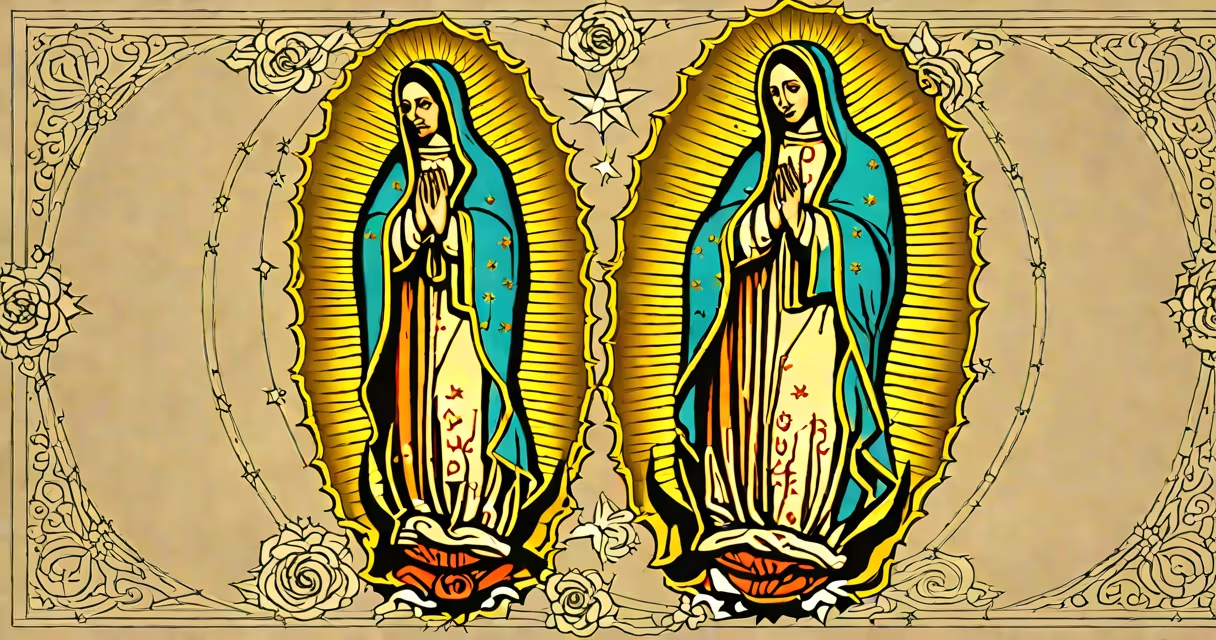
Our Lady of Guadalupe represents a convergence of Indigenous Mesoamerican symbolism and Catholic doctrine, embodied in the 1531 apparition to Saint Juan Diego on Tepeyac Hill near Mexico City. She is venerated as the Virgin Mary, mother of Jesus, yet her image incorporates elements from Nahua cosmology, including a dark complexion, celestial imagery, and a robe patterned with symbolic motifs. This synthesis forged a unique religious identity that remains central to Mexican Catholicism and national identity.
The story begins in December 1531, when Juan Diego, an Indigenous convert, reported seeing a woman on the hill who spoke in Nahuatl, his native language. She asked him to request that the local bishop build a church in her honor. When the bishop demanded proof, Juan returned with roses-unseasonal in winter-carried in his tilma. When he opened it, the flowers fell away, revealing an image of the Virgin imprinted on the fabric. The tilma, made of cactus fiber, has survived centuries without decay, according to scientific analysis by the National Institute of Anthropology and History (INAH).
Her appearance is not merely a religious event-it's a cultural turning point. The Virgin wears a blue-green mantle, a color associated with divine royalty in pre-Hispanic traditions. Her feet rest on a crescent moon, a symbol of the Aztec goddess Tonantzin. The stars on her cloak mirror the constellation Virgo, which aligns with the date of the apparition-December 12-in the sky. These details were verified by astronomers at the University of Guadalajara, who confirmed the celestial alignment matched the night of December 12, 1531.
The image of Our Lady of Guadalupe operates on multiple levels: theological, political, and communal. Theologically, she embodies the Virgin Mary as intercessor and protector. But unlike European depictions of Mary, she appears with dark skin, a feature that resonated deeply with Indigenous populations under colonial rule. Her presence signaled divine approval of their existence and spiritual worth-a message that countered Spanish narratives of racial and religious superiority.
Politically, the image became a unifying force during the 1810 Mexican War of Independence. Insurgents carried her image into battle, and leaders like Miguel Hidalgo invoked her name in proclamations. Her role as a national icon was cemented when Pope Pius XII declared her the patroness of Latin America in 1946. Today, she is the most widely venerated saint in the Americas, with over 15 million pilgrims visiting her shrine annually at the Basilica of Our Lady of Guadalupe in Mexico City.
Communally, she serves as a bridge between personal devotion and collective identity. Families in Mexico and throughout Latin America often display her image in homes, workplaces, and public spaces. Her feast day, December 12, is a national holiday in Mexico. In the United States, she is especially prominent among Mexican-American communities, where she appears in murals, altars, and social justice movements.
The image of Our Lady of Guadalupe is reproduced in many forms, each carrying distinct symbolic weight:
| Type | Symbolic Meaning | Common Use |
|---|---|---|
| Original tilma (in basilica) | Divine authenticity; miracle of preservation | Pilgrimage site; spiritual center |
| Printed images (posters, cards) | Accessibility; personal devotion | Home altars, schools, churches |
| Statues (bronze, wood) | Permanence; ritual presence | Parish churches, processions |
| Artistic renderings (murals, paintings) | Cultural resistance; political expression | Public art, protest signs, festivals |
These representations are not interchangeable. The original tilma is treated as sacred relic, while street murals often depict her with a halo above a border wall-symbolizing protection for immigrants. The 2019 mural in Los Angeles showing her with a hijab and holding a sign reading "No human is illegal" reflects contemporary interpretations of her role as advocate for the marginalized.
Many assume Our Lady of Guadalupe is a purely Catholic figure. But her significance extends beyond ecclesiastical boundaries. She is also a symbol of syncretism-the blending of belief systems. The Catholic Church officially recognizes the apparition as authentic, but scholars such as historian Susan A. Carleton note that the narrative evolved over time through oral tradition and political negotiation.
A common error is equating her with the Aztec goddess Coatlicue. While both are maternal deities associated with earth and fertility, the Church discouraged direct comparisons. Instead, the Virgin is presented as a fulfillment of prophecy-Mary as the "New Eve" who reverses the fall. Yet Indigenous communities have long interpreted her as a continuation of ancient female power, not a replacement.
Another misconception is that the image was painted by a European artist. Scientific tests conducted by INAH in 2002 revealed no brushstrokes, pigments, or layering typical of oil painting. The colors appear to be embedded in the fabric fibers. Researchers at the University of California, San Diego, analyzed the image using multispectral imaging and confirmed that the face shows no evidence of human handwork-suggesting a non-material origin, though this remains debated.
In December 2019, over 3 million people attended the annual pilgrimage to the Basilica of Our Lady of Guadalupe. Among them was María Elena, a nurse from Tijuana. She traveled 12 hours by bus with her daughter and a small altar bearing candles, incense, and a photo of her late husband. "I didn't come for miracles," she said. "I came because I needed to feel seen."
Her experience mirrors thousands of others. The basilica's interior holds 20,000 visitors at once. Pilgrims walk through a corridor lined with 130-foot-high stained-glass windows depicting the apparition. They pass a glass case containing the original tilma, lit by soft golden light. Many leave notes-prayers, pleas, thank-yous-on a wall behind the altar. One note read: "For my son in prison. She knows his name."
This moment illustrates how the image functions not as a static artifact, but as a living symbol. It is not just about faith-it's about belonging. The Virgin's presence in everyday life-from school classrooms to labor strikes-shows her enduring relevance.
I visited the basilica in 2018 during the feast day. The air was thick with incense and the sound of hundreds of voices chanting "¡Viva la Virgen!" in unison. I watched a man kneel and press his forehead to the floor in front of the tilma. He stayed there for ten minutes. Later, I saw a young woman place a photograph of her missing sister beside the altar. The image of Our Lady of Guadalupe is not just a religious icon-it's a space where grief, hope, and identity intersect.
She represents protection, dignity, and continuity. For millions, she is not a distant figure in a painting but a witness to suffering and a promise of renewal. Her image continues to inspire art, activism, and prayer across continents.
Understanding what Our Lady of Guadalupe represents requires looking beyond dogma. She stands at the crossroads of history, faith, and culture-where the sacred meets the everyday. Her enduring power lies in this duality: she is both holy and human, divine and familiar. That balance is why she remains central to the lives of so many.