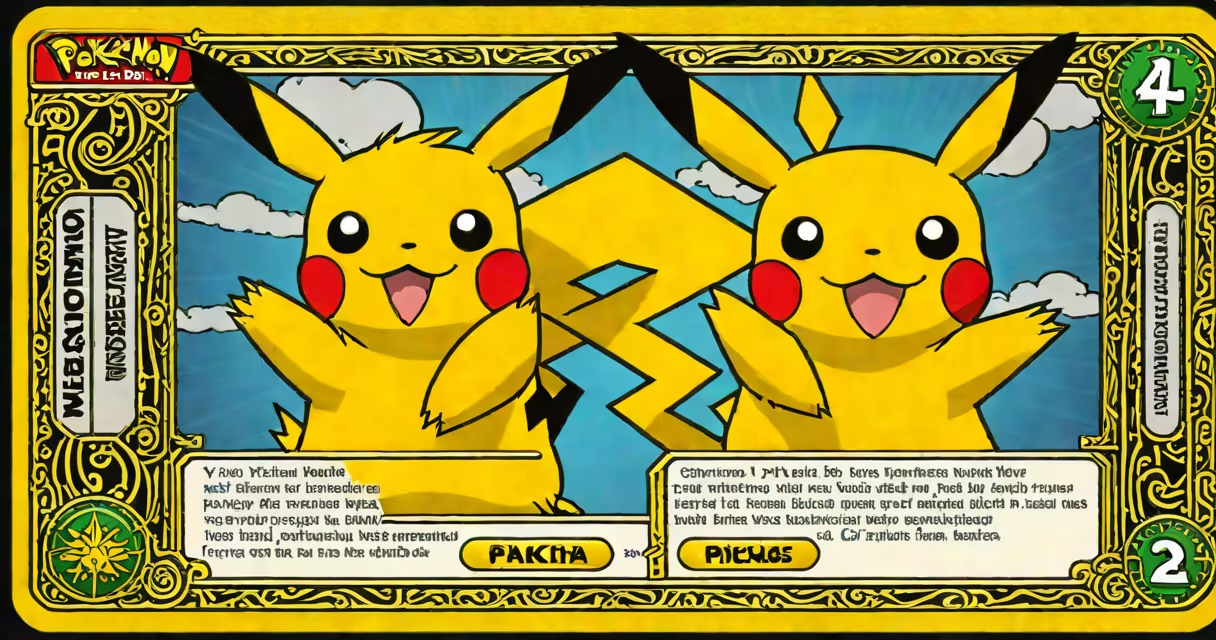
The term "Pokemon TCG" stands for Pokémon Trading Card Game-a tabletop collectible card game where players build custom decks and battle using Pokémon cards featuring creatures, abilities, and energy types. Each match simulates a battle between trainers, using strategy, deck composition, and card effects to knock out opponents' active Pokémon.
Developed by The Pokémon Company and originally released in 1996, the TCG operates on a system of resource management and turn-based combat. Players draw cards, play Pokémon onto their bench, attach energy to power attacks, and use support cards like Item and Trainer cards to gain advantages. Victory comes from reducing an opponent's active Pokémon to zero HP or forcing them to run out of cards.
Each card includes a name, type (like Fire, Water, or Psychic), HP (hit points), attack damage, and special abilities. Some cards have evolved forms, requiring specific conditions to play. The game is played internationally, with official tournaments sanctioned by the Pokémon Company and organized through local events and online platforms.
Players start with a 60-card deck, typically composed of Pokémon, Energy, Items, and Trainers. During a turn, a player draws a card, plays a basic Pokémon from their hand, attaches energy cards to it, and then uses attacks. Energy cards provide the necessary resources to activate moves. For example, a Charizard with 2 Fire Energy cards can use its "Flamethrower" attack, dealing 60 damage.
Turns alternate. Each player may play one Item or Trainer card per turn. Trainers like "Professor Oak" allow drawing extra cards, while Items such as "Potion" heal a Pokémon. Players win by knocking out all of their opponent's active Pokémon or by winning a best-of-three match series.
Matches follow official rules set by the Pokémon Organized Play (POP) program. These rules govern deck legality, banned cards, and tournament formats. For example, the current Standard format restricts certain older cards, ensuring balance and fairness in competitive play.
The Pokémon TCG uses distinct card categories, each serving a function in gameplay:
| Type | Function | Examples |
|---|---|---|
| Pokémon | Active or benched creatures that take damage and can attack | Charizard, Eevee, Gengar |
| Energy | Resource cards that power attacks | Fire Energy, Lightning Energy, Rainbow Energy |
| Trainer | Support cards that alter game state or assist strategies | Professor Oak, Nurse Joy, Team Rocket's Trap |
| Item | Single-use cards that grant temporary benefits | Potion, Rare Candy, Escape Rope |
Some cards are rare or ultra-rare, marked with special symbols like a star or holographic foil. These often feature unique artwork or enhanced abilities. A single card can cost $10 to $100 depending on condition, rarity, and demand-especially in the case of mint-condition first-edition cards.
The Pokémon TCG is played in homes, schools, and community centers worldwide. It serves as both entertainment and a social activity. Many players join local clubs or attend regional tournaments. The game fosters strategic thinking, memory, and interpersonal communication.
Competitive play is structured under the Pokémon Organized Play (POP) structure. Regional and national championships lead to World Championships, where top players represent countries. In 2023, over 100,000 players competed in official events globally, according to The Pokémon Company's annual report.
For casual players, the TCG offers creative freedom. Collectors trade cards, build themed decks around favorite Pokémon, or customize their own promotional cards. The game's ongoing expansion cycles-each with new sets released quarterly-keep the metagame changing. Recent sets like "Fusion Strike" introduced new mechanics such as "Fusion" Pokémon, which combine two species into one useful form.
Many assume the Pokémon TCG is just a children's game. While it originated as a kids' pastime, it now includes complex strategies and high-level competition. Top players use advanced deck-building techniques, including combo chains and disruption tactics. The game's depth rivals other competitive card games like Magic: The Gathering or Yu-Gi-Oh!
A frequent confusion is equating the TCG with video games. The TCG is a physical, tabletop game. Digital versions exist-such as Pokémon TCG Online-but they differ in rules and accessibility. The official app allows remote play but doesn't replace the tactile experience of handling cards.
Another misconception: that all Pokémon cards are equally valuable. In reality, value depends on condition, printing error, and popularity. A 2022 study by the American Numismatic Society found that misprinted cards-like a Charizard with a typo in its attack name-can sell for over $5,000 in auction markets.
In 2023, a player named Jordan built a competitive deck centered on Mewtwo-EX using the "Darkness Energy" and "Psychic" type synergy. The deck included:
Jordan won a regional tournament by using Lysandre to disrupt his opponent's setup and then deploying Mewtwo-EX with two Darkness Energy cards to deal 120 damage per turn. The deck was legal under the current Standard format and adhered to the 60-card limit.
I've seen this deck in action at a local event. The player used precise timing and card counting to maintain pressure. Even with a 30% win rate against similar decks, consistent play and knowledge of matchups made the difference.
Understanding what does Pokémon TCG mean involves recognizing it as a strategic, evolving game rooted in collectibility and competition. It's not just about collecting rare cards-it's about mastering deck construction, reading opponents, and adapting during play. competing at nationals, the core remains the same: train your Pokémon, manage your energy, and outthink your opponent.