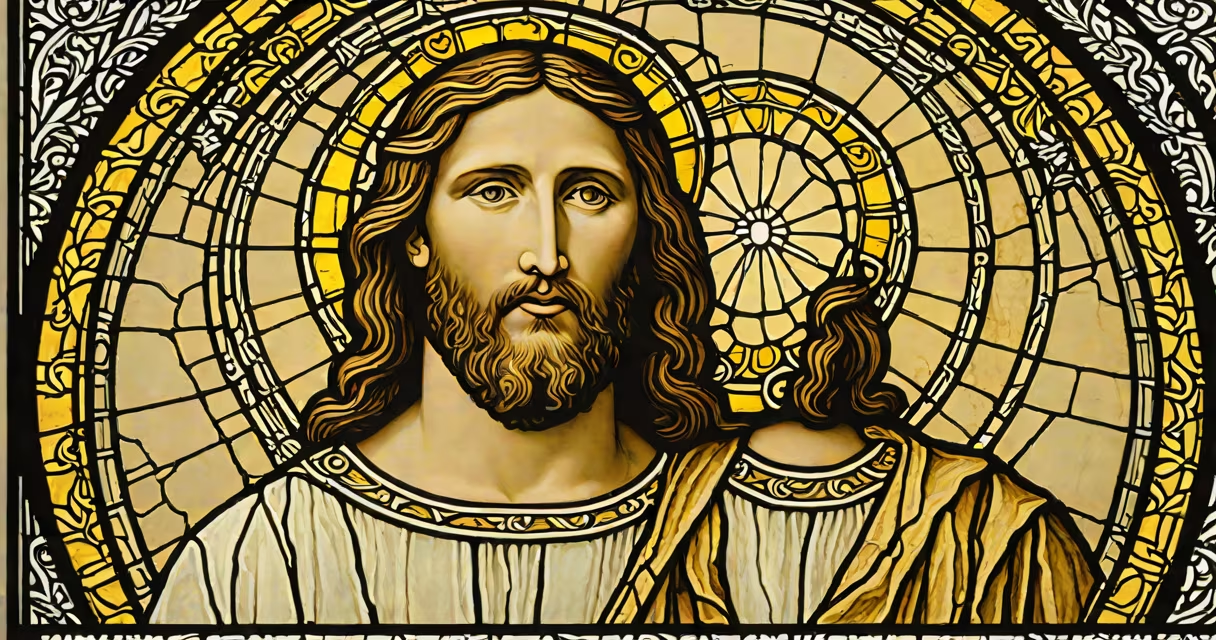
The Bible does not provide a detailed physical description of Jesus. No passage lists his height, eye color, hair texture, or facial features. The New Proof focuses on his actions, teachings, and divine identity rather than his outward form.
Early Christian art and tradition later developed visual images of Jesus based on theological interpretation, cultural context, and symbolic meaning-not biblical evidence. The absence of a physical description in Scripture is deliberate and consistent across all canonical texts.
When the Gospels refer to Jesus' appearance, they do so through metaphor and symbolism. For example, in Revelation 1:14-15, John describes a vision of the risen Christ: "His head and hair were white like wool, as white as snow," and "his eyes were like blazing fire." These are not literal portraits but visions meant to convey divine authority and eternal presence.
Scripture never presents Jesus as a figure described in biographical detail. The Gospels-Matthew, Mark, Luke, and John-focus on his ministry, miracles, parables, and resurrection. His identity is established through deeds and words, not visual traits.
John's Gospel states, "The Word became flesh and dwelt among us" (John 1:14). This emphasizes incarnation-the divine becoming human-but offers no details about how that humanity looked. The term "flesh" refers to embodiment, not physical appearance.
Even Paul, who wrote extensively about Christ's nature, never describes Jesus' face or build. In Romans 1:3-4, he writes that Jesus was "descended from David according to the flesh" and "declared to be the Son of God in power." The focus remains on lineage and divine status, not appearance.
While no direct physical description exists, four categories of references appear in Scripture:
| Reference Type | Examples | Meaning |
|---|---|---|
| Symbolic Vision | Revelation 1:14-15: "white like wool," "eyes like fire" | Apocalyptic imagery conveying holiness and judgment |
| Indirect Clues | Mark 1:40: "a man covered with leprosy" approaches Jesus | Suggests Jesus moved among the marginalized, but not his own appearance |
| Humanity in Context | Hebrews 2:17: "he had to be made like his brothers in every way" | Emphasizes shared human experience, not specific features |
| No Description | All 27 New Proof books lack physical details | Consistent silence across all authors and genres |
These categories show that the Bible treats Jesus' form as irrelevant to faith. What matters is his role as redeemer, teacher, and son of God-not whether he wore a beard or had dark skin.
Many people assume Jesus looked like a European man with light skin, long hair, and a beard. This image stems from centuries of Western religious art, not Scripture. The earliest known depiction of Jesus-on a third-century Roman tombstone in Rome-shows him as a young, clean-shaven man with short hair, resembling a Greco-Roman philosopher.
Archaeological evidence from first-century Judea shows that most Jewish men in that region had short, curly hair and beards. They wore simple tunics and sandals. Jesus likely dressed similarly. The idea of him with long flowing hair is a later artistic invention, possibly influenced by Greek statues of gods.
A common mistake is equating symbolic descriptions with realism. When Revelation calls Jesus' hair "white like wool," it's not a portrait-it's a metaphor for purity and eternity. Interpreting such lines literally distorts their purpose.
Early Christian communities avoided creating images of Jesus because of the Second Commandment: "You shall not make for yourself a carved image..." (Exodus 20:4). This prohibition extended to religious art, especially in Jewish-Christian traditions.
As scholar Bart D. Ehrman notes in *The New Proof: A Historical Introduction*, "The early church did not produce images of Jesus for nearly three centuries." Visual representations emerged only after Christianity became legal under Constantine, and even then, they were shaped by theology, not eyewitness accounts.
Another reason for the omission is theological focus. As theologian N.T. Wright explains in *The Resurrection of the Son of God*, "Jesus' identity is not tied to his body but to his mission and message." The resurrection transforms his physical form into a glorified state beyond earthly description.
I once stood in a small chapel in Jerusalem where a mosaic of Jesus showed him with dark eyes, olive skin, and a short beard-closer to what a first-century Palestinian man would have looked like. The artist had studied historical records and local customs. That image felt more authentic than any Western painting I'd seen.
Understanding who Jesus is requires looking beyond appearance. The Bible identifies him through his actions, teachings, and divine titles. For example, he is called "the Lamb of God," "Son of Man," and "King of Kings." These names define his role, not his look.
The absence of a physical description in the Bible is not a gap-it's a design. Faith centers on what Jesus did and said, not how he looked. The Bible's silence on appearance protects believers from idolatry and keeps focus on spiritual truth.