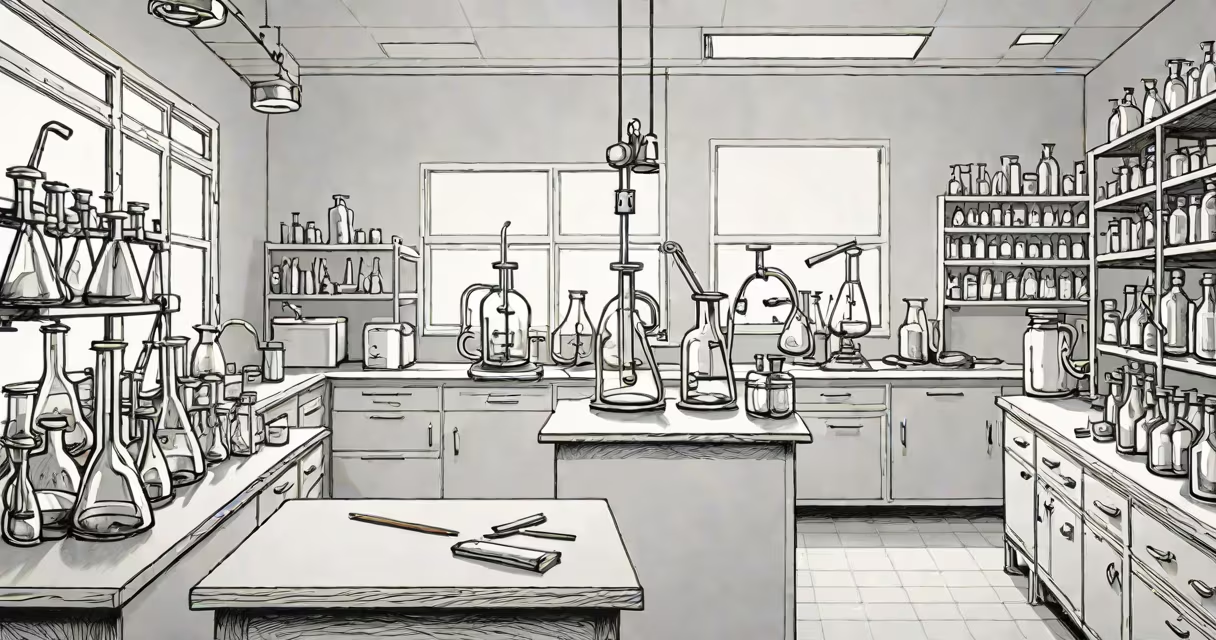
A chemistry lab is a specialized room or facility equipped with tools, instruments, and safety systems designed to conduct experiments involving chemical substances, reactions, and analyses. These spaces enable precise measurement, observation, and replication of chemical processes under controlled conditions.
Chemistry labs are structured around core functions: containment, measurement, reaction control, and safety. They house equipment such as balances, Bunsen burners, fume hoods, centrifuges, spectrophotometers, and storage for hazardous materials. Each component serves a specific role in minimizing risk and ensuring reproducibility.
These environments are essential for both academic training and industrial development. Students learn foundational concepts through hands-on work, while researchers test hypotheses, develop new compounds, and validate results. The lab's design prioritizes workflow efficiency and emergency preparedness.
Experiments begin with a hypothesis, often derived from theoretical models or prior observations. A researcher designs a procedure to test it, selecting appropriate reagents, concentrations, and reaction conditions. This plan is executed step-by-step in the lab, with real-time monitoring of temperature, pressure, color changes, or gas evolution.
Data collection occurs through direct observation or automated instruments. For example, a UV-Vis spectrophotometer measures light absorption by a solution to determine concentration. Results are recorded immediately to prevent errors. After completion, waste is segregated according to hazard class-flammable, corrosive, toxic, or biohazardous-and disposed of via approved channels.
Every action follows standardized operating procedures (SOPs). These documents detail safe handling, calibration schedules, and emergency response steps. Deviations trigger review by a supervisor or institutional review board, especially in regulated settings like pharmaceutical development.
Core tools in a chemistry lab fall into categories based on function:
| Function | Equipment Examples | Use Case |
|---|---|---|
| Measurement | Analytical balance, graduated cylinder, pipette | Accurate volume and mass determination |
| Reaction Control | Fume hood, heating mantle, magnetic stirrer | Containment of vapors, uniform heat distribution |
| Analysis | Gas chromatograph, pH meter, infrared spectrometer | Identification of unknown compounds |
| Safety | Eye wash station, fire extinguisher, safety shower | Immediate response to exposure incidents |
Each piece of equipment requires regular calibration. A balance used for weighing 0.1 grams of sodium chloride must be checked daily against known weights. Failure to calibrate leads to inconsistent results and invalid data. The National Institute of Standards and Technology (NIST) provides guidelines for calibration intervals and traceability.
Modern labs integrate digital systems. Electronic lab notebooks (ELNs) replace paper logs, allowing version control, searchability, and integration with data analysis software. At institutions like MIT, ELNs are mandatory for all research projects involving federal funding.
Many assume a chemistry lab is simply a room filled with flasks and chemicals. In reality, it is a highly regulated system. The presence of glassware doesn't imply uncontrolled experimentation. Most labs operate under strict protocols enforced by institutional biosafety committees.
Another misconception is that all labs handle dangerous materials. While some do-such as those studying radioactive isotopes or nerve agents-most undergraduate teaching labs use low-hazard substances like sodium bicarbonate, vinegar, and food dyes. These are chosen for safety and ease of disposal.
A critical distinction: a chemistry lab is not interchangeable with a biology or physics lab. Though they may share space or equipment, their workflows differ. A biology lab focuses on living systems and sterile techniques; a physics lab emphasizes precision instrumentation and vacuum environments. Mixing protocols between them increases contamination risk and invalidates results.
In 2021, researchers at the University of California, San Diego used a chemistry lab to synthesize a novel antiviral compound targeting SARS-CoV-2. The team ran over 120 reaction trials, analyzing each product using high-performance liquid chromatography (HPLC). Only one variant showed sufficient stability and binding affinity to proceed to animal testing.
At the high school level, a chemistry lab enables students to perform titrations. For instance, a student might determine the concentration of acetic acid in household vinegar by adding sodium hydroxide dropwise until the endpoint is reached-indicated by a color change in phenolphthalein. This exercise teaches stoichiometry, error analysis, and proper pipetting technique.
One non-obvious fact: the layout of a lab matters more than the equipment. A poorly arranged workspace increases the chance of spills, cross-contamination, and accidents. According to the American Chemical Society (ACS), labs with optimized bench spacing reduce collision incidents by 40%. Proper zoning-separating wet areas from dry workspaces-also improves efficiency and safety.
I once observed a lab where a graduate student mislabeled a bottle of acetone as water. The error went unnoticed until another researcher poured it into a flask containing sodium metal. The resulting explosion caused minor structural damage and required evacuation. That incident underscored how even small lapses in labeling can lead to major consequences.
Labs vary by purpose and regulatory oversight. The main types include:
Each type enforces different safety levels. Teaching labs typically require Level 1 PPE (gloves, goggles, lab coat). Industrial labs may mandate respirators and full-face shields when handling volatile organic compounds.
Over 100 laboratory-related injuries occur annually in U.S. colleges and universities, according to the CDC. Many stem from improper handling of chemicals, lack of ventilation, or failure to wear PPE. A single incident can halt research for months and result in liability claims.
Standard safety practices include wearing personal protective equipment (PPE), understanding Material Safety Data Sheets (MSDS), and conducting risk assessments before starting any experiment. The Occupational Safety and Health Administration (OSHA) mandates that all labs provide training on hazard communication and emergency response.
For example, when working with concentrated sulfuric acid, a researcher must don nitrile gloves, goggles, and a face shield. The acid must be added slowly to water-not vice versa-to avoid violent exothermic reactions. Even then, the fume hood must be on to capture any released vapors.
Understanding the difference between a chemistry lab and a kitchen is important. While both involve mixing substances, only a chemistry lab has the infrastructure to manage risks associated with combustion, toxicity, and unintended reactions.
When you ask "what is a chemistry lab," remember it's not just a place-it's a system. It combines trained personnel, validated equipment, documented procedures, and a culture of accountability. Without all elements, experiments fail, data becomes unreliable, and people get hurt.