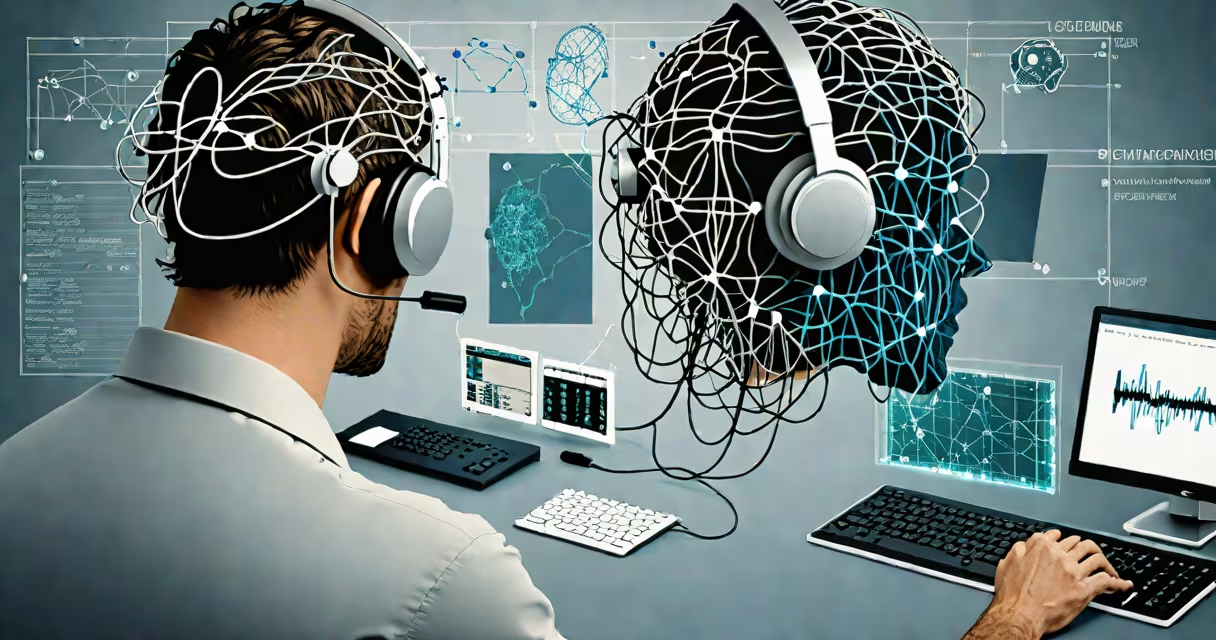
Brain computer interface technology translates neural activity from the brain into commands for external devices, enabling direct communication between the nervous system and machines without muscle movement. This allows individuals to control prosthetics, computers, or robotic systems using thought alone.
BCI systems detect electrical signals generated by neurons in the brain, typically through electrodes placed on the scalp (non-invasive), implanted under the skull (invasive), or inserted into brain tissue (high-resolution invasive). These signals are processed in real time to interpret intended actions-such as moving a cursor or gripping an object-and then sent to a device to execute them.
The technology emerged from decades of neuroscience research. Early experiments in the 1970s laid groundwork for decoding motor intentions from brain signals. Today, BCIs are used clinically and in research to restore function in people with paralysis, spinal cord injuries, or neurological disorders like ALS.
BCI operates in four stages: signal acquisition, signal processing, translation, and device execution. The process begins when a user thinks about a specific action-like moving their hand left. Neurons fire in patterns associated with that intention.
Electrodes capture these signals. Non-invasive methods use EEG caps with 32 to 256 sensors placed on the scalp. Invasive implants, such as Utah arrays, place microelectrodes directly into the cerebral cortex. Invasive systems offer higher resolution but require surgery and carry infection risk.
A machine learning algorithm analyzes the raw neural data. It identifies patterns linked to specific movements or intentions. For example, a classifier trained on a user's brain activity during imagined hand movements learns to predict when they want to move a cursor right.
Once decoded, the command is sent to a device-such as a wheelchair, robotic arm, or computer interface. Feedback loops allow users to adjust their mental effort based on visual or tactile responses, improving accuracy over time.
BCIs differ by invasiveness, signal source, and application. The main categories are non-invasive, semi-invasive, and invasive.
| Type | Signal Source | Pros | Cons | Use Cases |
|---|---|---|---|---|
| Non-invasive | Scalp EEG | Safe, portable, low cost | Low spatial resolution, noisy signals | Consumer wearables, basic research |
| Semi-invasive | Dura-matter surface | Better signal quality than EEG | Requires craniotomy, limited long-term stability | Neurorehabilitation, epilepsy monitoring |
| Invasive | Brain tissue (microelectrodes) | High precision, real-time control | Risk of scarring, immune response, surgical complications | Restoring limb function, clinical trials for paralysis |
One notable example is the BrainGate system, developed at Brown University and Stanford. Implanted electrodes in the motor cortex of a paralyzed patient enabled them to control a robotic arm to drink from a bottle using only thought. The user achieved this with 90% success rate after 18 months of training.
Another example is Neuralink's implantable device, which aims to record from thousands of neurons simultaneously. While still in early human trials, it has demonstrated the ability to decode speech-related neural patterns in real time.
Medical applications dominate current BCI use. Patients with amyotrophic lateral sclerosis (ALS), spinal cord injury, or stroke often lose voluntary motor control. BCIs restore limited independence-allowing them to communicate via text, operate wheelchairs, or control smart home devices.
For instance, a 2021 study published in Nature showed that a paralyzed man using a BCI could type at 90 characters per minute-faster than most smartphone users typing with one finger. The system used intracortical electrodes and adaptive algorithms to improve speed and accuracy over time.
Non-medical applications are emerging. Consumer-grade BCIs like the Muse headband measure attention and meditation levels using EEG. They're used in mindfulness apps, gaming, and biofeedback training-but lack the precision needed for complex control.
There's a common misconception that BCIs read thoughts directly. They don't. They decode patterns related to movement, intent, or sensory perception-not internal monologue or emotions. A BCI cannot tell you what someone is thinking about a memory or feeling about a person.
One non-obvious fact: the brain adapts to BCI use through neuroplasticity. Users learn to modulate their neural activity more effectively over time. This adaptation is why performance improves with practice-even after years of use.
Many assume BCIs enable telekinesis or mind reading. That's false. Current systems decode motor intentions or sensory states, not abstract thoughts. You can't "think" a password into a login screen with today's tech.
Another misunderstanding is that all BCIs require surgery. Non-invasive options exist and are widely available. However, they trade precision for safety and convenience.
Performance varies. A 2023 review in IEEE Transactions on Neural Systems and Rehabilitation Engineering found that average BCI accuracy across studies ranged from 68% to 89%, depending on task complexity and user training. Some users never achieve reliable control due to individual differences in brain anatomy or signal variability.
I once observed a BCI demo at a medical conference where a participant struggled to move a cursor to a target. After five minutes of focused effort, the system finally responded. The user said, "I didn't feel like I was doing anything different." That moment highlighted how subtle neural changes must be detected-and how hard it is to train the brain to produce consistent signals.
Despite progress, challenges remain. Signal drift over time requires recalibration. Long-term implant stability is uncertain. Regulatory approval remains slow. And ethical concerns around privacy, consent, and potential misuse persist.
Research continues toward bidirectional BCIs-systems that both read brain signals and send feedback to the brain. This could restore sensation in prosthetic limbs or treat chronic pain by modulating neural circuits.
Companies like Synchron and Blackrock Neurotech are advancing implantable devices for clinical use. Synchron's Endovascular BCI, delivered via blood vessels, avoids open brain surgery. It's currently being tested in humans for restoring mobility in paraplegic patients.
As the field matures, integration with AI will improve decoding speed and adaptability. Machine learning models trained on large datasets may reduce calibration time and increase reliability across users.
Brain computer interface technology is not about replacing human thought. It's about expanding access to action for those whose bodies no longer respond to their will. It's a tool for restoring agency, not replacing consciousness.
Understanding what is brain computer interface technology reveals a useful intersection of neuroscience, engineering, and ethics. Its real impact lies not in futuristic speculation, but in tangible improvements for people living with disability. As research advances, so too must public awareness and responsible development.