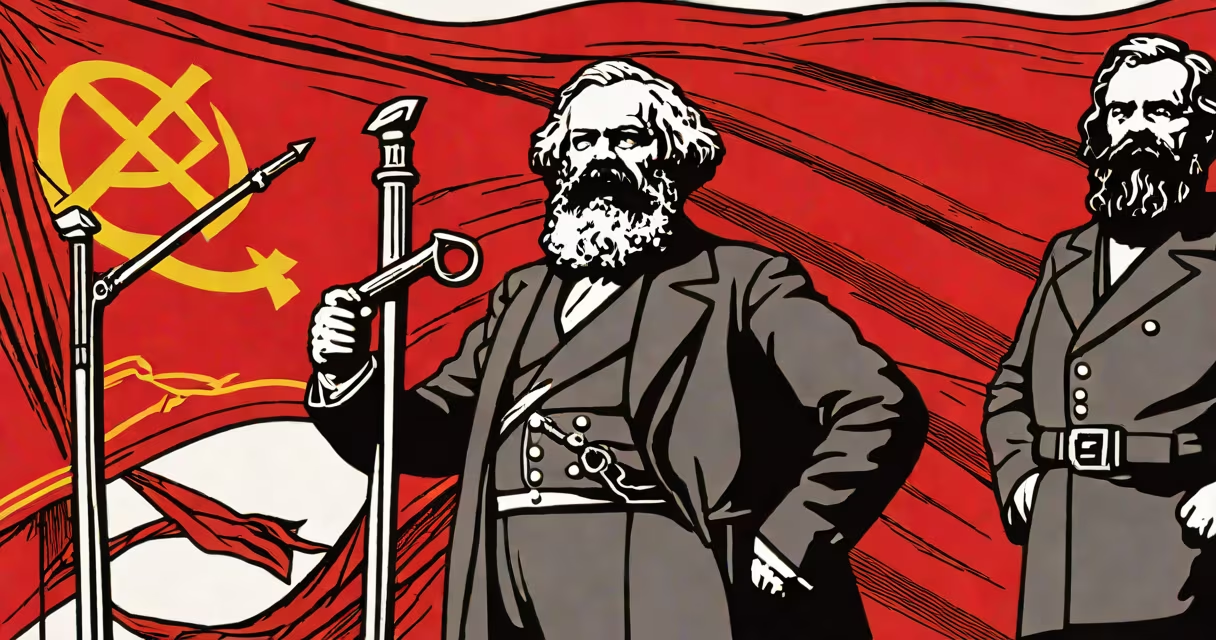
Communism ideology is a political and economic system rooted in the belief that society should be organized around collective ownership of property and the elimination of class distinctions. It emerged from the writings of Karl Marx and Friedrich Engels in the 19th century, particularly in The Communist Manifesto, and envisions a classless, stateless society where resources are distributed according to need.
At its core, communism ideology asserts that history progresses through stages driven by material conditions and class conflict. Capitalism, the current stage, creates wealth through private ownership but also concentrates power and exploitation. The working class-called the proletariat-must overthrow the ruling class-the bourgeoisie-to establish a socialist transitional phase, eventually leading to full communism.
This ideology rejects private property as a source of inequality and views the state as a tool of class domination. Its ultimate goal is a society where labor is not alienated, goods are produced for use rather than profit, and individuals contribute according to their ability and receive according to their needs.
Communism ideology operates through a series of historical and structural phases. According to Marx's structure, societies evolve from feudalism to capitalism, then to socialism, and finally to communism. Each stage is defined by dominant modes of production and the resulting class relations.
In capitalist societies, the means of production-factories, land, tools-are privately owned. Workers sell their labor to employers for wages, but surplus value created by labor is captured by owners as profit. Marx argued this process leads to systemic crises, worker alienation, and increasing inequality.
Communism ideology proposes that the proletariat must seize control of the means of production through revolution. Once in power, the state-under proletarian leadership-would manage the economy, redistribute wealth, and dismantle bourgeois institutions. Over time, as class antagonisms fade, the state would "wither away," and a truly communal society would emerge.
While Marx and Engels laid the theoretical foundation, later interpretations diverged. Not all forms of communism share the same structure or methods.
| Type | Core Principle | Historical Example | Distinctive Feature |
|---|---|---|---|
| Marxist-Leninist | Revolutionary vanguard party guides transition to communism | Soviet Union (1922-1991) | Centralized planning, state control of economy |
| Market Socialism | Public ownership with market mechanisms | China (post-1978 reforms) | State-owned enterprises operate in markets |
| Anarchist Communism | Spontaneous, decentralized organization without state | Libertarian movements in Spain (1936-1939) | No central authority; direct worker control |
| Democratic Socialism | Reformist path via democracy and gradual change | Nordic countries (Sweden, Denmark) | High taxes fund public services; private sector remains |
Marxist-Leninist systems, such as those in the Soviet Union and Maoist China, emphasized a vanguard party to lead the revolution and maintain control during the socialist phase. These states implemented centralized planning, nationalized industries, and suppressed dissent under the claim of advancing the revolution.
China's model since 1978 blends state ownership with market mechanisms. State-owned enterprises dominate key sectors like energy and telecommunications, while private businesses flourish in consumer goods and tech. This hybrid system has lifted hundreds of millions out of poverty but maintains strict political control.
Anarchist communism, by contrast, rejects both state power and hierarchical organization. During the Spanish Civil War, anarchist collectives in Catalonia ran farms, factories, and hospitals without central command. Workers managed operations through assemblies and mutual agreements. This model has never achieved large-scale implementation but remains influential in radical left circles.
Communism ideology is frequently conflated with socialism, capitalism, and even authoritarian regimes. These are distinct concepts, though they often overlap in practice.
Capitalism is an economic system based on private ownership, competition, and profit-driven production. In contrast, communism ideology seeks to abolish private property and replace markets with planned distribution. The two systems are structurally opposed.
Socialism is often seen as a stepping stone toward communism. While both advocate for public or collective ownership, socialism allows for a transitional state that manages the economy. Full communism, by Marx's definition, requires the absence of the state and class distinctions-conditions not met in any existing nation.
A critical distinction missed by many is that Marx did not define communism as a single model. He described it as a changing, historical process-not a blueprint. The idea that communism must look like the Soviet Union or North Korea is a misreading of his work. As the Marx-Engels Reader notes, Marx believed that communism would develop differently in different nations based on historical context.
Another misconception is that communism eliminates individual freedom. On the contrary, Marx argued that true freedom arises only when people are freed from economic coercion. Under capitalism, workers must sell labor to survive. In communism, individuals are free to pursue self-development because basic needs are guaranteed.
Despite widespread theoretical appeal, no country has fully achieved communist ideology as defined by Marx. All attempts have resulted in state-controlled economies with varying degrees of political repression.
Consider the Soviet Union. After the 1917 revolution, the Bolsheviks abolished private land ownership and nationalized industry. By 1930, 90% of farmland was collectivized. Central planning replaced markets. Yet, despite rapid industrialization, living standards remained low, innovation stagnated, and dissent was crushed.
China's reform era began in 1978 when Deng Xiaoping introduced market incentives within a socialist structure. Farmers were allowed to sell surplus crops. Special economic zones opened to foreign investment. GDP grew at an average of 9.5% annually from 1978 to 2010. Poverty rates dropped from 88% to less than 1% by 2020. Yet, the Chinese Communist Party retains absolute political control.
Even in small-scale experiments, challenges arise. In Venezuela, the 1999 constitution declared a "socialist state" and mandated worker cooperatives. But corruption, mismanagement, and hyperinflation led to economic collapse. By 2022, inflation reached 1.3 million percent. Food shortages became routine. The experiment failed not due to ideology, but due to poor implementation and lack of institutional safeguards.
One non-obvious point: Marx never specified how a communist society would organize daily life. He focused on abolishing class and exploitation, not on designing administrative systems. The absence of detailed planning in his texts left room for interpretation-and error. As historian Eric Hobsbawm noted, "Marx did not write a manual for running a society."
Communism ideology is not a monolithic system but a set of principles centered on equality, collective ownership, and the end of class rule. It arose from critiques of capitalism and envisioned a future where human potential is realized beyond economic necessity.
Understanding it requires separating theory from historical outcomes. The failures of 20th-century communist states do not invalidate the underlying critique of inequality and exploitation. Nor do they prove the inevitability of state control. The challenge lies in distinguishing Marx's vision from its implementations.