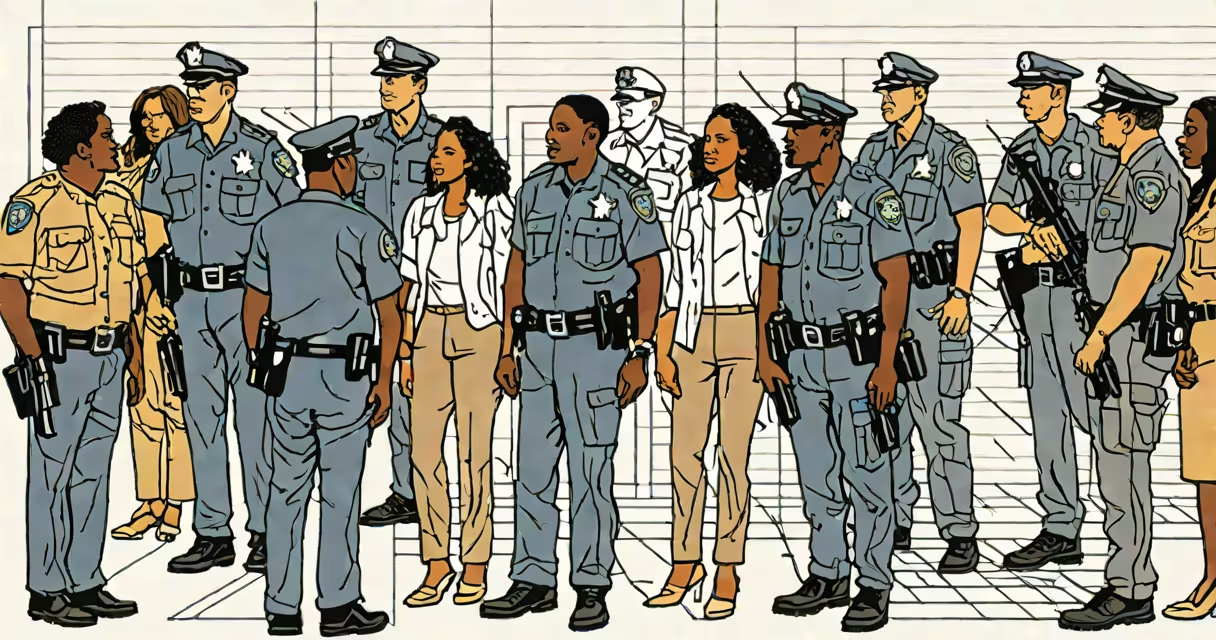
Racial profiling is the practice of targeting individuals for suspicion or scrutiny based on their race, ethnicity, or national origin rather than on specific evidence of wrongdoing. It occurs when law enforcement or other authorities make decisions about who to stop, search, or investigate based on stereotypes or assumptions tied to identity, not behavior.
The U.S. Department of Justice defines racial profiling as "the use of race or ethnicity as a basis for suspecting someone of criminal activity." This includes actions such as stopping drivers more frequently based on appearance, conducting searches disproportionately among certain groups, or detaining individuals during immigration checks due to perceived ethnic characteristics. These practices violate both federal civil rights laws and constitutional protections against unreasonable search and seizure under the Fourth Amendment.
A 2019 report by the American Civil Liberties Union (ACLU) documented that Black drivers were 20% more likely than white drivers to be pulled over during traffic stops, even though they were less likely to be carrying contraband. Similarly, Latino drivers faced higher stop rates in several states despite lower rates of violations. These disparities persist even after controlling for location, time of day, and vehicle type.
Racial profiling operates through implicit bias-the automatic associations people make between certain groups and negative traits. These biases are shaped by historical patterns of exclusion, media representation, and institutional policies. Even well-intentioned officers may unconsciously associate darker skin tones with criminality, leading to disproportionate targeting.
One documented example occurred in 2016 when a New York City police officer stopped a Black man for walking while wearing headphones. The officer claimed he was "acting suspicious," but video footage showed the man simply listening to music while walking home. The incident sparked protests and renewed scrutiny of NYPD's stop-and-frisk program, which had led to over 600,000 stops between 2002 and 2013-over 80% of which involved Black or Latino individuals, despite making up only about half the city's population.
Another form appears in airport security. The Transportation Security Administration (TSA) has long faced criticism for using race-based criteria in selecting passengers for enhanced screening. A 2017 Government Accountability Office (GAO) audit found that Middle Eastern and South Asian travelers were more than twice as likely to be selected for secondary screening compared to white travelers, even when flight risk factors were controlled.
Racial profiling manifests across multiple domains, often blending overt discrimination with systemic patterns. Below are common forms:
| Type | Description | Real-World Example |
|---|---|---|
| Law Enforcement Stops | Targeting individuals during traffic or pedestrian stops based on race or ethnicity. | Black men stopped more often than white men in Chicago, despite similar arrest rates. |
| Immigration Enforcement | Detaining or questioning individuals based on perceived national origin or accent. | Undocumented immigrants detained at border checkpoints based on language or appearance. |
| Surveillance and Data Collection | Using facial recognition systems trained on biased datasets to misidentify people of color. | Amazon Rekognition falsely matched 28 members of Congress with mugshots-disproportionately affecting people of color. |
| Commercial Screening | td>Stores or airlines using race-linked assumptions to flag customers as potential threats. | Security guards at a mall in California detained a teenager because he "looked like a shoplifter" based on his race. |
These forms are not isolated incidents. They reflect embedded patterns in policy design, training, and oversight. For instance, many police departments still use "high-crime" zones as justification for increased patrols in minority neighborhoods-even when crime rates are stable or declining.
People often confuse racial profiling with legitimate investigative techniques. Not all differences in treatment are discriminatory. But when data shows consistent disparities across large populations-especially when behavior remains unchanged-it signals systemic issues.
One misconception is that profiling only happens in extreme cases. In reality, it occurs daily in subtle ways. A 2021 study published in *Nature Human Behaviour* found that judges were more likely to impose harsher sentences on Black defendants than white ones, even when controlling for offense severity and prior record. The researchers concluded that implicit bias influenced judicial decision-making-not conscious racism.
Another error is assuming that racial profiling applies only to visible minorities. Native American, Arab, and Southeast Asian communities also face elevated risks. In 2020, the FBI reported a 17% increase in hate crimes against Asian Americans, many involving false assumptions about criminal intent based on appearance.
Racial profiling is not limited to government actors. Private entities-including retailers, landlords, and schools-can engage in it too. A 2018 incident at a Starbucks in Philadelphia saw two Black men arrested after being asked to leave for sitting without ordering. The event went viral and led to nationwide reforms, including mandatory anti-bias training for employees.
Racial profiling erodes public trust in institutions. When people feel targeted not for what they do but for who they are, they are less likely to cooperate with law enforcement or report crimes. A 2022 National Institute of Justice survey found that 63% of Black adults in urban areas believed they would be treated unfairly by police during a routine interaction.
Psychologically, repeated exposure to profiling causes trauma. Chronic stress from fear of harassment contributes to anxiety, depression, and lowered self-worth. Children exposed to racialized policing show higher levels of cortisol, a stress hormone linked to long-term health risks.
Legally, racial profiling violates key protections. The Equal Protection Clause of the Fourteenth Amendment prohibits state actors from treating individuals differently based on race. The Supreme Court ruled in *United States v. Brignoni-Ponce* (1975) that immigration agents cannot stop vehicles solely based on Mexican ancestry. Yet enforcement gaps remain, especially in rural border regions.
I once observed a community meeting in Oakland where residents shared stories of being repeatedly questioned by police while walking home from work. One woman described how she was pulled over for "driving too slowly" in her own neighborhood-after driving the same route for 15 years without issue. She later learned that the officer had been instructed to focus on "high-risk" areas, which included her predominantly Black neighborhood. That moment clarified how institutional mandates can override individual rights.
Challenging racial profiling requires awareness, accountability, and reform. Individuals can document encounters using dashcams, smartphones, or written reports. Reporting incidents to organizations like the ACLU or local civil rights groups helps build data for legal action.
Communities should demand transparency. Cities like Seattle and Minneapolis have implemented body-worn camera programs with public access to footage and regular audits of stop data. These measures help identify patterns and hold officers accountable.
Racial profiling is not a rare occurrence-it is a recurring pattern rooted in history, reinforced by policy, and perpetuated by silence. Recognizing it is the first step toward dismantling its impact.