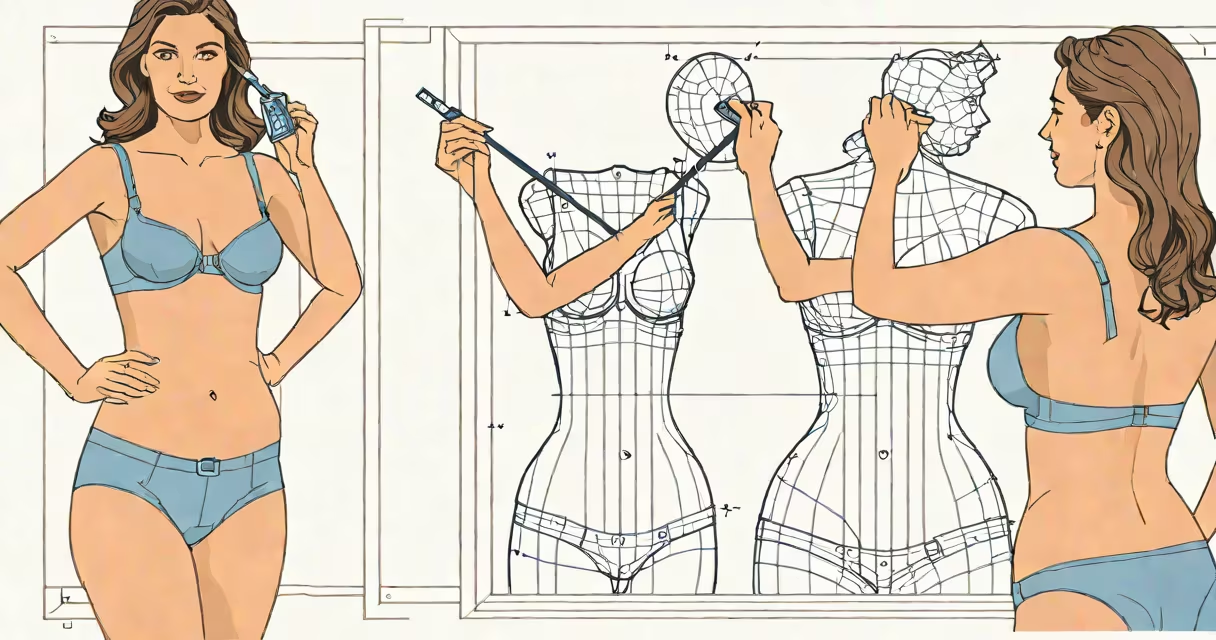
The difference in bra sizes comes from two distinct measurements: band size, which fits around the ribcage just below the breasts, and cup size, which measures the volume of breast tissue above the band. A bra labeled 34B has a 34-inch band and a B cup. These numbers are not interchangeable-they represent separate dimensions.
Bra sizing is based on a standardized system used by most U.S. manufacturers. The band size is derived from the underbust measurement, rounded to the nearest even number. For example, a 32.5-inch underbust becomes a 32-band size. Cup size is determined by the difference between the bust and underbust measurements. A 2-inch difference equals a B cup, 3 inches equals a C cup, and so on.
Many people assume that a larger band size always means a larger bra size. That's incorrect. A 36C is not bigger than a 34B-it's just different. The 36C has a larger band and a deeper cup, but the total volume may be similar. This distinction is critical for finding a properly fitting bra.
Bra sizing follows a consistent mathematical pattern. Start by measuring the underbust-the area directly beneath the breasts-using a flexible tape measure. Wrap it snugly, not tight, around the torso, keeping it level. Round the result to the nearest even number to determine the band size.
Next, measure the bust at the fullest part-typically at the nipple level. Subtract the underbust measurement from the bust measurement. The difference determines the cup size:
For example, a woman with a 32-inch underbust and a 36-inch bust has a 4-inch difference. Her cup size is D. Her full bra size is 32D.
Bra sizes fall into two categories: band size and cup size. Band sizes typically range from 28 to 48 inches in standard U.S. sizing. Cup sizes extend from A to K, though some brands go higher. Not all brands use the same scale-some use extended letters like DD, DDD, or even E, F, G.
Here's how different combinations affect fit and function:
| Bra Size | Band (Underbust) | Cup (Difference) | Typical Fit Implication |
|---|---|---|---|
| 32A | 32 inches | 1 inch | Small volume, snug band-ideal for smaller frames |
| 36C | 36 inches | 3 inches | Medium volume, slightly looser band-common for average builds |
| 38DD | 38 inches | 5 inches | Larger volume, wider band-often requires specialized support |
| 40G | 40 inches | 7 inches | High volume, wide band-requires structured construction |
Some women wear the same band size but different cup sizes due to changes in breast volume over time. A 34B may become a 34C after pregnancy or weight gain. This shift doesn't require changing the band-it only affects the cup.
One widespread error is assuming that a bra size like 36C is universally larger than 34B. While the band is larger, the cup volume may be nearly identical. A 34B has a 2-inch difference; a 36C has a 3-inch difference. The 36C has more volume, but not dramatically so. The band size does not scale volume linearly.
Another mistake is using the same band size across brands. Brands vary in cut and stretch. A 36C from Brand A may feel tighter than a 36C from Brand B. This is why trying on bras in person-even with accurate measurements-is essential.
A lesser-known fact: cup size is not about the actual volume of the breast, but the difference between bust and underbust. Two women with the same cup size can have vastly different breast volumes. One may have a small underbust and large bust, another a large underbust and moderate bust-but both have the same cup size.
I measured my underbust at 30.5 inches. Rounded to the nearest even number, that's a 30-band size. My bust measured 35 inches. The difference is 4.5 inches. According to standard charts, that falls between a D and DD cup. Since most brands don't offer half-cups, I tried 30D and 30DD.
The 30D felt too tight across the chest and dug into my shoulders. The 30DD had enough room in the cups but the band was loose. I then tried a 32D-band size increased by two inches, cup remained D. The band fit snugly, the cups held my breasts without spilling. I found my correct size: 32D.
This shows that adjusting both band and cup is necessary. You can't fix a loose band by going up in cup size. You need to adjust the band size independently.
Ill-fitting bras cause discomfort, poor posture, and long-term strain. A study published in the journal Body Image found that 80% of women wear the wrong bra size, with many wearing bands that are too loose or cups that are too small (DOI:10.1016/j.bodyim.2018.02.003). Poor fit leads to shoulder pain, backache, and reduced confidence.
Properly sized bras distribute weight evenly. A well-fitted band supports 80% of the breast's weight. When the band is too loose, the straps carry the load-leading to sagging and discomfort. Cups that are too small force tissue into the sides, creating "spillage" and visible bulges.
For accurate results, measure at the same time of day-after waking, before showering. Breast volume fluctuates throughout the day due to fluid retention. Measuring during peak volume gives a more realistic fit.
Understanding the difference in bra sizes prevents years of trial and error. It turns a frustrating shopping experience into a precise process grounded in measurement and consistency.