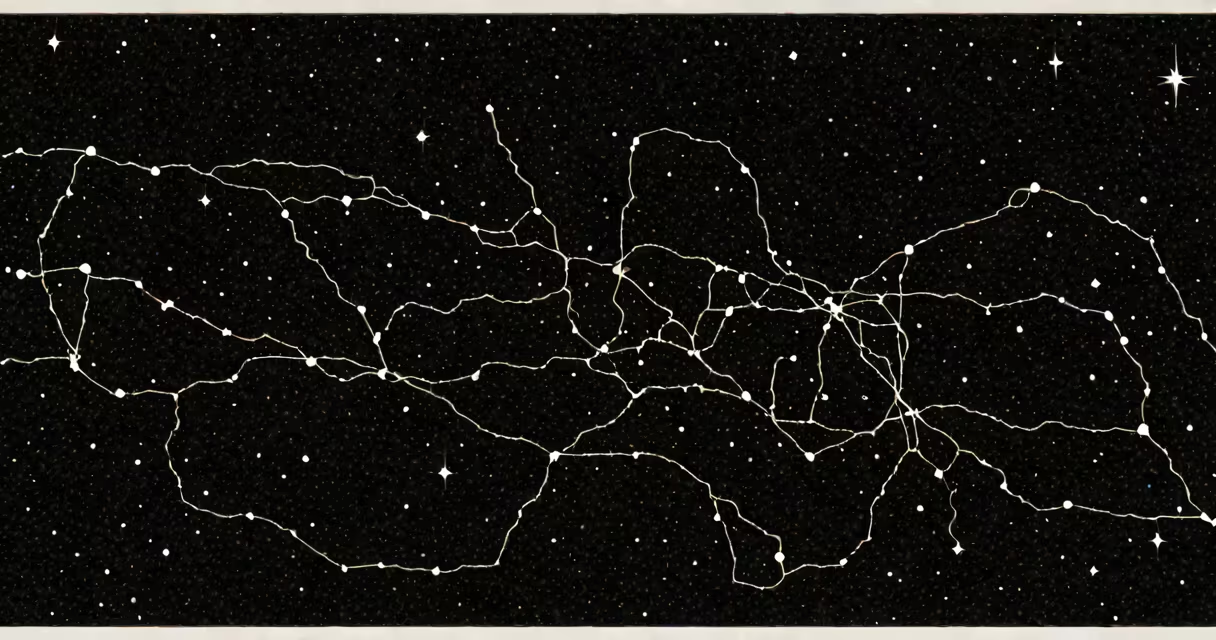
The largest constellation in the sky is Hydra, covering 1,303 square degrees-more than 3% of the celestial sphere. It spans nearly 60 degrees from head to tail, making it longer than the distance between the Big Dipper and Orion's Belt.
Hydra lies in the southern celestial hemisphere and is visible primarily from latitudes south of the equator. Its name comes from Greek mythology, where it was a serpent-like creature with nine heads, slain by Hercules during his Twelve Labors. The constellation's elongated shape reflects this mythological origin, with a serpentine curve winding through the stars.
Despite its vast size, Hydra is not prominent in the night sky due to its faint stars. Most of its 34 named stars are below magnitude 4.0, meaning they're barely visible to the naked eye under dark skies. This contrasts sharply with brighter constellations like Orion or Ursa Major, which dominate the view even in light-polluted areas.
Astronomers measure constellations by their angular area-the amount of sky they occupy when projected onto the celestial sphere. Area is measured in square degrees, with the entire sky totaling 41,253 square degrees. A full moon covers about 0.2 square degrees, so Hydra's 1,303 square degrees equates to roughly 6,500 full moons.
Size isn't determined by brightness or star count. For example, Virgo, the second-largest constellation, covers 1,294 square degrees-just 9 fewer than Hydra. But Virgo contains Spica, a first-magnitude star, while Hydra's brightest star, Alphard, is only magnitude 1.99. That makes Virgo far easier to locate despite being slightly smaller.
Historically, constellations were defined by cultural narratives, not geometry. The Greeks mapped patterns based on myths, while ancient Chinese astronomers grouped stars into different "palaces" and "mansions." Modern boundaries were formalized in 1930 by the International Astronomical Union (IAU), which assigned precise borders to 88 official constellations. These borders ensure no ambiguity in astronomical references.
Constellations fall into categories based on their location and historical origin:
| Category | Examples | Area (sq deg) | Notes |
|---|---|---|---|
| Large Southern Constellations | Hydra, Virgo, Centaurus | 1,303, 1,294, 1,060 | Most visible from southern latitudes |
| Mid-sized Northern Constellations | Orion, Ursa Major, Leo | 590, 506, 948 | Highly visible; contain bright stars |
| Small and Faint | Crux, Equuleus, Pictor | 68, 72, 150 | Often overlooked despite being officially recognized |
Hydra ranks first in area but is not among the most recognizable. Its lack of bright stars and diffuse shape make it hard to identify without a star chart. In contrast, Orion, though only 590 square degrees, stands out due to its distinctive belt and sword-a cluster of stars that includes the Orion Nebula.
Some constellations were created by European explorers in the 16th and 17th centuries. These include Microscopium, Sculptor, and Antlia-all small and obscure. Their inclusion reflects the expansion of European astronomy beyond Greco-Roman traditions. The IAU standardized these later additions alongside older ones, ensuring consistency in celestial mapping.
People often confuse size with prominence. A large constellation isn't necessarily easier to find. Hydra's sheer scale can mislead observers into thinking it should stand out. In reality, its stars are too dim and scattered to form a clear pattern without aid.
Another misconception is that constellations are physical groupings of stars. They are not. Stars within a constellation may be separated by hundreds of light-years. For example, Alphard in Hydra is 177 light-years away, while the stars in Orion's Belt are all within 1,000 light-years-but still not physically connected.
A lesser-known fact: Hydra is the only constellation named after a monster from Greek myth that is not associated with a hero's triumph. Most constellations tied to myths involve heroes like Perseus or Heracles. Hydra's story ends with the creature being destroyed, but its name persists as a reminder of chaos and resilience.
To observe Hydra, start near the bright star Regulus in Leo. From there, trace a line southward and slightly eastward. The constellation stretches from near the celestial equator into the southern sky. You'll pass through Corvus (the Crow) and Crater (the Cup) before reaching Hydra's head near the border of Virgo.
Using a smartphone app like Stellarium or SkySafari can help track Hydra's path. Set your location to a dark-sky site like Mauna Kea in Hawaii or the Atacama Desert in Chile. At such locations, Hydra becomes visible as a faint, winding band of stars. On a clear night, you can see about 20 stars in the constellation with binoculars.
I once spent an hour tracking Hydra during a stargazing event in Chile. Despite knowing its position, the faintness of its stars made it difficult to distinguish from background noise. Only with a detailed map did we confirm its presence. This experience reinforced that size doesn't equal visibility-and that patience matters in observational astronomy.
While size doesn't affect a constellation's scientific utility, it influences how we perceive the night sky. Large constellations like Hydra serve as reference points for deeper sky surveys. They help astronomers define regions for galaxy clustering studies or deep-field imaging.
For example, the Sloan Digital Sky Survey (SDSS) uses constellation boundaries to organize data. When researchers study the distribution of galaxies in the Hydra-Centaurus Supercluster, they rely on Hydra's defined area to avoid overlap with neighboring regions. This precision ensures accurate cataloging of celestial objects.
Size also plays a role in cultural astronomy. Indigenous groups in Australia and South America have long used large constellations for navigation and seasonal tracking. The Yolngu people of northern Australia associate parts of Hydra with ancestral beings, using its position to mark the beginning of the dry season.
Understanding what is the largest constellation reveals more than just star patterns-it shows how humans interpret space through myth, measurement, and observation. While Hydra dominates in area, its quiet presence reminds us that not all wonders are loud.