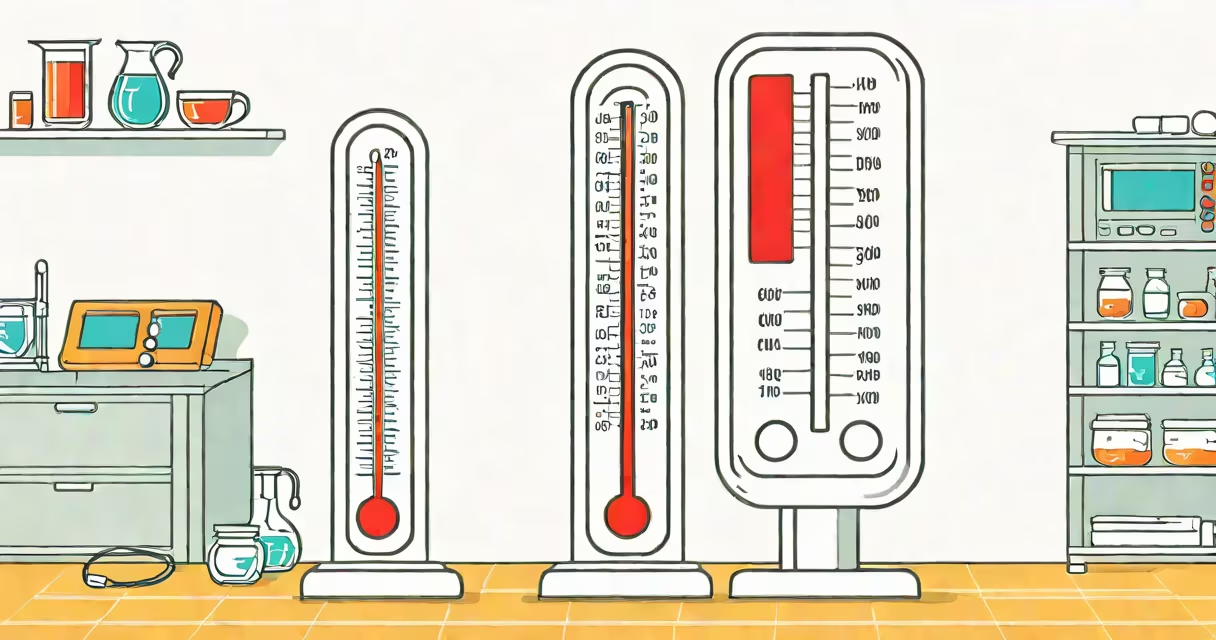
A thermometer is the primary instrument used to measure heat, quantifying temperature through changes in physical properties such as liquid expansion, electrical resistance, or infrared radiation. It converts thermal energy into a readable scale, typically in degrees Celsius, Fahrenheit, or Kelvin.
Thermometers operate based on predictable material responses to temperature shifts. For example, mercury or alcohol expands in a sealed glass tube when heated, moving up a calibrated scale. Modern digital thermometers rely on thermistors or thermocouples-components whose electrical resistance changes predictably with heat. Infrared thermometers detect thermal radiation emitted by objects, allowing non-contact readings from a distance.
Temperature measurement is essential in medicine, meteorology, industrial processes, and scientific research. A fever in a patient is assessed using a clinical thermometer. Weather reports depend on outdoor sensors measuring ambient air temperature. In manufacturing, precise heat control ensures product quality during processes like metal forging or food pasteurization.
Thermometers fall into several categories based on their operating principle and application:
| Type | Operating Principle | Common Use | Accuracy Range |
|---|---|---|---|
| Mercury-in-glass | Liquid expansion in a capillary tube | Historical lab use, limited today due to toxicity | ±0.1°C |
| Digital (thermistor) | Electrical resistance change with temperature | Clinical, home, kitchen use | ±0.2°C |
| Infrared (non-contact) | Sensing emitted thermal radiation | Industrial, medical screening, HVAC | ±1°C (varies with distance) |
| Bimetallic strip | Differential expansion of two metals | Ovens, thermostats, industrial controls | ±2°C |
Each type suits specific environments. Mercury thermometers were standard in labs until safety concerns led to phase-out under U.S. EPA regulations. Digital thermometers dominate consumer markets due to speed and ease of reading. Infrared models allow rapid screening of people in healthcare settings, such as during flu season, without physical contact.
One often-overlooked fact: temperature and heat are not the same. Temperature measures average kinetic energy of particles; heat measures total thermal energy. A large body of water at 20°C holds more heat than a small cup at 100°C because heat depends on mass and specific heat capacity. Thermometers measure temperature, not heat directly.
Hospitals use digital oral and tympanic thermometers to track patient fevers. The World Health Organization recommends accurate temperature monitoring in diagnosing infections, especially in children. A single-degree rise above 37.5°C may indicate illness requiring intervention.
Weather stations deploy shielded electronic sensors called thermistors in Stevenson screens to avoid solar heating bias. Data from these instruments feed into national weather services like NOAA's National Centers for Environmental Information, which tracks long-term climate trends. For example, NOAA reported that global average surface temperatures rose 1.2°C between 1880 and 2020, a trend confirmed by thousands of ground-based thermometers worldwide.
Industrial settings require rugged, high-precision instruments. In semiconductor fabrication, temperatures must stay within ±0.1°C during wafer processing. Thermocouples made from nickel-chromium and constantan alloys are embedded in equipment to monitor oven zones in real time. Failure to maintain tolerances results in defective chips.
People often mistake "heat" and "temperature." A pot of boiling water contains more heat than a red-hot nail, even though the nail has a higher temperature. Thermometers measure temperature, not heat energy. To calculate actual heat, you need mass, specific heat, and temperature change-a formula used in physics and engineering.
Another misconception: all thermometers are equally accurate. A kitchen thermometer designed for meat may read 10°C off when used to check engine coolant. Calibration matters. The National Institute of Standards and Technology (NIST) certifies reference standards for traceable accuracy. NIST-traceable thermometers are required in laboratories handling sensitive experiments.
I once tested five household thermometers against a NIST-certified device. One digital model read 38.6°C for a known 37.0°C bath-over 1.5°C off. This error could lead to misdiagnosis. Always verify calibration, especially in critical applications.
Understanding what is used to measure heat clarifies how we interpret thermal conditions across science, health, and industry. Accurate temperature data supports decisions from daily routines to global policy. The right tool, properly calibrated, ensures reliability in every reading.