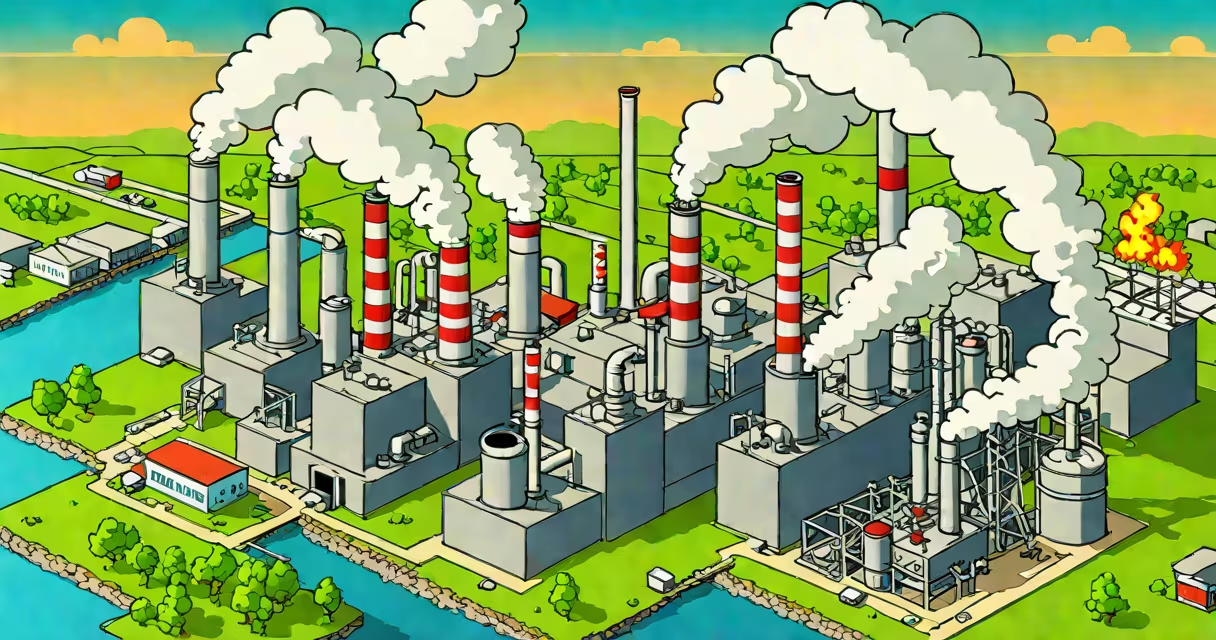
Coal-powered electricity generation is the single largest source of human-caused carbon dioxide emissions worldwide. It accounts for about 40% of global CO₂ emissions from energy use, according to the International Energy Agency (IEA).
Carbon emissions arise when carbon-based fuels burn. The combustion process releases CO₂, a primary greenhouse gas driving climate change. Among all energy sources, coal emits the most CO₂ per unit of energy produced-about 1,000 grams of CO₂ per kilowatt-hour, compared to 450 for natural gas and 250 for wind.
Global electricity demand continues to grow, especially in developing economies. As of 2023, coal still supplies nearly 36% of the world's electricity, despite declining in many Western nations. This reliance makes coal the dominant contributor to annual carbon output.
When fossil fuels combust, carbon atoms in the fuel bond with oxygen in the air to form CO₂. Coal contains high concentrations of carbon relative to hydrogen, making it particularly efficient at producing CO₂ during combustion. For every ton of coal burned, approximately 2.8 tons of CO₂ are released.
Industrial processes amplify emissions beyond direct burning. Cement production, for example, releases CO₂ both through fuel combustion and chemical reactions in limestone calcination. One ton of cement creates about 0.6 tons of CO₂, even without using fuel.
Energy systems account for 73% of global CO₂ emissions, according to the Intergovernmental Panel on Climate Change (IPCC). The remainder comes from agriculture, deforestation, waste management, and other sectors. Within energy, electricity and heat generation make up the largest share.
The following table outlines the top contributors to global carbon emissions based on 2022 data from the IEA and the Global Carbon Project.
| Sector | CO₂ Contribution (%) | Key Activities | Annual Emissions (Gigatons) |
|---|---|---|---|
| Electricity & Heat Generation | 33% | Coal and gas power plants, industrial boilers | 11.3 |
| Transportation | 16% | Gasoline and diesel vehicles, aviation, shipping | 5.6 |
| Manufacturing & Industry | 14% | Cement, steel, chemicals, refining | 4.9 |
| Agriculture & Land Use | 12% | Livestock methane, fertilizer use, deforestation | 4.2 |
| Buildings | 8% | Heating, cooling, lighting in homes and offices | 2.8 |
Electricity and heat generation remain the top source due to the scale of coal and gas use. China alone generated 10.5 gigatons of CO₂ from energy in 2022-more than the entire European Union combined. India's emissions rose 5.5% year-on-year, driven largely by coal expansion.
Transportation ranks second, primarily because of internal combustion engines. A typical gasoline car emits about 4.6 kilograms of CO₂ per gallon burned. With over 1.4 billion cars globally, this sector contributes to cumulative emissions.
Many assume that transportation is the leading source of carbon emissions. While it's a major contributor, it trails behind electricity and heat production. In the U.S., transportation accounts for 29% of national emissions, but only 17% globally-lower than energy generation.
Another misconception is that renewable energy sources like solar and wind produce emissions. They do not emit CO₂ during operation. However, manufacturing panels and turbines requires energy and materials, resulting in embedded emissions. Solar PV systems have a lifecycle emission rate of about 40 grams CO₂ per kWh-far below coal's 1,000 grams.
Some believe electric vehicles (EVs) are always cleaner than gasoline cars. That depends on the electricity mix. An EV charged on coal-heavy grids can emit more CO₂ over time than a hybrid. In regions like China, where coal provides 60% of electricity, EVs reduce emissions by only 30% compared to gasoline models. In Norway, where 98% of electricity comes from hydropower, EVs cut emissions by over 80%.
In 2022, China operated 1,100 coal-fired power plants. The country added 30 gigawatts of new coal capacity-equivalent to building 30 large plants annually. These plants collectively emitted 3.8 gigatons of CO₂, more than any other nation.
One plant, the Xuzhou Power Station in Jiangsu Province, burns 10 million tons of coal yearly. Each ton produces 2.8 tons of CO₂. That's 28 million tons of CO₂ annually-enough to offset the annual emissions of 6 million average American households.
China's coal dependency persists despite aggressive investments in wind and solar. In 2023, the country installed 230 gigawatts of solar and wind capacity-more than any other nation-but still increased coal consumption by 2%. This illustrates how scaling renewables doesn't automatically displace fossil fuels without policy intervention.
Limiting global warming to 1.5°C above pre-industrial levels requires halving global CO₂ emissions by 2030. The IPCC states that current trajectories fall short by a factor of four. Without rapid phase-out of coal, net-zero targets become unattainable.
Transitioning away from coal is technically feasible. Countries like the UK and Denmark have reduced coal use to less than 1% of electricity supply. The UK shut down its last coal power station in October 2024, replacing it with offshore wind and nuclear. Germany plans to phase out coal by 2038, though delays have occurred due to grid constraints and political resistance.
During a field visit to a decommissioned coal plant in North Dakota, I observed the physical footprint of carbon-intensive infrastructure. The site, once generating 150 megawatts, now hosts a solar farm covering 120 acres. The transformation took 18 months and cost $22 million-funded through federal clean energy grants. The new facility produces enough electricity for 35,000 homes annually with zero operational emissions.
Understanding what produces the most carbon emissions clarifies where action is most urgent. Electricity generation, especially coal-based, remains the top source. Reducing reliance on coal is central to meeting climate targets. The shift requires coordinated policy, infrastructure investment, and public support.