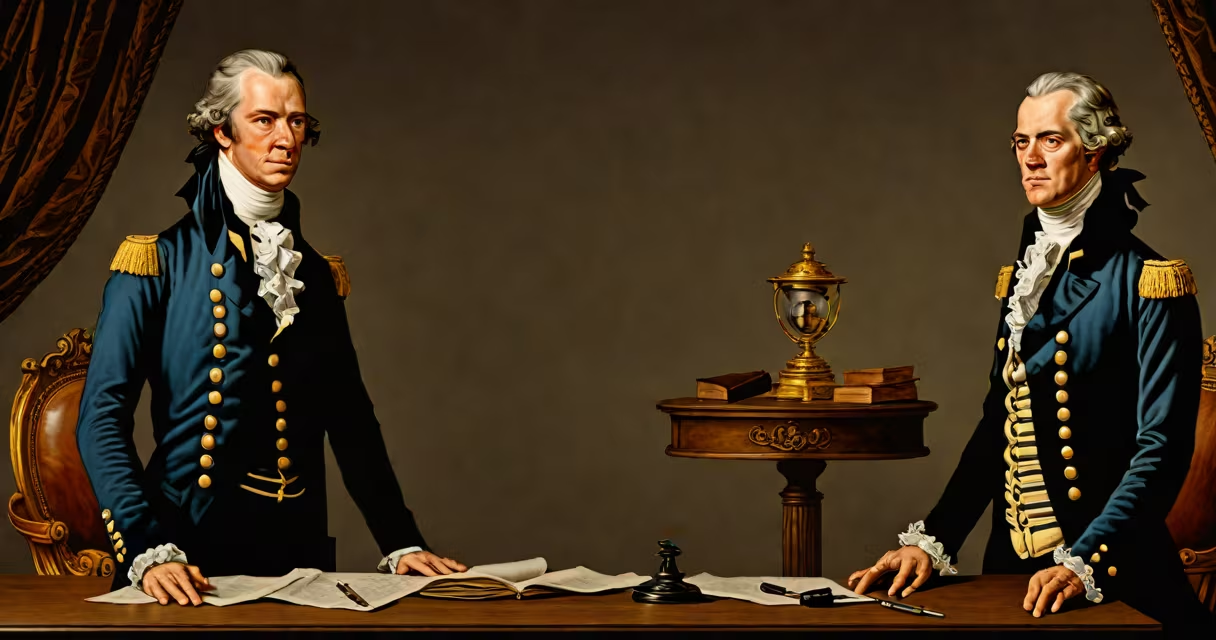
Aaron Burr shot and killed Alexander Hamilton in a duel on July 11, 1804, in Weehawken, New Jersey. The confrontation stemmed from years of political rivalry and personal offense, culminating in a fatal exchange of gunfire.
Hamilton, then U.S. Secretary of the Treasury, had opposed Burr's political ambitions for years. The immediate trigger was a published letter in which Hamilton criticized Burr's character and suitability for public office. Burr saw this as a personal insult and demanded satisfaction through a duel, a practice still legally permitted in some states at the time.
Duels were not uncommon among elite Americans in the early 1800s. They followed strict codes of honor, often settled with pistols at a distance of ten paces. Both men arrived at the dueling ground with seconds-trusted allies who managed the process. Hamilton's second was Dr. David Hosack, a prominent physician. Burr's second was William P. Van Ness.
The two men stood ten paces apart. A signal was given. Hamilton fired first-but his shot went wide, striking a tree branch above Burr's head. Burr then fired. His bullet entered Hamilton's abdomen, lodging near his spine. He collapsed within minutes.
Hamilton was carried to a nearby house, where he lay dying for 30 hours. He never regained consciousness. His last words, recorded by Dr. Hosack, were "I have always been a man of principle." He died at 1:05 p.m. on July 12, 1804.
Burr was indicted for murder in New York and New Jersey. He fled to North Carolina to avoid arrest, then returned to New York City. He was tried twice-once in New York, once in New Jersey-but acquitted both times due to lack of evidence and legal technicalities. The charges were dropped in 1807 after a separate federal treason trial.
Hamilton's death shocked the nation. He was 47 years old and at the height of his influence. His vision for a strong central government, a national bank, and a professional military had shaped the young republic. His absence left a void in Federalist leadership.
Burr's political career ended in disgrace. He served as Vice President under Thomas Jefferson from 1801 to 1805, but their relationship deteriorated quickly. After the duel, he was widely ostracized. He later attempted to form a separatist nation in the western territories, an act that led to his arrest and trial for treason-a case that reached the Supreme Court.
Historians agree that the duel was not about politics alone. Personal pride, reputation, and social standing played key roles. As historian Ron Chernow wrote in Washington: A Life, "The duel was less about policy than about ego."
Many assume Hamilton was killed in battle or by a foreign agent. He was not. He died in a private, ritualized conflict between two American leaders. The idea that he was assassinated by a shadowy figure is false.
Another myth is that Hamilton intended to fire into the air. Some accounts suggest he meant to miss, but evidence from his letters and the testimony of his second indicate he aimed to wound-not kill. However, his shot missed entirely, possibly due to a misfire or poor aim under pressure.
There is no credible evidence that Burr planned to kill Hamilton beforehand. The duel was meant to settle a dispute, not execute a vendetta. But the outcome was irreversible.
The story of Hamilton's death became a cultural touchstone. Lin-Manuel Miranda's musical Hamilton dramatizes the tension between the two men, portraying Burr as calculating and ambitious. The song "The Room Where It Happens" reflects the power struggles that preceded the duel.
However, the musical takes creative liberties. In reality, Hamilton was not a romantic rival to Burr's wife, Angelica Schuyler. And while Burr's actions were controversial, they were not the result of a single, hidden motive. Historical records show Burr was deeply involved in political maneuvering, but not in a way that suggests premeditated murder.
When did Hamilton come out? The musical premiered Off-Broadway in 2015 and moved to Broadway in 2016. Its popularity revived interest in Hamilton's life and legacy, including the circumstances of his death. The show's portrayal of the duel-where Burr says "I'll be the one who lives"-has become iconic, though historically inaccurate in tone.
| Aspect | Fact | Myth |
|---|---|---|
| Location | Weehawken, New Jersey | Manhattan or Washington, D.C. |
| Weapons | Pistols, loaded with lead balls | Swords or knives |
| Intent | Settle honor dispute | Political assassination |
| Aftermath | Burr exiled, tried for treason | Burr became president |
I once stood at the site of the duel in Weehawken. The Hudson River flows below, and a small plaque marks the spot where Hamilton fell. The view is quiet now, but in 1804, it was charged with tension. The silence there feels heavier than any monument.
Today, the National Park Service maintains the site as part of the Lower Manhattan Historic District. Visitors can walk the path where the two men stood, though the original dueling ground has been altered by urban development.
Who killed Alexander Hamilton? Aaron Burr. The answer is clear. The facts are documented in court records, medical reports, and surviving correspondence. The duel remains one of the most consequential personal conflicts in American history.
Understanding who killed Alexander Hamilton requires separating myth from record. The event wasn't a plot twist-it was a tragedy rooted in the norms of its time. And while the musical Hamilton captures the drama, it doesn't replace the truth.
For more on the timeline of that musical, see when did Hamilton come out.