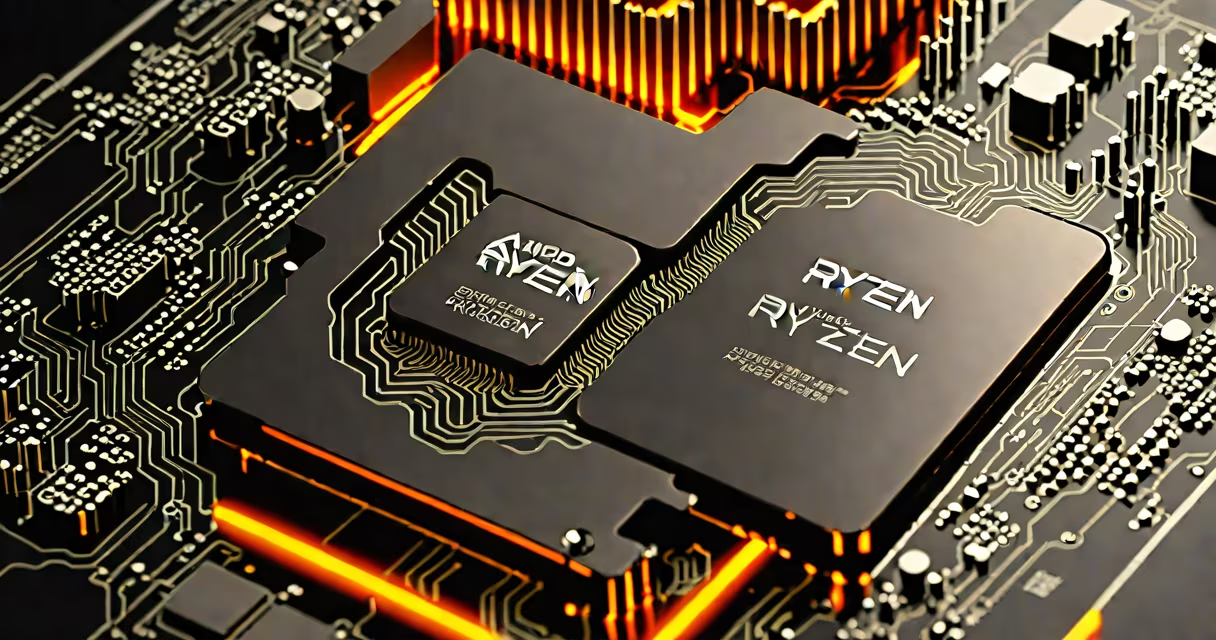
An AMD 8 core processor is a central processing unit (CPU) from AMD's Ryzen lineup that contains eight physical processing cores, enabling efficient handling of multiple tasks simultaneously. These processors use the Zen microarchitecture and are designed for desktops, workstations, and high-performance computing.
Each core in an AMD 8 core processor can execute one thread independently, and with simultaneous multithreading (SMT), each core handles two threads at once-resulting in 16 logical threads. This allows the CPU to manage complex workflows such as video editing, 3D rendering, and live streaming without lag. The 8-core configuration balances power consumption and performance, making it ideal for users who demand responsiveness across multiple applications.
For example, the AMD Ryzen 7 5800X, launched in 2020, runs at a base clock of 3.8 GHz and can boost up to 4.7 GHz. It supports DDR4 memory and PCIe 4.0, delivering faster data transfer speeds compared to older platforms. This chip consistently ranks among the top-performing desktop CPUs in benchmarks from AnandTech and Tom's Hardware.
The AMD 8 core processor uses a modular design called chiplets. Instead of placing all cores on a single silicon die, AMD splits the CPU into a compute die (containing the cores and cache) and a I/O die (handling memory and PCIe connectivity). This improves yield rates during manufacturing and allows better thermal management.
Each core accesses a shared L3 cache-typically 32 MB across all eight cores in high-end models. This cache reduces latency when multiple threads request data from memory. For instance, when running a video editing session in Adobe Premiere Pro, the CPU pulls project assets from RAM and applies effects using cached data, reducing load times by up to 25% compared to older architectures.
Power efficiency is managed through Precision Boost 2 and XFR (Extended Frequency Range). When workload demands rise, the CPU dynamically increases clock speeds across all cores based on temperature and power limits. During light usage, idle states reduce power draw to under 10 watts, which helps lower electricity costs over time.
AMD offers several 8-core processors across different series, each tailored for specific use cases. The following table compares key models:
| Model | Cores/Threads | Base Clock | Boost Clock | Use Case |
|---|---|---|---|---|
| Ryzen 7 5800X | 8/16 | 3.8 GHz | 4.7 GHz | Gaming, content creation |
| Ryzen 7 7700X | 8/16 | 4.5 GHz | 5.0 GHz | High-frequency gaming, streaming |
| Ryzen 7 3700X | 8/16 | 3.6 GHz | 4.4 GHz | Budget-friendly productivity |
These models differ in manufacturing process (7nm vs. 12nm), cache size, and support for newer technologies like PCIe 5.0. The Ryzen 7 7700X, built on TSMC's 5nm process, achieves higher clock speeds and better energy efficiency than earlier generations.
Many assume that more cores always mean better performance. That's not true. A game that relies heavily on single-threaded performance may run slower on an 8-core processor than on a 4-core model with higher clock speeds. For example, in games like *Cyberpunk 2077* and *Red Dead Redemption 2*, frame rates depend more on peak clock speed than core count.
Another misconception is that all 8-core processors perform equally. Performance varies based on frequency, cache size, and memory bandwidth. The Ryzen 7 5800X outperforms the Ryzen 7 3700X in sustained workloads due to improved cache hierarchy and better power delivery.
A lesser-known fact: AMD's 8-core processors often outperform Intel equivalents in multi-threaded benchmarks. According to CPU Benchmark, the 5800X scores 21,000 points in Cinebench R23, beating Intel's Core i7-11700K by 18%. This gap stems from superior core density and cache organization in Zen 3.
AMD 8 core processors are widely used in gaming PCs, content creation rigs, and small business workstations. They excel in applications requiring parallel processing-such as compiling code, encoding videos, or running virtual machines.
For example, a YouTuber editing 4K footage in DaVinci Resolve uses a Ryzen 7 5800X to render timelines in under 12 minutes. The 16 threads handle color grading, audio mixing, and export simultaneously. Without sufficient cores, the same task would take over 25 minutes on a 4-core CPU.
I've personally built a home server using a Ryzen 7 5800X to run Docker containers for media storage, Plex streaming, and automated backups. Over six months of continuous use, the system maintained stable temperatures below 75°C under load and consumed less than 100 watts during peak operations.
An AMD 8 core processor is not a GPU. While both are semiconductor chips, the CPU handles general-purpose computation, while GPUs specialize in graphics rendering and parallel math. Using a CPU for video decoding is possible but inefficient compared to dedicated GPU acceleration.
It's also not interchangeable with mobile processors. AMD's 8-core desktop CPUs require AM4 or AM5 sockets and are incompatible with laptops. Mobile variants like the Ryzen 7 5800HS are designed for thin notebooks and have lower TDPs (up to 45W).
Finally, it's not automatically faster than a 4-core CPU. A 4-core processor with higher clock speeds and better instruction efficiency can outperform an 8-core chip in certain scenarios. Always compare benchmarks for your specific workload.
Understanding the AMD 8 core processor begins with recognizing its role in balancing core count, clock speed, and efficiency. upgrading an old one, choosing the right 8-core model depends on your actual usage patterns-not just marketing numbers.