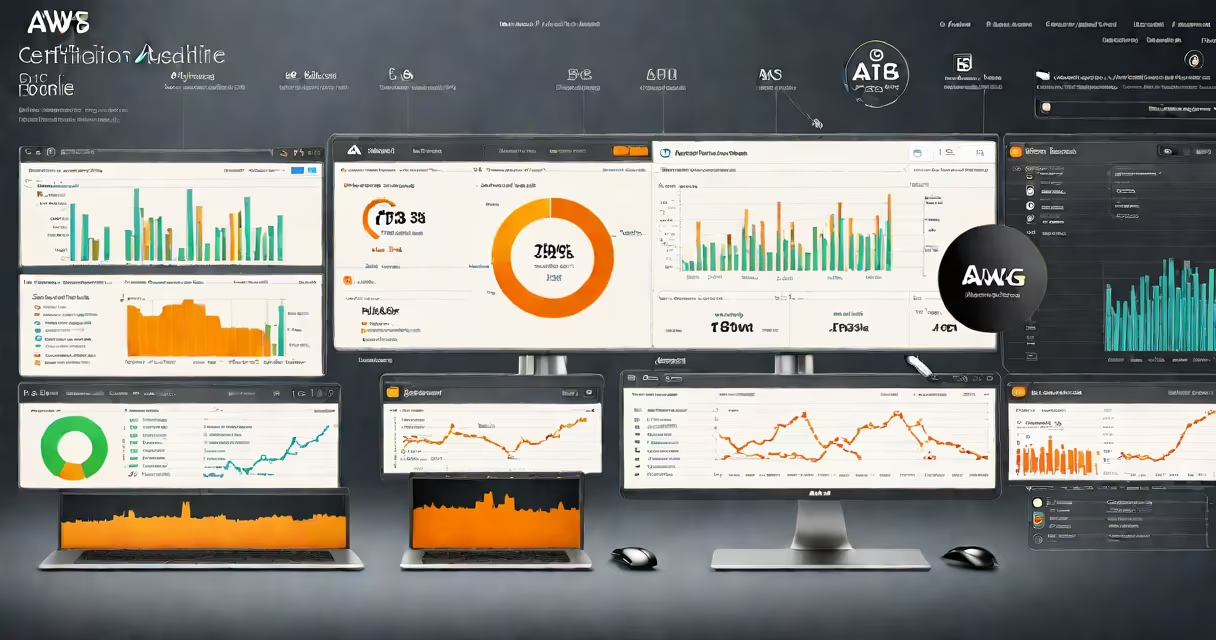
The AWS Certification Data Analytics Specialty is a role-based credential that validates advanced skills in designing, implementing, and managing scalable data solutions using AWS services. It targets professionals who architect and operate data platforms in production environments.
This certification requires passing a single exam (DAS-C01) that tests practical knowledge across data ingestion, storage, processing, security, and visualization. Candidates must demonstrate ability to select appropriate AWS services based on workload requirements, cost constraints, and compliance needs.
Amazon Web Services (AWS) offers this credential to validate expertise beyond basic cloud operations. It's designed for individuals who work with large datasets, build data pipelines, and deliver insights through dashboards and reporting tools. The exam covers real-world scenarios such as ingesting streaming data from IoT devices, transforming batch data using AWS Glue, and visualizing results in Amazon QuickSight.
Candidates must pass the DAS-C01 exam, which consists of 65 multiple-choice and multiple-response questions. The test duration is 130 minutes and includes scenario-based questions requiring analysis of architecture trade-offs.
Exam content focuses on five domains: data ingestion (15%), data storage and retrieval (20%), data processing (25%), data security (15%), and data visualization and reporting (15%). Questions assess decision-making under constraints like latency, cost, and regulatory compliance.
For example, a question may ask whether to use Amazon Kinesis Data Streams or Amazon Managed Streaming for Apache Kafka (MSK) for real-time fraud detection. Correct answers require understanding of throughput, message ordering, and integration complexity.
The certification evaluates familiarity with key AWS services used in data workflows:
Professionals must understand how these services integrate. For instance, data from mobile apps flows into Amazon Kinesis Firehose, lands in S3, gets cataloged via AWS Glue, and is queried by Redshift for reporting.
Security is embedded throughout. The exam tests knowledge of encryption at rest and in transit, IAM roles for cross-service access, and data lake governance using AWS Lake Formation.
Many confuse the Data Analytics Specialty with the AWS Certified Solutions Architect - Associate. The former focuses on data workflows and analytics, while the latter emphasizes infrastructure design and high availability.
Another misconception is that the certification covers machine learning. While AWS SageMaker is part of the broader AWS system, the Data Analytics Specialty does not test model training or deployment. It stops at data preparation and insight delivery.
A less obvious point: the exam does not assume prior experience with specific programming languages. While Python and SQL are commonly used in data tasks, the test evaluates conceptual understanding over coding proficiency. A candidate can pass without writing a single line of code.
Consider a retail company that collects transaction logs from 10,000 stores daily. The goal is to generate daily sales reports and detect anomalies in real time.
Using AWS services, the solution involves:
Each step aligns with exam objectives. The candidate must choose services based on performance, cost, and operational overhead. For example, selecting S3 over EFS for long-term storage reduces cost by 60% over three years, according to AWS pricing calculator.
Understanding the differences between AWS data credentials helps chart the right career path.
| Certification | Focus Area | Prerequisites | Best For |
|---|---|---|---|
| AWS Certified Data Analytics - Specialty | End-to-end data platform design | Associate-level AWS certification | Architects, data engineers |
| AWS Certified Big Data - Specialty (retired) | High-scale data processing | None (was retired in 2022) | Historical reference only |
| AWS Certified Machine Learning - Specialty | ML model development and deployment | Associate-level AWS certification | Data scientists, ML engineers |
The Data Analytics Specialty replaced the older Big Data Specialty. AWS retired the Big Data credential in 2022 due to evolving service offerings and customer demand for updated skill validation.
I personally prepared for the DAS-C01 exam by deploying a sample data pipeline in a sandbox account. I ingested mock sales data from a CSV file, processed it with Glue, stored it in S3, and built a QuickSight dashboard. This hands-on practice helped me recognize subtle differences in service behavior under load.
Official study resources include the AWS Skill Builder course for the Data Analytics Specialty and the AWS Well-Architected Structure. These materials emphasize architectural patterns over memorization.
Practice exams from AWS and third-party providers simulate real test conditions. They expose candidates to ambiguous scenarios where multiple services appear viable. Success comes from analyzing constraints like budget, latency, and team expertise.
For example, a question might present a scenario requiring low-latency access to historical data. Options include Amazon S3, Amazon EFS, and Amazon Redshift. The correct choice depends on whether the data is accessed frequently or infrequently. S3 with Glacier for archival is optimal for low-access patterns.
Use the AWS documentation and whitepapers to deepen understanding. The open data catalog provides real datasets for testing data ingestion and transformation workflows.
Organizations increasingly rely on data-driven decisions. According to a 2023 survey by Flexera, 94% of enterprises use AWS for at least one data workload. The Data Analytics Specialty ensures professionals can implement secure, efficient, and compliant data architectures.
Companies like Netflix and Airbnb use AWS to process petabytes of user data daily. Their teams include certified data specialists who maintain data quality and system reliability. Certification signals that a professional meets industry standards for data platform excellence.
Employers view this credential as proof of applied knowledge. It's often listed as preferred or required in job postings for senior data engineer and analytics architect roles.
After earning the aws certification data analytics specialty, professionals gain access to exclusive AWS events, technical support, and community forums. The credential remains valid for three years, after which recertification is required.
Mastering the aws certification data analytics specialty equips professionals to build systems that turn raw data into actionable insights. It's not just about knowing services-it's about choosing the right ones for the problem at hand.