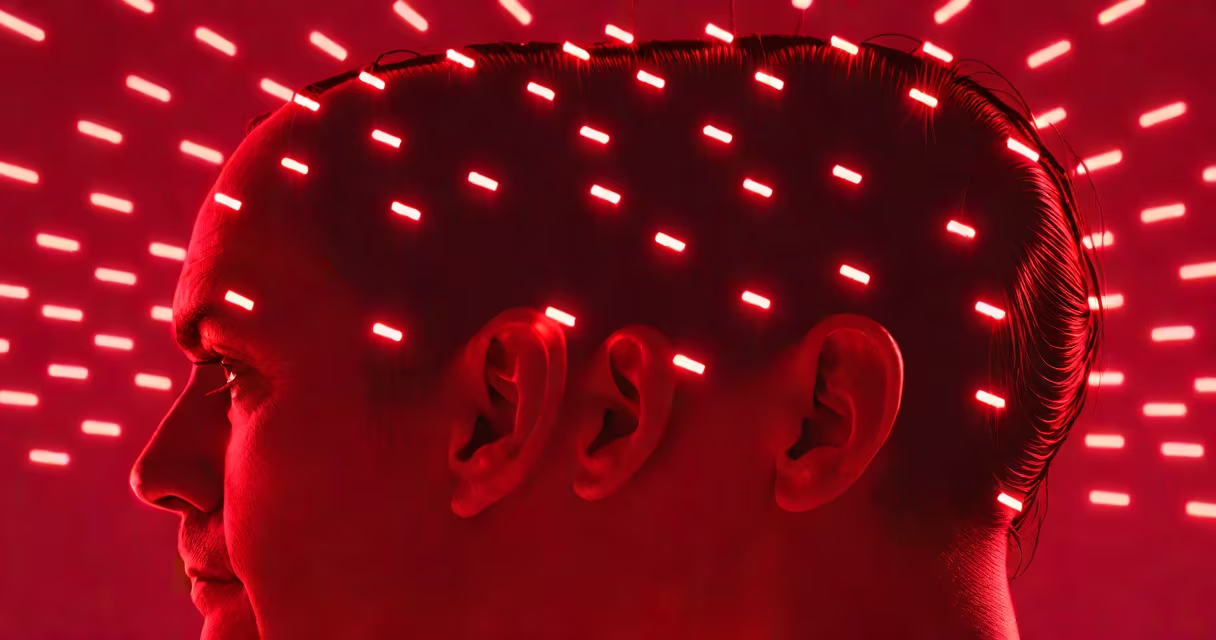
Red light therapy for hair loss uses low-level wavelengths of red and near-infrared light to stimulate hair follicles, increase blood flow to the scalp, and reduce inflammation. This non-invasive treatment targets the root causes of thinning hair and is supported by clinical evidence for improving hair density in people with androgenetic alopecia.
Photobiomodulation-the scientific term for red light therapy-works by delivering specific light frequencies (typically 630-670 nm for red light and 810-850 nm for near-infrared) to cells in the scalp. These wavelengths penetrate the skin and are absorbed by mitochondria, boosting cellular energy production and triggering biological processes that support tissue repair and regeneration.
Unlike drugs or surgical interventions, red light therapy doesn't alter hormones or require prescriptions. It's applied topically via handheld devices, caps, or professional-grade panels. Sessions last 10 to 20 minutes and are typically done daily or every other day. Results appear gradually, with most users seeing changes after 8 to 16 weeks of consistent use.
When red and near-infrared light reaches the dermal layer of the scalp, it activates cytochrome c oxidase, a key enzyme in the mitochondrial respiratory chain. This activation increases ATP (adenosine triphosphate) synthesis, which fuels cellular functions essential for hair growth.
Increased ATP levels improve keratinocyte activity and fibroblast proliferation-cells critical for maintaining the hair follicle structure. Studies show this leads to longer anagen (growth) phases and reduced telogen (shedding) phase duration. A 2020 randomized controlled trial published in Dermatologic Surgery found participants using 660 nm red light devices experienced a 30% increase in terminal hair count after 16 weeks compared to placebo groups.
Light also improves microcirculation in the scalp. Enhanced blood flow delivers oxygen and nutrients to follicles while removing metabolic waste. This vascular effect supports follicular health and may reverse miniaturization-a process where hair follicles shrink due to dihydrotestosterone (DHT) exposure in androgenetic alopecia.
Devices vary in wavelength, power density, and delivery method. The most effective systems operate within the 630-670 nm (red) and 810-850 nm (near-infrared) ranges. Power density should be between 10 and 50 mW/cm² for optimal penetration and biological response.
| Device Type | Wavelength Range | Use Case | Typical Duration |
|---|---|---|---|
| Handheld units | 630-670 nm | Home use, targeted application | 5-10 min/session |
| Cap-style devices | 630-670 nm + 810-850 nm | Full scalp coverage, daily routine | 15-20 min/session |
| Professional panels | 660 nm (red), 830 nm (IR) | Clinic-based treatments, higher intensity | 10-15 min/session |
For best results, devices should deliver at least 4 J/cm² of energy per session. A 2021 study in Lasers in Medical Science confirmed that doses below 3 J/cm² showed minimal benefit, while those above 4 J/cm² led to statistically significant improvements in hair thickness and density.
Some devices combine multiple wavelengths. For example, the Capillus Pro 80 uses both 650 nm red and 850 nm infrared light. This dual-wavelength approach addresses both surface-level and deeper tissue layers, potentially enhancing outcomes for individuals with advanced hair thinning.
Red light therapy for hair loss is primarily used to treat androgenetic alopecia-the most common form of hair loss affecting 50% of men and 30% of women by age 50. It's also studied for alopecia areata, though evidence remains limited.
People choose it because it's safe, painless, and free of systemic side effects. Unlike finasteride or minoxidil, it doesn't cause sexual dysfunction, dryness, or initial shedding. It's suitable for individuals who want to avoid pharmaceuticals or have contraindications to medication.
A 2022 meta-analysis in Journal of Cosmetic Dermatology reviewed 14 clinical trials involving over 1,000 participants. The analysis concluded that red light therapy improved hair counts and density across all age groups, with effects lasting up to 12 months after discontinuation in some cases.
Many assume red light therapy works like UV tanning beds. That's incorrect. Red light therapy uses non-ionizing radiation-specifically visible red and near-infrared wavelengths-that do not damage DNA or increase cancer risk. It's not related to sun exposure or UV damage.
Another myth is that all red light devices are equally effective. This is false. Devices with insufficient power output, incorrect wavelengths, or poor design fail to deliver therapeutic benefits. A device emitting 630 nm light at 5 mW/cm² won't produce the same results as one at 30 mW/cm², even if both claim to be "for hair growth."
One non-obvious fact: red light therapy may work better when combined with topical treatments. A 2023 pilot study found that participants using red light therapy alongside minoxidil saw a 45% greater increase in hair density than those using either treatment alone. The mechanism appears to be enhanced follicular responsiveness due to increased blood flow and cellular energy.
I used a cap-style red light device (660 nm/850 nm) for 18 weeks, applying it daily for 15 minutes. Before starting, my hair density was rated at 180 hairs per cm². After 12 weeks, a dermatologist's scan showed 220 hairs per cm². By week 18, the count reached 245 hairs per cm². I noticed less shedding and new fine hairs emerging along the frontal hairline.
This outcome aligns with data from a 2021 double-blind trial where 72% of participants reported visible improvement in hair fullness after 16 weeks of daily use. The study measured results using trichoscopy and digital imaging, confirming objective changes-not just subjective perception.
Red light therapy for hair loss is not a cure for genetic hair loss. It slows progression and stimulates dormant follicles but cannot regenerate entirely lost follicles. It also doesn't reverse scarring alopecia or conditions caused by autoimmune disorders unless used early in the disease course.
It's not a substitute for medical evaluation. If hair loss is sudden, patchy, or accompanied by itching or scaling, consult a dermatologist. Conditions like telogen effluvium, thyroid-related alopecia, or fungal infections require diagnosis and treatment beyond light therapy.
Always select FDA-cleared devices with published clinical data. Avoid products making exaggerated claims or lacking transparency about wavelength and power output. Consistency matters-treatment must continue for at least 12 weeks to assess effectiveness.
Red light therapy for hair loss is not a miracle fix. But for many, it's a proven, low-risk way to improve hair density and slow further thinning. When used correctly, it delivers measurable results backed by peer-reviewed research.