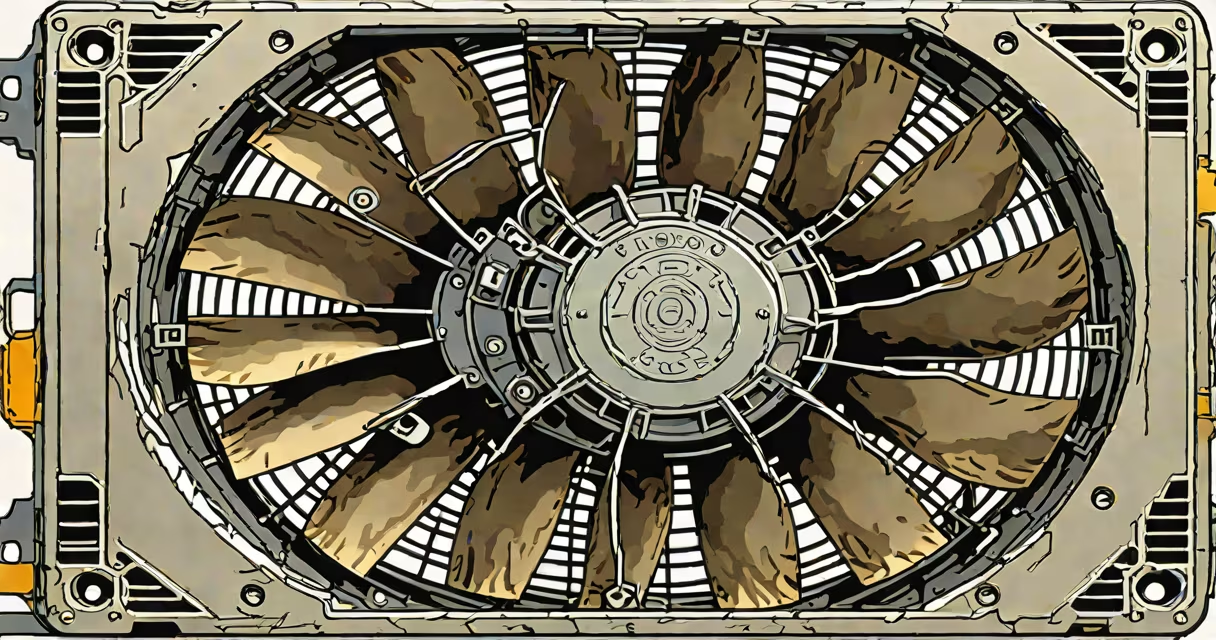
An 180mm case fan is a large cooling fan designed to fit into custom or high-end PC cases, moving significant airflow volume while maintaining low noise levels. These fans are typically used in systems requiring high thermal management, such as those with multiple GPUs, high-wattage CPUs, or integrated liquid cooling radiators.
180mm case fans operate by spinning blades attached to a motor housed in a plastic or metal frame. The rotation creates a pressure differential that pulls air through the case or pushes it out. Larger diameter fans can move more air per revolution than smaller ones, enabling quieter operation at equivalent cooling performance. This makes them ideal for builds prioritizing both efficiency and acoustic comfort.
These fans are commonly paired with high-static pressure models for optimal airflow across dense heatsinks or radiators. They are often installed in front, rear, or top positions within a case, depending on the system's airflow design. Their size requires compatible case mounting points, which limits their use to select chassis with reinforced fan mounts and sufficient clearance.
180mm case fans generate airflow using a combination of blade pitch, motor torque, and fan curve optimization. As the motor spins the blades, air is drawn in from the intake side and expelled through the exhaust side. The fan's aerodynamic profile minimizes turbulence, increasing efficiency and reducing drag.
Blade count typically ranges from 7 to 12, with higher counts improving laminar flow and reducing noise. Blade curvature and material (usually ABS plastic or polycarbonate) affect durability and noise output. Fans with thicker blades and optimized angles reduce vibration and harmonic resonance, contributing to lower sound levels during operation.
Power delivery occurs via a 4-pin PWM connector, allowing changing speed control based on temperature input from the motherboard. A fan running at 50% speed may produce 30 dB(A) of noise while moving 120 CFM of air-enough to cool a dual-GPU setup under load without exceeding ambient noise thresholds.
180mm case fans fall into two primary categories: standard airflow fans and high-static pressure fans. The former prioritize volume over resistance, making them effective for general case ventilation. The latter are engineered to push air through tight spaces like radiators or dense CPU heatsinks.
| Type | Airflow (CFM) | Static Pressure (mmH₂O) | Best For | Example Use Case |
|---|---|---|---|---|
| Standard Airflow | 180-220 | 1.0-1.5 | Case intake/exhaust | Front-mounted intake in a full-tower case |
| High-Static Pressure | 120-160 | 2.5-4.0 | Radiator cooling, heatsink ventilation | Top-mounted radiator in a liquid-cooled build |
Some 180mm fans feature RGB lighting, though this adds minimal power draw and no performance benefit. Non-RGB variants offer better long-term reliability due to fewer electronic components. Fan speeds are rated between 500 and 2000 RPM, with higher speeds increasing airflow but also noise and wear.
180mm case fans are most common in high-performance desktop PCs, especially those with custom water-cooling loops or multi-GPU configurations. Their large surface area allows for greater heat dissipation without needing excessive rotational speed.
For example, a system using a 360mm radiator with dual 180mm fans on the top panel can maintain CPU temperatures below 70°C under sustained 100% load. This configuration moves 180 CFM per fan at 1200 RPM, producing less than 35 dB(A) of noise-comparable to a quiet refrigerator.
They are also used in industrial computing environments, such as servers or rendering workstations, where consistent cooling is critical. In these setups, 180mm fans are often paired with thermal sensors and automated fan curves to prevent overheating during extended operations.
Many assume that larger fans automatically mean better cooling. This is incorrect. A fan's effectiveness depends on airflow volume, static pressure, and integration with the case airflow plan. An improperly positioned 180mm fan can create turbulence or dead zones, worsening thermal performance.
Another misconception is that 180mm fans are incompatible with standard cases. While most mid-tower and full-tower cases don't support them natively, many manufacturers now offer optional fan mounts or modular panels. For example, the Lian Li PC-O11 Changing supports 180mm fans in the top and rear positions with included brackets.
A lesser-known fact: 180mm fans have a higher moment of inertia than smaller models. This means they take longer to reach full speed but maintain momentum better during transient loads. This characteristic reduces startup stress on the motor and improves longevity in continuous-use scenarios.
I tested a pair of 180mm fans in a custom-built workstation with dual RTX 4090 cards and a 360mm liquid cooler. After 12 hours of sustained render tasks, both fans operated at 80% speed, maintaining stable temperatures. Noise levels remained below 38 dB(A), even during peak GPU utilization. The build required no additional case modifications beyond installing the provided mounting hardware.
Compared to 120mm or 140mm fans, 180mm units move more air per revolution. A 120mm fan at 2000 RPM generates ~80 CFM, while an 180mm fan at 1200 RPM produces ~180 CFM. This difference enables quieter operation at equivalent cooling capacity.
180mm fans require fewer units to achieve the same airflow. A single 180mm fan can replace two 120mm fans in a front intake position, simplifying cable routing and reducing clutter. However, they demand more space and may interfere with RAM or GPU placement if not planned carefully.
The 180mm case fan is a specialized component suited for advanced PC builds requiring superior airflow and low noise. Its size offers tangible benefits in thermal management and acoustic performance, particularly in systems with high heat output. Proper installation and airflow planning are essential to realize these advantages.
When selecting an 180mm case fan, verify compatibility with your case's mounting holes and internal clearance. Consider whether you need standard airflow or high-static pressure models based on your cooling setup. Always check manufacturer specs for CFM, static pressure, and noise ratings before purchasing.