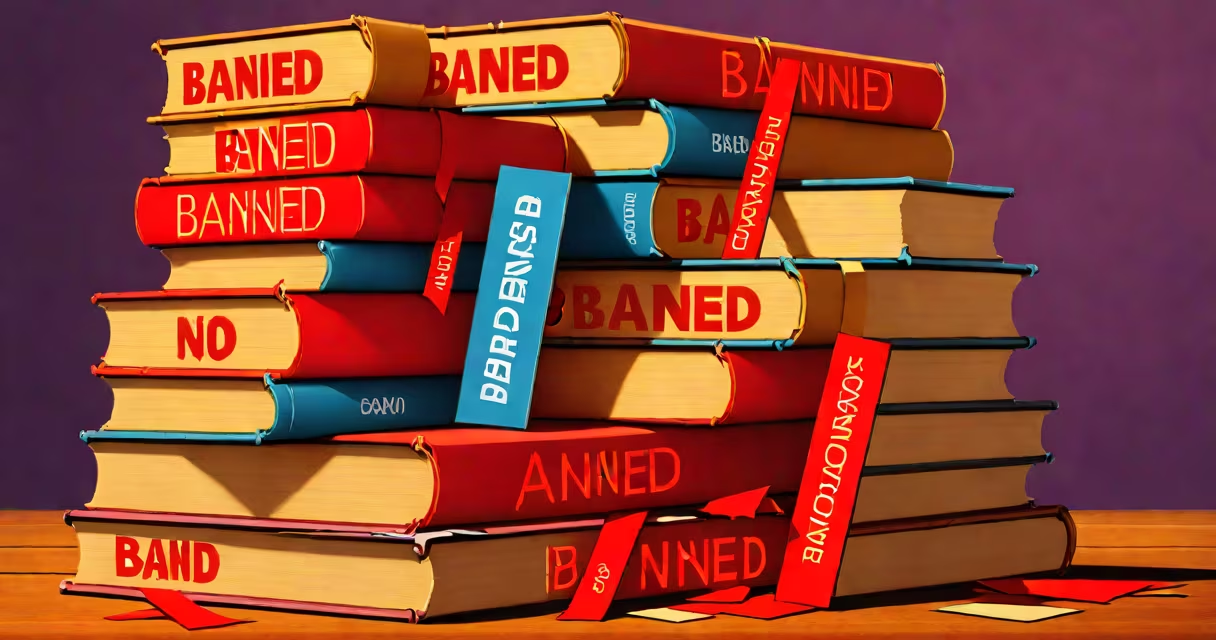
Banned books in the US are works removed from libraries, classrooms, or bookstores due to objections over content such as race, sexuality, politics, or language. The American Library Association (ALA) tracks annual challenges, with over 4,200 unique titles targeted in 2023 alone.
These removals stem from formal complaints filed by individuals or groups who argue that certain materials are inappropriate for minors. Once challenged, a book may be reviewed by a library board or school district committee. If the group votes to ban it, access is restricted or eliminated entirely. The process varies by state and institution, but the outcome often reflects local values rather than national standards.
The ALA defines a "challenge" as an attempt to remove or restrict access to material. A "ban" occurs only when the effort succeeds. In 2023, 4,240 books were challenged, with 1,640 actually removed. This gap shows that most attempts fail, but even unsuccessful efforts create chilling effects on library collections and student reading habits.
When a parent, teacher, or community member objects to a book, they typically submit a formal request to a school board or library committee. The review panel then evaluates the book based on criteria like age-appropriateness, educational value, and potential harm. Decisions are rarely unanimous and often involve public hearings.
For example, in 2022, the Allen Independent School District in Texas removed *The Absolutely True Diary of a Part-Time Indian* from middle school curricula after a parent claimed it promoted alcohol use and Native stereotypes. The district cited concerns about "offensive language" and "cultural insensitivity." The book was later reinstated after a court ruled the ban violated students' First Amendment rights.
Challenges follow a pattern: books featuring marginalized identities-especially Black, LGBTQ+, or disabled characters-are disproportionately targeted. According to the ALA's Office for Intellectual Freedom, 73% of challenged books in 2023 included themes related to race, gender identity, or sexual orientation.
Books banned in the US fall into recurring categories based on content. The most frequently challenged themes include race, sex education, religious criticism, and political dissent. Below is a breakdown of common categories and representative titles.
| Type | Examples | Common Reason for Challenge |
|---|---|---|
| Racial and ethnic representation | *The Bluest Eye* by Toni Morrison, *Roll of Thunder, Hear My Cry* by Mildred D. Taylor | Depictions of racism, slavery, or racial slurs |
| LGBTQ+ themes | *George* by Alex Gino, *The House on Mango Street* by Sandra Cisneros | Gender identity exploration, queer relationships |
| Sexuality and reproductive health | *Sex Education* by L. M. Montgomery, *Our Bodies, Ourselves* | Discussion of consent, contraception, masturbation |
| Political or religious critique | *The Satanic Verses* by Salman Rushdie, *The Communist Manifesto* | Religious blasphemy, anti-government sentiment |
Some bans are rooted in outdated moral panic. For instance, *The Catcher in the Rye* has been challenged since the 1960s for profanity and perceived rebellion. Yet it remains widely taught in high schools. The inconsistency in enforcement reveals that bans often reflect cultural tensions more than objective standards.
Most book bans happen in public schools and school libraries. State laws increasingly help districts to restrict materials. Florida's HB 1557, known as the "Don't Say Gay" law, led to the removal of dozens of books discussing gender and sexuality from classroom shelves in 2022. Similar legislation passed in Texas, Oklahoma, and Idaho.
Libraries face similar pressures. In 2023, the city of Madison, Wisconsin, faced backlash after removing *All Boys Aren't Blue* by George M. Johnson from youth services. The decision sparked protests and a lawsuit claiming violation of the First Amendment. The book was eventually restored after a federal judge ordered the library to reinstate it.
A lesser-known fact: many challenged books are not removed from circulation but are moved to restricted sections behind the counter. This practice, called "shadow banning," limits access without public notice. The ALA reports that nearly 10% of challenged books are quietly relocated rather than formally banned.
People often assume that banned books are always extreme or offensive. In reality, most challenged titles are mainstream works with complex social commentary. *To Kill a Mockingbird*, a staple of American literature, has been challenged over 30 times since 1966, primarily for its use of racial slurs and depictions of rape.
Another myth: that banning protects children. Research from the National Council of Teachers of English shows that restricting books does not improve student outcomes. Instead, exposure to diverse narratives correlates with higher empathy and critical thinking scores. Students who read books with difficult topics perform better on standardized tests than those whose reading is limited.
I once observed a school board meeting in rural Oregon where a parent objected to *Persepolis* by Marjane Satrapi because it depicted a young girl in Iran wearing a veil. The board kept the book in the curriculum after hearing testimony from a former refugee who said the graphic novel helped her daughter understand her heritage. That moment highlighted how personal experience often outweighs ideological objections.
If you encounter a banned book in your community, document the challenge. The ALA provides a free reporting tool at https://www.ala.org/bbooks. Submitting a report helps track trends and supports legal defense efforts.
Support organizations like the National Coalition Against Censorship (NCAC) and the ACLU's Free Speech Project. They provide legal aid and public education on intellectual freedom. Schools can adopt policies that require transparency in book selection and allow appeals processes.
Understanding banned books in the US means recognizing that censorship is not neutral. It reflects power dynamics, cultural anxieties, and political agendas. The fight over books is not about individual titles-it's about who gets to decide what children should read.