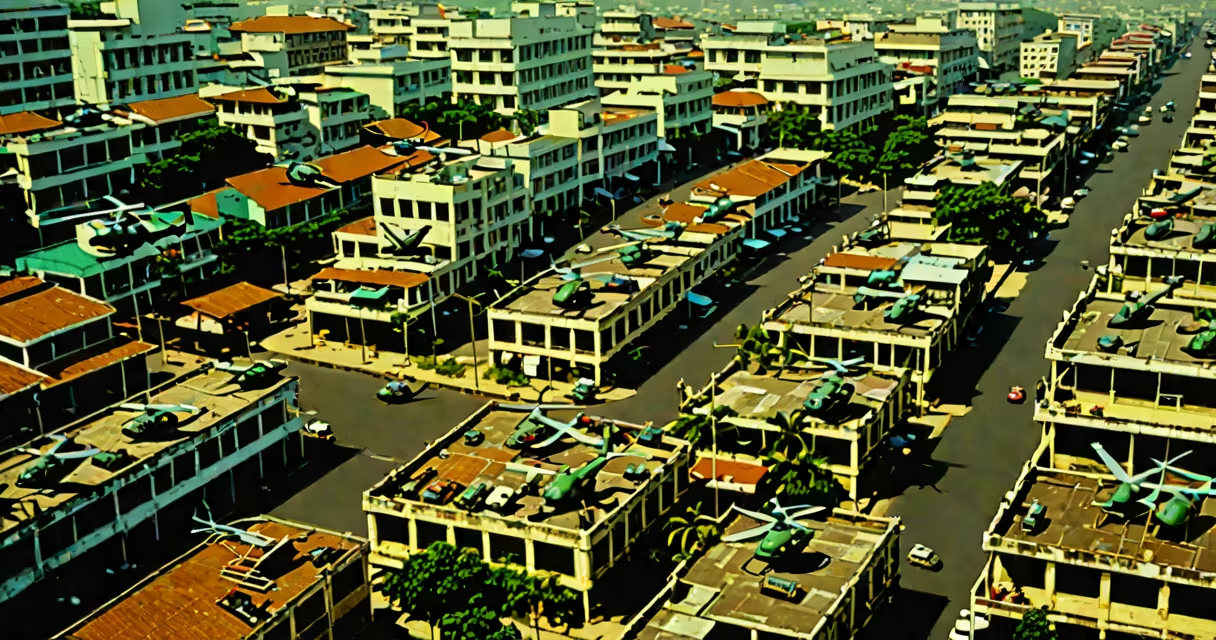
The end of Vietnam War occurred on April 30, 1975, when North Vietnamese troops captured Saigon, the capital of South Vietnam, marking the collapse of the Republic of Vietnam and the unification of the country under communist control.
North Vietnam launched a final offensive in March 1975, rapidly advancing through South Vietnamese territory. By April, major cities like Da Nang and Hue had fallen. The South Vietnamese military, weakened by years of conflict and lacking consistent U.S. support after American troop withdrawal in 1973, disintegrated under pressure. On April 29, U.S. forces executed Operation Frequent Wind-a helicopter evacuation of American personnel and at-risk South Vietnamese allies-from the rooftop of the U.S. Embassy in Saigon. Over 7,000 people were airlifted out in less than 24 hours.
At 10:45 a.m. on April 30, a North Vietnamese tank crashed through the gates of the Presidential Palace in Saigon. The South Vietnamese president, Dương Văn Minh, surrendered without resistance. The flag of the Republic of Vietnam was replaced by the red flag with a yellow star of North Vietnam. The event ended nearly two decades of war, including direct U.S. military involvement from 1965 to 1973.
North Vietnam had declared victory on April 30, but the formal reunification of the country did not occur until July 2, 1976, when the Socialist Republic of Vietnam was officially established. The capital was moved from Saigon to Hanoi, though the city retained its name for public recognition.
The end of Vietnam War was not a negotiated peace but a military conquest. The Paris Peace Accords of January 1973 had called for a ceasefire and the withdrawal of U.S. troops, but neither side honored the agreement long-term. North Vietnam resumed offensive operations in 1974, exploiting the weakening of South Vietnam's government and military after U.S. aid cuts.
| Event | Date | Significance |
|---|---|---|
| U.S. troop withdrawal | March 1973 | Ended direct American combat role; South Vietnam lost key military support |
| North Vietnamese offensive begins | March 1975 | Triggered rapid collapse of South Vietnamese defenses |
| Evacuation of U.S. personnel from Saigon | April 29-30, 1975 | Operation Frequent Wind; over 7,000 evacuated via helicopters |
| North Vietnamese capture of Saigon | April 30, 1975 | Symbolic end of the war; surrender of South Vietnamese leadership |
| Formal reunification of Vietnam | July 2, 1976 | Establishment of the Socialist Republic of Vietnam |
Many assume the end of Vietnam War meant a stable transition. It did not. The aftermath included mass re-education camps, forced labor, and the exodus of over 1 million refugees-known as the "boat people"-who fled by sea. Between 1975 and 1995, more than 1.2 million Vietnamese left the country, seeking asylum in the U.S., Canada, Australia, and Europe.
A common misunderstanding is that the U.S. lost the war due to military failure. The reality is more complex. The U.S. never formally declared war on North Vietnam. Its involvement was framed as supporting a sovereign ally against external aggression. After the 1973 Paris Accords, the U.S. Congress cut funding for South Vietnam, removing the economic and logistical foundation needed to sustain the military. North Vietnam exploited this gap, not because it was militarily superior, but because it had greater strategic patience and domestic cohesion.
One non-obvious fact: The last U.S. military personnel left Saigon on April 29, 1975-before the city fell. The evacuation was completed in under 12 hours. The final helicopter lifted off at 7:53 a.m. local time. A U.S. Marine officer later recalled watching the scene from the embassy roof: "There was no panic. Just quiet coordination. We weren't fleeing-we were executing a plan." This moment became iconic in American memory, symbolizing both the limits of foreign intervention and the abruptness of withdrawal.
Another misconception is that the war ended cleanly with the fall of Saigon. In truth, fighting continued in remote areas for years. The People's Army of Vietnam (PAVN) faced resistance from remnants of the South Vietnamese military and anti-communist militias in the Central Highlands and Mekong Delta. The last official battle occurred in 1976 near the Cambodian border, where a group of former ARVN soldiers held out for months before surrendering.
Historical records confirm that North Vietnam's strategy relied on attrition and political mobilization, not battlefield dominance. According to the U.S. Department of State's Foreign Relations of the United States series, North Vietnam's leadership believed that prolonged conflict would erode South Vietnam's legitimacy and U.S. resolve. They were correct. The U.S. public turned against the war after the Tet Offensive in 1968. Congressional opposition grew. When President Nixon withdrew troops in 1973, he did so under pressure from a divided electorate.
For context, the war cost approximately 1.1 million Vietnamese lives, including 58,000 U.S. military deaths. Civilian casualties exceeded 2 million. The environmental toll was severe-over 19 million gallons of defoliants like Agent Orange were sprayed, causing long-term health effects and birth defects across generations.
Understanding the end of Vietnam War requires looking beyond headlines. It was not a single event but a culmination of geopolitical miscalculation, domestic fatigue, and asymmetric warfare. The fall of Saigon was not a defeat-it was a consequence of choices made over ten years, by leaders in Washington, Hanoi, and Saigon alike.