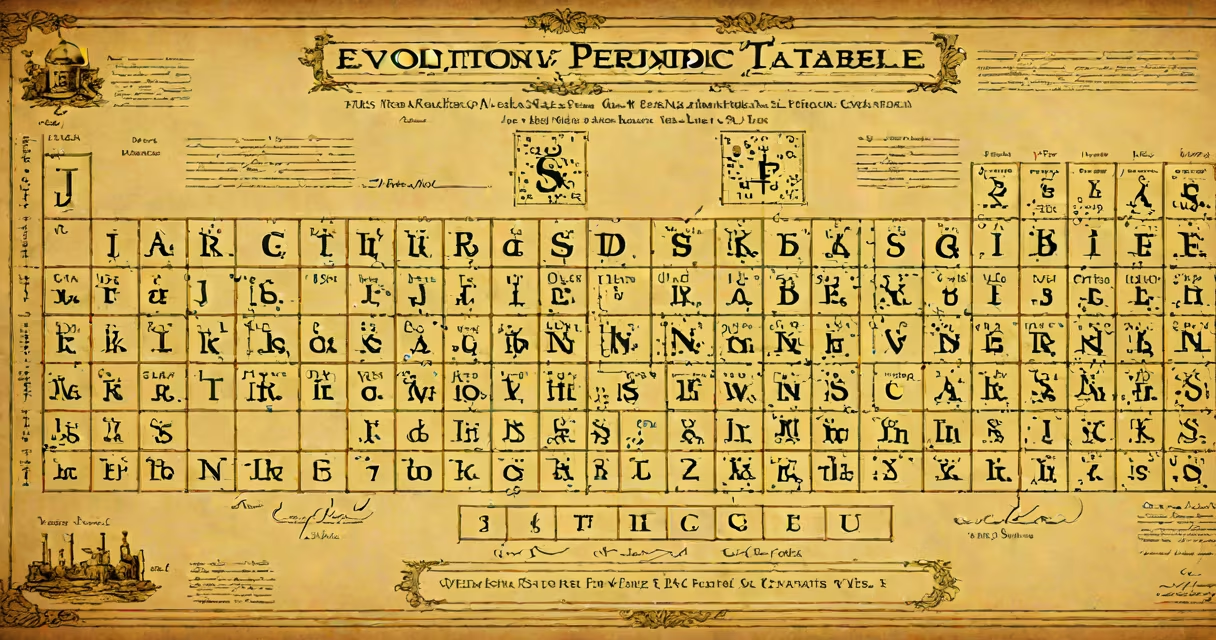
The evolution of periodic table describes how scientists transformed early elemental groupings into a structured, predictive structure based on atomic number and recurring chemical behavior. This progression began with early patterns in element properties and culminated in the modern table that organizes 118 confirmed elements.
Early chemists noticed that certain elements shared similar traits-like metals reacting with acids or halogens forming salts. By the 1860s, dozens of elements had been isolated, but their relationships remained unclear. Scientists tried organizing them by atomic weight, but inconsistencies emerged. The breakthrough came when Russian chemist Dmitri Mendeleev arranged elements by increasing atomic weight and grouped those with similar properties into vertical columns. He left gaps for elements not yet discovered, predicting their existence and even estimating their properties.
Mendeleev's 1869 version correctly forecasted gallium (eka-gallium), germanium (eka-silicon), and scandium (eka-boron) with notable accuracy. When these elements were later found, their measured properties matched his predictions closely. This validated the periodic law-the idea that elemental properties recur periodically when elements are ordered by atomic number. Today's periodic table reflects this principle, with elements arranged by atomic number rather than atomic weight, correcting earlier misplacements like tellurium and iodine.
The modern periodic table is not a single invention but a series of refinements. Mendeleev's original table placed elements by atomic weight and left gaps for missing ones. Later, Henry Moseley's work in 1913 showed that atomic number-not atomic weight-determined an element's position. This resolved anomalies such as argon (atomic number 18) appearing before potassium (19), despite argon being heavier.
As more elements were synthesized, the table expanded. The discovery of noble gases (helium, neon, argon) in the late 1800s led to a new group-Group 18-filling a gap in the periodic pattern. The actinide series was identified in the 1940s, leading to the placement of elements 89-103 below the main table. These additions reflect how the table adapts to new scientific understanding.
Elements beyond uranium (atomic number 92) are synthetic. They don't occur naturally and are created in particle accelerators. Elements 113 (nihonium), 115 (moscovium), 117 (tennessine), and 118 (oganesson) were confirmed between 2010 and 2016. Their inclusion required international validation through naming proposals submitted to the International Union of Pure and Applied Chemistry (IUPAC).
The following table outlines major milestones in the development of the periodic table:
| Year | Event | Scientist/Group | Impact |
|---|---|---|---|
| 1869 | First periodic table published | Dmitri Mendeleev | Introduced gaps for undiscovered elements; predicted properties |
| 1913 | Atomic number defined as element position | Henry Moseley | Replaced atomic weight with atomic number; fixed ordering errors |
| 1894-1900 | Noble gases discovered | William Ramsay et al. | Added Group 18; completed periodic pattern |
| 1940s | Actinides identified | Glenn T. Seaborg | Reorganized f-block; introduced concept of transuranic elements |
| 2016 | Four new elements confirmed | IUPAC | Finalized 7th period; added nihonium, moscovium, tennessine, oganesson |
A common misconception is that Mendeleev's table was perfect from the start. It wasn't. He incorrectly assigned some elements to groups based on incomplete data. For example, he placed manganese in Group 7, which aligned with its oxidation states-but later analysis showed it belonged in Group 7 due to electron configuration, not just reactivity. The modern table uses quantum mechanics to explain why elements behave as they do, not just observed patterns.
The periodic table is more than a reference tool-it's a predictive model. When scientists discovered element 118, oganesson, they used the table to anticipate its behavior. As a member of Group 18, it should be inert like xenon. But calculations suggest it may be reactive due to relativistic effects on its electrons. This prediction, made using periodic trends, was later supported by simulations.
Another non-obvious fact: the table's layout is not fixed. Alternative versions exist-such as the spiral form proposed by Alfred Werner or the 3D periodic table developed by researchers at the University of Nottingham. These aim to better visualize relationships between elements, especially for transition metals and lanthanides. However, the standard 18-column format remains dominant because it balances clarity, space, and usability in education and research.
During my time teaching high school chemistry, I used a physical periodic table with removable element cards. Students often asked why some elements were colored differently. I explained that the color coding represents categories: metals (blue), metalloids (green), nonmetals (red), and noble gases (purple). This visual cue helped students grasp classification quickly-something the original table lacked.
People often think the periodic table is complete. It is not. While all 118 elements have been officially recognized, the stability of elements beyond uranium decreases rapidly. Element 119 and beyond remain theoretical. The "island of stability" hypothesis suggests that some superheavy elements near atomic number 114 may have longer half-lives due to closed nuclear shells. If confirmed, this could lead to another expansion of the table.
Some confuse the periodic table with the periodic law. The law states that properties of elements recur periodically when arranged by atomic number. The table is the visual representation of that law. Confusing the two leads to misunderstandings about how predictions are made. For example, knowing that lithium (Li) reacts vigorously with water doesn't mean sodium (Na) will behave identically-though it does, because both are alkali metals in Group 1.
Another error: assuming all elements follow the same trend within a group. While reactivity increases down Group 1 (alkali metals), it decreases down Group 17 (halogens). Fluorine is the most reactive halogen, despite being lightest. This reversal occurs because fluorine's small size concentrates electron density, making it highly electronegative. The periodic table shows these exceptions, reinforcing its role as a guide to chemical behavior.
Understanding the evolution of periodic table helps clarify how science builds knowledge incrementally. It's not a static artifact but a living document shaped by observation, theory, and experimentation. The table continues to evolve as new elements are synthesized and our understanding of atomic structure deepens.