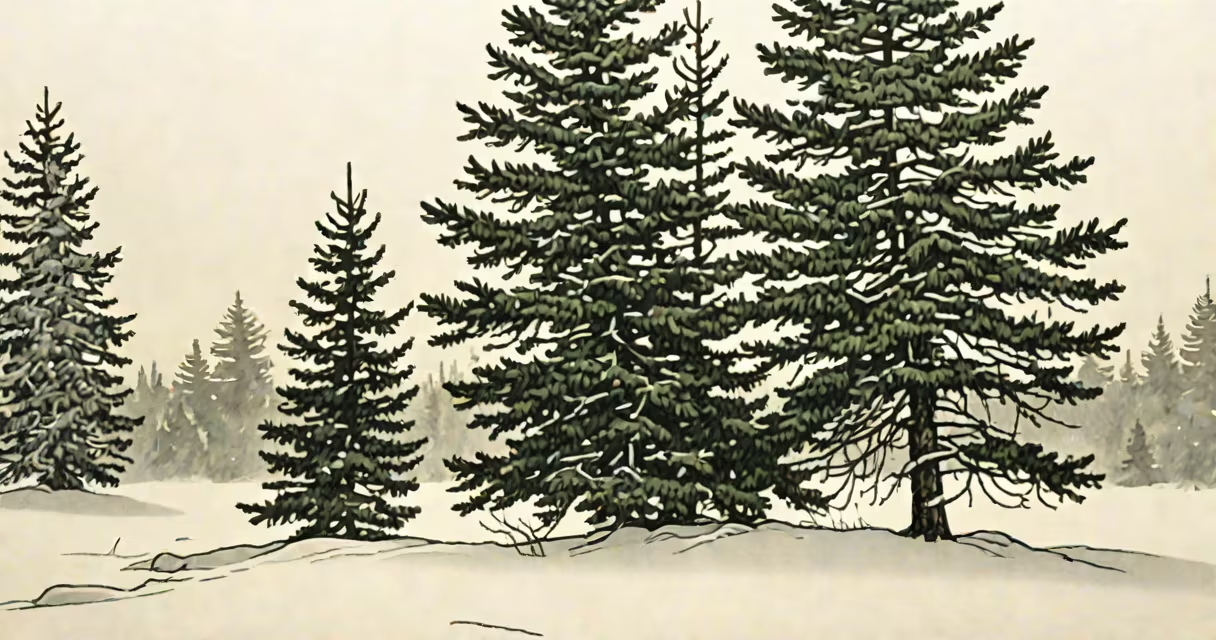
The black spruce tree (Picea mariana) is a small to medium-sized evergreen conifer native to the boreal forests of Canada and the northern United States. It thrives in cold climates, often growing in wet, poorly drained soils such as bogs and muskeg. Its dark green needles and narrow, conical crown make it a distinctive feature of northern landscapes.
Found across Alaska, western Canada, and the northeastern U.S., the black spruce is adapted to harsh conditions. It grows slowly, reaching heights of 10 to 15 meters (33 to 50 feet), with a trunk diameter rarely exceeding 30 centimeters (12 inches). Its bark is thin and scaly, ranging from gray to reddish-brown, and becomes deeply fissured with age.
Black spruce reproduces via winged seeds released from small, upright cones that mature in one year. These cones remain closed for years, only opening after exposure to heat-such as during wildfires-ensuring regeneration in disturbed areas. The species is highly resilient, surviving in nutrient-poor soils and enduring long winters with minimal sunlight.
Black spruce plays a foundational role in boreal and subarctic ecosystems. Its dense canopy provides shelter for birds and small mammals, while its roots stabilize peat-rich soils. The tree supports a network of fungi through ectomycorrhizal associations, which improve nutrient uptake in low-fertility environments.
When wildfires occur, black spruce stands often regenerate quickly. Its serotinous cones-those that stay closed until heated-release seeds only after fire, giving the species a competitive edge in post-fire recovery. This adaptation is critical in maintaining forest succession patterns across northern Canada and Alaska.
A study by the Canadian Forest Service found that black spruce dominates over 60% of the boreal forest biome in central Canada. In these regions, it forms nearly pure stands, especially in areas with shallow, acidic soils and high water tables.
While Picea mariana is the accepted scientific name, regional variants exist based on geography and soil conditions. These include:
| Variant | Region | Distinct Features |
|---|---|---|
| Typica | Eastern Canada, New England | Darker needles, shorter internodes, grows in wetlands |
| Alaskana | Alaska, western Yukon | Slenderer growth habit, longer needles (1.5-2 cm) |
| Subnigra | High-elevation sites in northern Rockies | Compact form, deeper green color, slower growth |
These variants are not formally classified as separate species but are recognized in field guides and ecological surveys. The differences are subtle but affect planting success in reforestation projects.
Black spruce is widely harvested for timber, pulpwood, and paper production. Its wood is soft, light, and straight-grained, making it ideal for construction materials and industrial uses. In Canada, it accounts for about 15% of annual softwood harvest volume, according to Natural Resources Canada.
It is also a popular choice for Christmas trees. Its compact size, dense branching, and ability to retain needles for weeks after cutting make it well-suited for indoor decoration. In the U.S., black spruce is among the top five species used for cut Christmas trees, particularly in the Northeast and Midwest.
A 2021 survey by the National Christmas Tree Association reported that 12% of U.S. Christmas trees sold were black spruce, with higher demand in states like Maine, Vermont, and Michigan. Growers favor it because it can be cultivated in containers and transplanted with minimal root disturbance.
Many people confuse black spruce with other spruces, especially the Norway spruce (Picea abies), which is commonly used in Europe. Despite the name, black spruce is not always black-its bark is dark gray or brown, and its needles are a uniform dark green, not glossy or bluish like some other spruce species.
Another misconception is that black spruce is rare or endangered. On the contrary, it is abundant across its range. The International Union for Conservation of Nature (IUCN) lists it as a species of "Least Concern" due to its wide distribution and stable population. However, climate change is altering its habitat, pushing it northward and reducing its presence in southern boreal zones.
A lesser-known fact: black spruce produces a resin that was historically used by Indigenous peoples in Canada for medicinal and sealing purposes. The Cree and Ojibwe tribes collected the sap from wounded trees to treat skin irritations and wounds. This traditional use is documented in ethnobotanical records from the 19th century.
In 2022, a family-owned farm in Unity, Maine, planted 15,000 black spruce seedlings on 20 acres of former farmland. The goal was to grow Christmas trees for local sale within six years. The site had poor drainage and acidic soil-conditions ideal for black spruce.
By year four, the trees averaged 1.2 meters (4 feet) tall with consistent taper and dense branching. The farm reported that 92% of harvested trees retained their needles past December 25, outperforming white pine and Fraser fir in needle retention tests conducted by the University of Maine Cooperative Extension.
"We chose black spruce because it's hardy, low-maintenance, and fits our climate," said the farm manager. "Customers love the scent-it's sharp and clean, not too sweet."