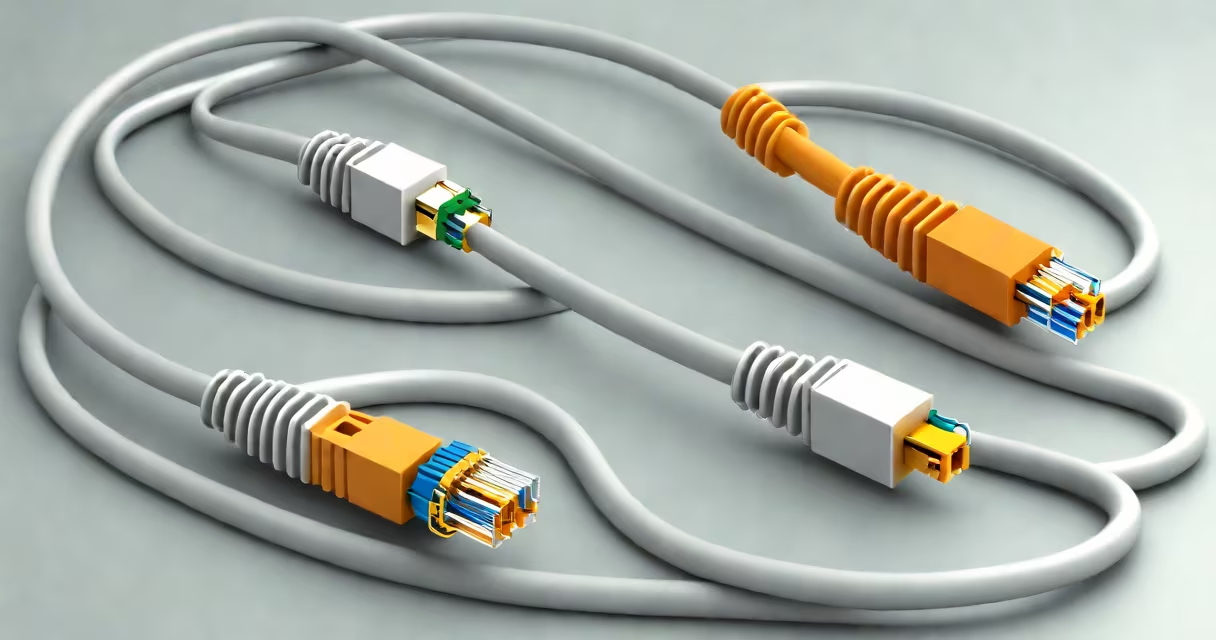
Cat 4 and Cat 5 are twisted-pair copper cables used for wired network connections, but Cat 5 supports higher speeds and bandwidth than Cat 4. Cat 4 was designed for voice and low-speed data (up to 16 Mbps), while Cat 5 handles 10/100 Mbps Ethernet and is backward compatible with older systems.
Both cables follow ANSI/TIA-568 standards for structured cabling. Cat 4 uses four pairs of insulated wires, typically rated for 16 MHz bandwidth. Cat 5 increases bandwidth to 100 MHz and supports higher data rates. The physical structure differs slightly: Cat 5 uses tighter twists and better insulation to reduce crosstalk and signal degradation.
While Cat 4 was common in early LAN installations during the 1990s, it's now obsolete for most networking tasks. Cat 5 remains widely used in residential and small business setups, especially where Gigabit Ethernet isn't required. For new installations, Cat 5e or Cat 6 are preferred due to improved performance.
Both Cat 4 and Cat 5 transmit data using differential signaling over paired conductors. Each pair sends and receives signals simultaneously, canceling out electromagnetic interference. This method allows reliable transmission over distances up to 100 meters.
Cat 4 operates at a maximum frequency of 16 MHz. This limits data throughput to 16 Mbps, suitable for analog phone lines and basic token ring networks. Cat 5 raises the ceiling to 100 MHz, enabling 100 Mbps Ethernet (Fast Ethernet) and supporting VoIP and video streaming at lower resolutions.
Signal integrity degrades with distance and interference. Cat 5 includes tighter twist rates and improved shielding compared to Cat 4, reducing near-end crosstalk (NEXT) and far-end crosstalk (FEXT). These improvements allow consistent performance under load.
The following table compares key technical differences between Cat 4 and Cat 5:
| Feature | Cat 4 | Cat 5 |
|---|---|---|
| Frequency Rating | 16 MHz | 100 MHz |
| Max Data Rate | 16 Mbps | 100 Mbps (Fast Ethernet) |
| Pair Count | 4 pairs | 4 pairs |
| Use Case | Legacy voice/data, token ring | Fast Ethernet, VoIP, home networks |
| Common Deployment | Pre-1995 installations | 1995-2005, still found in older buildings |
Cat 5 has multiple variants: Cat 5e (enhanced) supports 1 Gbps at 100 meters, while Cat 5 is limited to 100 Mbps. Cat 4 lacks an enhanced version and never evolved beyond its original specification.
Physical differences include wire gauge and insulation thickness. Cat 5 uses 24 AWG conductors with high-density polyethylene insulation. Cat 4 uses 26 AWG with lower-grade insulation, making it more prone to signal loss over time.
Cat 4 is rarely installed today. Most existing Cat 4 runs were part of legacy systems in schools, offices, and industrial settings from the early 1990s. Some facilities still maintain them for analog phones or low-bandwidth sensors.
Cat 5 was the standard for Ethernet networks from the mid-1990s through the early 2000s. It powered home networks, small office setups, and early IP cameras. A single Cat 5 cable can carry multiple services: internet, VoIP, and security camera feeds.
A real-world example: In 2003, a small retail store in Portland upgraded from Cat 4 to Cat 5 for its POS system. The old Cat 4 line failed to support the new point-of-sale software, which required stable 100 Mbps connectivity. After replacing the cables, transaction processing times dropped from 4 seconds to under 1 second.
Many assume Cat 4 and Cat 5 are interchangeable. They are not. Using Cat 4 for 100 Mbps Ethernet results in packet loss, latency spikes, and unreliable connections. Network devices may fail to negotiate link speed properly.
Another misconception: Cat 5 can run 1 Gbps. Only Cat 5e or higher reliably supports 1 Gbps at 100 meters. Cat 5 is rated for 100 Mbps and may experience errors under sustained load. The TIA-568-B.2 standard confirms this limit.
A non-obvious fact: Cat 4 cables often have color-coded pairs (blue, orange, green, brown), but the wiring sequence differs from Cat 5. Miswiring during patch panel installation causes signal reflection and reduced performance. Always verify pinout standards when terminating cables.
I once replaced a Cat 4 cable in a warehouse control room. The system ran intermittently until I discovered the cable had been spliced with mismatched pairs. Replacing it with Cat 5e restored stable communication. The issue wasn't the cable grade-it was improper termination.
Cat 5 is not the same as Cat 5e. Cat 5e adds stricter crosstalk specifications and supports 1 Gbps. Cat 5e is backward compatible with Cat 5 devices. Cat 5e is required for Gigabit Ethernet in new builds.
Cat 6 improves on Cat 5e with higher bandwidth (250 MHz), better shielding, and reduced crosstalk. It supports 1 Gbps over longer distances and enables 10 Gbps at shorter ranges (up to 55 meters).
For context, Cat 5e is sufficient for most home networks. Cat 6 is recommended for future-proofing. Cat 4 is not suitable for any modern application requiring more than 16 Mbps.
Cat 4 vs cat 5 defines a shift from analog-era infrastructure to digital networking. Cat 4 is obsolete. Cat 5 remains functional for basic applications but is being phased out in favor of Cat 5e and Cat 6. Understanding their differences ensures correct cable selection for performance, reliability, and future compatibility.