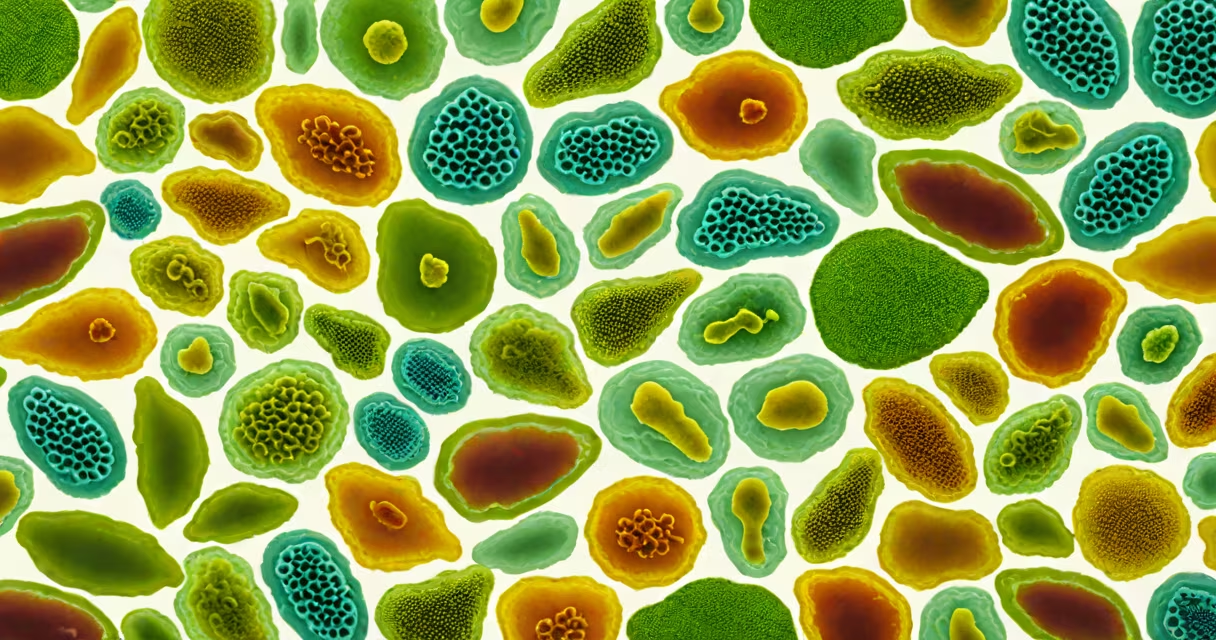
Protists are a group of eukaryotic organisms that do not belong to the plant, animal, or fungal kingdoms. They include algae, protozoa, and slime molds, and are defined by shared cellular complexity rather than evolutionary lineage. This category spans single-celled and simple multicellular forms, many of which play critical roles in aquatic food webs.
Protists are eukaryotes, meaning their cells contain membrane-bound organelles such as nuclei, mitochondria, and Golgi bodies. Unlike bacteria, which are prokaryotes, protists have complex internal structures. Most protists live in moist environments-freshwater, marine habitats, soil, or inside other organisms. Their size ranges from microscopic (1-100 micrometers) to visible to the naked eye in rare cases, such as the giant alga *Caulerpa*.
Despite their diversity, protists share several defining features. They are typically unicellular, though some form colonies or simple multicellular structures. They reproduce both sexually and asexually, often using mechanisms like binary fission, conjugation, or spore formation. Many protists move using flagella, cilia, or pseudopodia, enabling them to seek nutrients or avoid predators.
Protists exhibit many metabolic strategies. Photosynthetic protists, like diatoms and green algae, produce energy through photosynthesis and contribute to global oxygen production-about 20% of Earth's oxygen comes from marine phytoplankton, a major group of protists. Heterotrophic protists, such as *Amoeba* and *Paramecium*, consume organic material either by engulfing prey (phagocytosis) or absorbing dissolved nutrients.
Some protists are mixotrophs-capable of both photosynthesis and consuming food. The dinoflagellate *Peridinium* can switch between modes depending on light availability. This flexibility allows them to thrive in variable environments. Others, like *Plasmodium falciparum*, the parasite responsible for malaria, are obligate parasites that rely entirely on host cells for survival.
Unlike plants, protists lack specialized tissues or organs. They do not have roots, stems, leaves, or vascular systems. Animals, while also multicellular and motile, do not share the same reproductive cycles or feeding mechanisms. Fungi, though eukaryotic, differ in cell wall composition (chitin vs. cellulose in many protists) and nutrient absorption methods.
Protists are grouped based on their nutritional mode, locomotion, and cellular structure. The main categories include:
| Type | Movement | Nutrition | Examples |
|---|---|---|---|
| Protozoa | Flagella, cilia, pseudopodia | Heterotrophic | *Amoeba*, *Paramecium*, *Trypanosoma* |
| Algae | Flagella or none | Photosynthetic | Diatoms, *Chlamydomonas*, *Volvox* |
| Slime Molds | Pseudopodia | Decomposers or predatory | *Dictyostelium discoideum* |
Each group reflects different adaptations. For example, *Amoeba proteus* uses pseudopodia to extend its cell membrane and engulf food particles-a process called phagocytosis. In contrast, *Euglena gracilis* combines plant-like photosynthesis with animal-like motility via a single flagellum. Its ability to switch between autotrophy and heterotrophy makes it a model organism in studies of metabolic plasticity.
A lesser-known fact: some protists form symbiotic relationships. The protist *Zoothamnium* lives on the surface of certain marine worms, providing protection in exchange for nutrients. These interactions show the ecological importance of protists beyond basic food web roles.
Many assume protists are primitive or outdated life forms. This is incorrect. Protists represent some of the earliest eukaryotic lineages, with fossil evidence dating back over 1.6 billion years. Their genetic diversity rivals that of animals and plants combined. For example, the genome of *Giardia lamblia*, a parasitic protist, contains genes associated with complex signaling pathways previously thought to exist only in higher eukaryotes.
Another misconception is that all protists are harmful. Only a small fraction cause disease. Of the estimated 100,000 protist species, fewer than 100 are known human pathogens. Most protists are beneficial-supporting ecosystems, forming the base of aquatic food chains, and contributing to carbon cycling.
Some confuse protists with bacteria due to their small size. But protists are eukaryotic; bacteria are prokaryotic. A key difference lies in DNA organization: protists have linear chromosomes enclosed in a nucleus, while bacterial DNA floats freely in the cytoplasm. This distinction affects how they replicate and respond to antibiotics.
In 2018, during a field study in Lake Tahoe, researchers documented a sudden bloom of *Prymnesium parvum*, a toxic golden alga. The population surged after a temperature rise and increased nutrient runoff. Within days, fish kills occurred, and water quality declined. This event underscored how protist blooms can rapidly alter ecosystems and impact human activities like fishing and recreation.
I observed similar dynamics firsthand while collecting samples from a local pond. Using a compound microscope, I identified *Cyclidium* species-flagellated protists with spiral-shaped cilia. Their rapid movement and high density indicated a healthy, nutrient-rich environment. This hands-on experience reinforced that protists are not just lab curiosities-they're important indicators of environmental health.
Understanding the characteristics of protists matters for ecology, medicine, and biotechnology. Algal protists are used in biofuel research due to their high lipid content. Some protist-derived compounds show promise in cancer treatment. The *Toxoplasma gondii* parasite, a protist, has helped scientists map neural pathways in the brain.