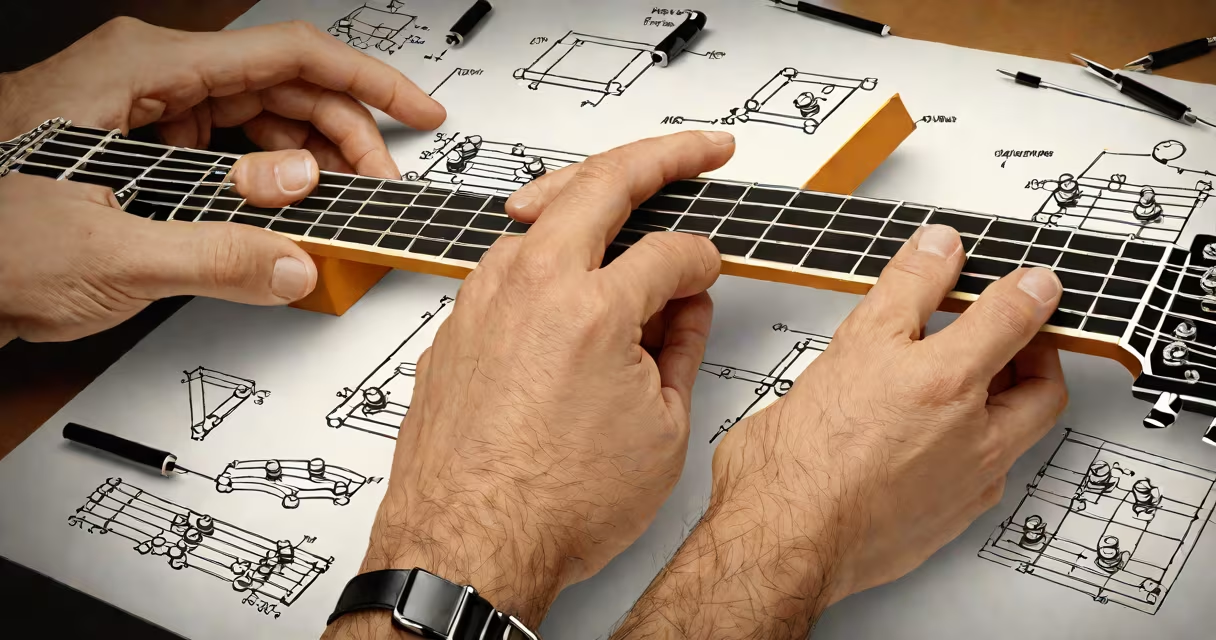
Chords on guitar are groups of two or more notes played together to form harmonic sounds, typically using fingers to press multiple strings at specific frets. They form the foundation of most popular music, enabling players to accompany melodies or play entire songs.
A single chord is created by pressing down one or more strings at designated frets with the fingers of the left hand (for right-handed players), while the right hand plucks or strums the strings. The combination of pitch, timing, and string selection determines the chord's tonal quality. For example, pressing the first fret on the low E string, second fret on the A string, and third fret on the D string produces a G major chord.
Understanding chords on guitar begins with recognizing that each chord represents a specific interval structure within a key. Major chords follow a root-major third-perfect fifth pattern (e.g., C-E-G), while minor chords use a root-minor third-perfect fifth (e.g., C-Eb-G). These intervals define whether a chord sounds happy (major) or sad (minor).
When a guitarist presses a string against a fret, the string vibrates at a frequency determined by its length and tension. The shorter the vibrating portion (i.e., the higher the fret), the higher the pitch. Pressing multiple strings at different frets creates a stack of pitches that form a chord.
For example, the open-position C major chord uses the following finger placements: index finger on the B string at the first fret, middle finger on the D string at the second fret, ring finger on the A string at the third fret. The low E, high E, and G strings are played open. Strumming all six strings produces a full C major chord.
Proper finger placement avoids muting adjacent strings. A common mistake is letting the fingertip touch more than one string, which causes buzzing or dead notes. Using the tips of the fingers and keeping them perpendicular to the fretboard reduces this issue. According to the Guitar Lessons website, consistent finger positioning improves intonation and reduces fatigue during long practice sessions.
Guitarists use several chord families, each serving a distinct musical function. The most common are major, minor, seventh, suspended, and power chords.
| Type | Formula | Sound | Common Use |
|---|---|---|---|
| Major | Root-Major 3rd-Perfect 5th | Cheerful, stable | Pop, rock, folk |
| Minor | Root-Minor 3rd-Perfect 5th | Somber, introspective | Ballads, blues, jazz |
| Seventh | Root-Major 3rd-Perfect 5th-Minor 7th | Bluesy, jazzy | Blues progressions, jazz standards |
| Suspended (sus) | Root-Perfect 4th-Perfect 5th (sus4) or Root-Major 2nd-Perfect 5th (sus2) | Tension, unresolved | Builds anticipation; often resolves to major or minor |
| Power chord | Root-Perfect 5th | Raw, driving | Rock, punk, metal |
One non-obvious detail: suspended chords do not contain a third, which removes the major/minor quality. This creates ambiguity-listeners perceive tension because the ear expects resolution. For example, a Csus4 (C-F-G) feels incomplete until it resolves to C major (C-E-G). This technique is widely used in songwriting to build emotional momentum.
Another misconception is that all chords require all six strings. Many essential chords, like G major and D major, are playable with only four or five strings. The open G chord uses the low E, A, D, and G strings, omitting the B and high E. This simplifies transitions between chords and reduces finger strain.
Chords on guitar underpin nearly every genre of music. In pop, a standard progression like I-V-vi-IV (e.g., C-G-Am-F) appears in hundreds of hit songs. In blues, dominant seventh chords dominate the 12-bar form. In country, barre chords allow quick movement across the neck for rhythmic backing.
Consider the song "Wonderwall" by Oasis. Its entire chord progression uses just four chords: C, G, Am, and F. The G major chord is formed by barring the first fret with the index finger and placing the ring finger on the third fret of the B string. This allows smooth switching between chords during live performance.
Chords on guitar are also important for improvisation and composition. Learning common chord shapes enables players to transpose songs into different keys, adapt to vocal ranges, or experiment with alternate tunings. For instance, tuning to DADGAD allows for drone-like textures and modal playing, expanding harmonic possibilities beyond standard tuning.
Beginners often struggle with finger independence. Pressing one string too hard can cause adjacent strings to buzz. The solution lies in finger angle: place fingertips directly above the fret, not behind it. Using the pad of the fingertip ensures full contact without unnecessary pressure.
Another frequent error is incorrect hand position. The wrist should remain relaxed and slightly curved, not bent backward or flat. A tense wrist leads to fatigue and limits dexterity. How to hold a guitar emphasizes maintaining a neutral posture to support sustained playing.
I once spent weeks trying to play a clean D major chord. My fingers kept muting the high E string. After adjusting my finger angle and lifting my wrist slightly, the chord rang out. That small adjustment made the difference between frustration and progress.
People sometimes confuse chords on guitar with scales or arpeggios. Scales are sequences of individual notes arranged by interval, such as the C major scale (C-D-E-F-G-A-B). Arpeggios are broken chords-notes played one after another instead of simultaneously. While related, they serve different purposes: scales for melodic lines, arpeggios for soloing, chords for harmonic support.
Many assume that learning chords requires memorizing dozens of shapes. In reality, mastering 10-15 core chords covers 80% of common songs. Focus on foundational shapes like C, G, D, A, E, and F major, plus their minor counterparts. Once these are internalized, moving to advanced forms becomes manageable.
Finally, chords on guitar are not limited to strumming. Fingerpicking patterns using individual strings create texture and dynamics. The Travis picking style, used in "House of the Rising Sun," relies on alternating bass notes and melody lines-all built from simple chord voicings.
Understanding chords on guitar unlocks access to music. "Hotel California," the ability to form and switch between chords is essential. Start with open-position chords, practice transitions slowly, and use a metronome to build consistency. With time, your hands learn the language of harmony.
Mastering chords on guitar doesn't require innate talent-it demands repetition, attention to detail, and correct technique. Explore what does sus mean in guitar chords to deepen your understanding of harmonic tension and resolution.