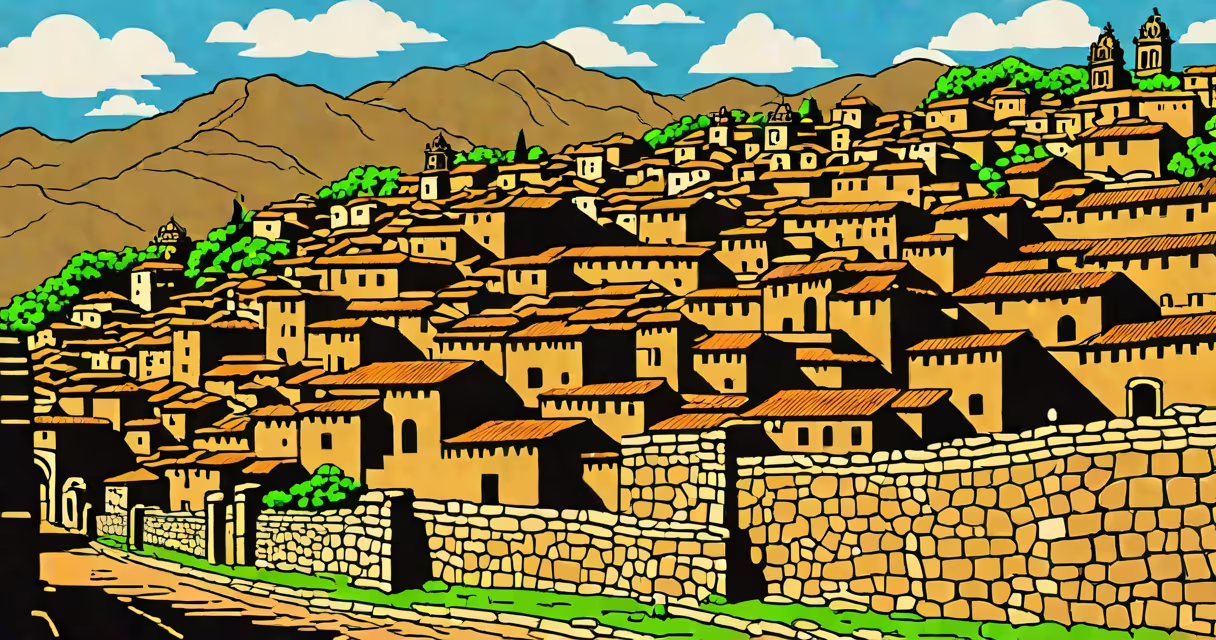
Cusco, also spelled Cuzco, is a high-altitude city in southern Peru that served as the capital of the Inca Empire before Spanish conquest in the 16th century. It lies at 3,399 meters (11,152 feet) above sea level in the Andes Mountains, blending pre-Columbian engineering with Spanish colonial design.
The name "Cusco" appears in Quechua, the language of the Incas, as "Qusqu," meaning "navel of the world." The city's central location in the Inca road network made it a political and spiritual hub. Today, it remains a cultural crossroads where Incan stonework, Catholic churches, and Andean customs coexist.
Modern travelers often see "Cusco" in English-language materials and "Cuzco" in Spanish and academic texts. Both spellings refer to the same city. The variation stems from phonetic differences in transliterating Quechua into Latin script. The Peruvian government officially uses "Cusco" in documents, though "Cuzco" persists in historical references and local speech.
Inca architects shaped Cusco's urban layout around sacred geometry. The city was laid out in the form of a puma-a mythical feline symbolizing power and protection. The body of the puma ran along the Urubamba River, while the head was located at the site of the Qorikancha temple, now occupied by the Santo Domingo Church.
Stonework in Cusco features precisely cut blocks fitted without mortar. These stones withstand frequent earthquakes due to their interlocking joints. Some blocks weigh over 100 tons. The Incas used wooden levers, ropes, and human labor to move them across mountain terrain. Archaeologists estimate that construction began in the 12th century and continued through the 15th century under Sapa Inca Pachacuti.
After the Spanish arrived in 1533, they dismantled many Inca structures to build churches and palaces. They used the same stone foundations, embedding new masonry into existing walls. This fusion created a layered architectural identity visible throughout the city center.
Cusco's heritage includes both Inca and colonial sites. The most visited are archaeological zones, religious buildings, and traditional neighborhoods.
| Type | Examples | Key Feature |
|---|---|---|
| Inca Ruins | Qorikancha, Sacsayhuamán, Kenko | Monumental stonework; astronomical alignment |
| Colonial Churches | Santo Domingo, San Pedro, San Cristóbal | Baroque facades; carved wooden altars |
| Traditional Neighborhoods | San Blas, Wari, Barrio de la Candelaria | Handwoven textiles; Andean festivals |
Qorikancha, the Temple of the Sun, was the most sacred site in the Inca world. Its walls were once covered in gold leaf. After the conquest, the Spanish built the Church of Santo Domingo atop the foundation. The church's altar sits directly over the original Inca sun shrine.
At Sacsayhuamán, massive polygonal stones form a fortress-like complex. The site's terraced walls stretch uphill for nearly 400 meters. Visitors often struggle to believe that such precision was achieved without metal tools or wheels.
Cusco is a major destination for tourists visiting Peru. Over 1.2 million international visitors passed through the city in 2023, according to Peru's Ministry of Tourism. Most arrive via flights to Alejandro Velasco Astete International Airport, located 12 kilometers from the city center.
Tourists come to explore Machu Picchu, which lies 1.5 hours by train from Cusco. The city serves as a base for trekking, cultural tours, and adventure travel. Local guides offer half-day walks through the historic center, pointing out details like the famous "door of the sun" at the Qorikancha.
Locals continue to practice ancestral traditions. The Inti Raymi festival, held annually on June 24, reenacts the Inca New Year ceremony. Thousands gather in the Plaza de Armas to witness dancers in feathered headdresses and priests offering coca leaves to the sun.
Many assume Cusco is a remote village. In reality, it is a modern city with a population of over 400,000. It has hospitals, universities, internet access, and public transportation. The city center is walkable and well-marked for tourists.
Another misconception is that all Inca ruins are near Cusco. While the city hosts major sites, others lie farther away. For example, Choquequirao, a lesser-known Inca complex, is 32 kilometers from Cusco and requires a multi-day hike to reach.
A less obvious point: the name "Cusco" appears in multiple languages. In Quechua, it is "Qusqu." In Aymara, spoken in nearby Bolivia, it is sometimes rendered as "Kusku." In Spanish, it is "Cuzco." The spelling variation reflects linguistic diversity across the Andes, not different places.
I once spent a week in Cusco during the rainy season. I walked the streets at dawn, watching mist rise off the stone walls. At the market in San Pedro, a woman offered me a cup of chicha morada. She spoke only Quechua. I didn't understand her, but the warmth in her eyes said everything. That moment showed me how deeply history lives in daily life here.
Cusco o Cuzco is not just a place on a map-it is a living archive of resilience, adaptation, and continuity. From Inca stonemasons to modern artisans, the city's identity rests on layers of memory embedded in stone, sound, and soil.