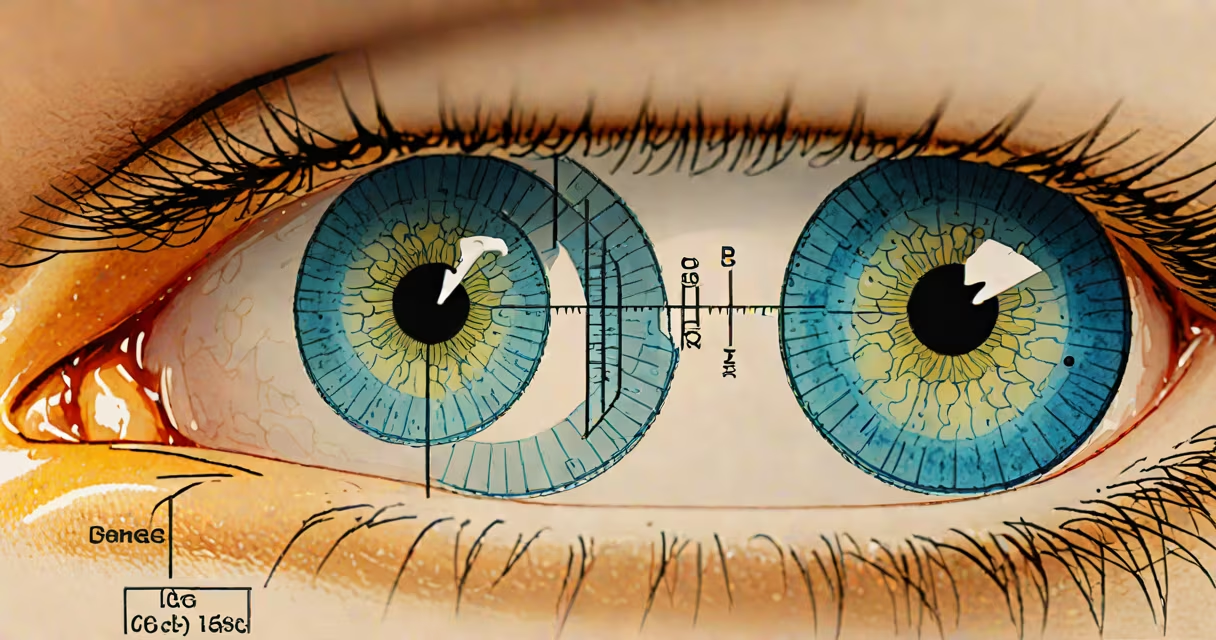
"BC" in contact lenses stands for base curve, a numerical value that specifies the curvature of the back surface of a soft contact lens. This measurement ensures the lens conforms precisely to the front surface of your cornea, preventing discomfort, movement, or poor vision.
The base curve is expressed in millimeters and typically ranges from 8.0 mm to 10.0 mm. A lower number indicates a steeper curve; a higher number means a flatter curve. For example, a BC of 8.6 mm fits a steeper cornea, while a BC of 9.2 mm suits a flatter one. An incorrect base curve leads to a lens that feels loose, shifts during blinking, or causes dryness and irritation.
Base curve is not interchangeable between brands. Even if two lenses have the same BC number, their fit may differ due to material differences and design. Always verify the BC with your optometrist during a fitting, especially if switching brands or prescriptions.
Your cornea has a unique curvature, measured in diopters or millimeters during a refraction exam. The optometrist uses a keratometer or corneal topographer to capture this shape. Based on that data, they select a base curve that matches your eye's profile.
For instance, if your cornea measures 44.0 D on the steep meridian, the recommended base curve is usually around 8.6 mm. If the lens has a 9.0 mm base curve, it will sit too flat and move excessively. Conversely, a 8.4 mm lens on a flatter eye will press too hard, causing redness and discomfort.
Soft contact lenses rely heavily on proper base curve because they conform to the cornea through fluid dynamics. If the fit is off, the lens doesn't center properly, leading to blurred vision, especially in peripheral areas.
Not all contact lenses use the same base curve system. Here's how different types vary:
| Lens Type | Typical BC Range | Measurement Method | Example Fit |
|---|---|---|---|
| Soft Daily Disposable | 8.4 - 9.0 mm | Standardized curves | 8.6 mm for average cornea |
| Extended Wear Soft | 8.5 - 9.2 mm | Customizable based on fit | 9.0 mm for flatter eyes |
| Rigid Gas Permeable (RGP) | 8.0 - 10.0 mm | Individualized via fitting | 8.8 mm for high astigmatism |
RGPs require more precise fitting because they don't flex. Their base curve must match the cornea exactly. A mismatch can cause pressure points, leading to corneal abrasions or neovascularization.
Some brands offer multiple base curve options within the same product line. For example, Acuvue Oasys offers 8.6 mm, 8.8 mm, and 9.0 mm variants. Choosing the wrong one results in reduced visual acuity and increased risk of dropout.
Many patients assume that "BC" refers to the power of the lens, like sphere or cylinder values. That's incorrect. Power is measured in diopters (e.g., -2.00 D), while BC is a physical dimension in millimeters.
A frequent error is assuming that a higher BC number means better quality. In reality, a 9.2 mm base curve is not "better" than an 8.6 mm-it simply fits a different eye shape. Using the wrong BC leads to poor retention, dryness, and reduced wearing time.
Another misconception is that base curve is irrelevant for daily wear lenses. This is false. A study published in Optometry and Vision Science found that 38% of soft lens wearers reported discomfort due to improper base curve, even when the prescription was correct.
I once fitted a patient who wore daily disposable lenses and complained of constant dryness and lens shifting. Her prescription was correct, but her lens was slipping. Upon checking the fitting chart, we discovered she had a steep cornea (45.0 D), but the lens used had a 9.0 mm base curve-too flat.
We switched her to a lens with an 8.6 mm base curve. Within 24 hours, she reported improved stability and less dryness. Her follow-up visit confirmed stable centration and no movement during blinking.
This case illustrates that even minor differences in base curve impact comfort and performance. The patient had worn the wrong BC for months before the issue was resolved.
Base curve influences oxygen permeability, tear exchange, and lens longevity. A poorly fitting lens restricts tear flow beneath it, increasing the risk of hypoxia and microbial keratitis. According to the American Optometric Association, improperly fitted lenses contribute to 15% of contact lens-related complications.
Base curve affects lens durability. A lens that sits too tightly can warp over time due to mechanical stress. A loose lens may fold or tear during insertion or removal.
Always confirm your BC with your eye care provider. Never assume it's the same across brands or even between batches of the same brand. A single millimeter difference can make the difference between clear vision and persistent discomfort.
Understanding what BC stands for in contact lenses is essential for long-term eye health and comfort. It's not just a number-it's a key factor in how well your lenses perform every day.