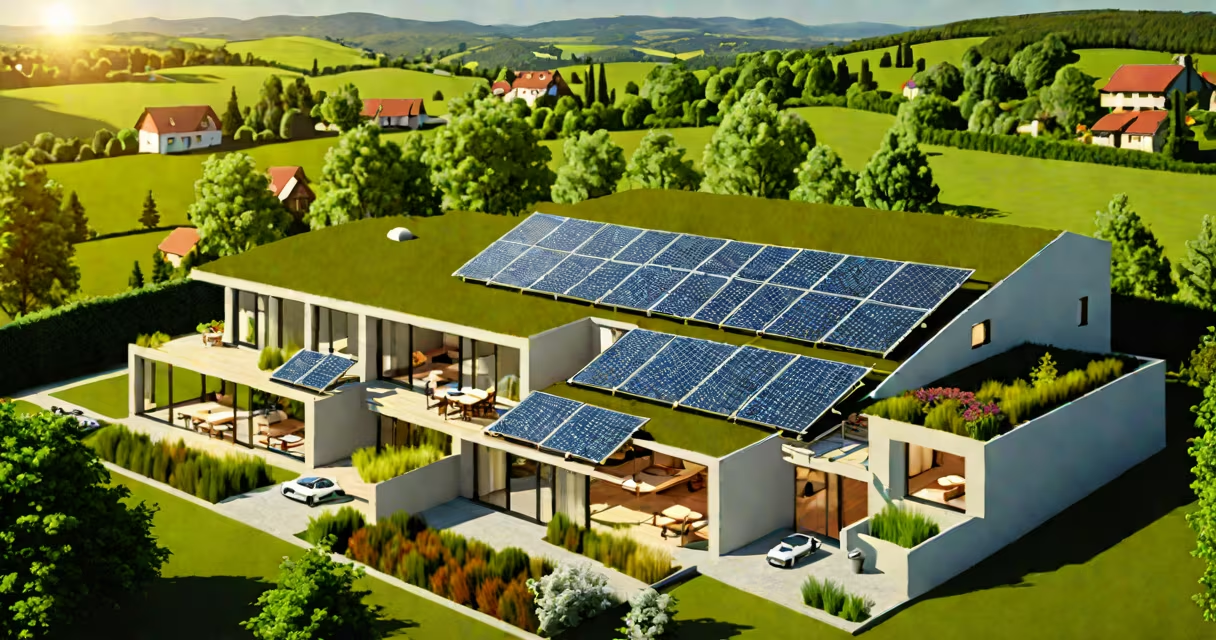
Sustainability in architecture means designing buildings that meet current needs without compromising the ability of future generations to meet theirs-through energy efficiency, responsible material use, site harmony, and long-term operational resilience. This approach integrates environmental, social, and economic factors throughout a structure's life cycle.
Architects apply sustainability principles by reducing a building's carbon footprint during construction and operation. They prioritize renewable materials like reclaimed wood or low-embodied-energy concrete, improve natural light and ventilation to cut energy use, and integrate systems such as rainwater harvesting and solar power. The goal is not just to build something that lasts, but to build something that actively contributes to ecological balance.
The U.S. Green Building Council's LEED certification system defines measurable standards for sustainable design, including water efficiency, indoor air quality, and site selection. A building achieving LEED Platinum status, for example, uses 40% less energy than a typical new building and reduces potable water use by 50%. These benchmarks make the definition of sustainability in architecture actionable and auditable.
At its core, sustainable architecture operates on three pillars: environmental stewardship, human health, and economic feasibility. Environmental stewardship involves minimizing resource extraction and waste. Human health focuses on creating spaces that support mental and physical well-being through access to daylight, clean air, and biophilic elements. Economic feasibility helps sustainable features remain cost-effective over decades, not just years.
Designers use tools like life cycle assessment (LCA) software to model a building's environmental impact from raw material sourcing through demolition. For example, a study by the National Institute of Standards and Technology found that using cross-laminated timber instead of steel in mid-rise construction reduced embodied carbon by 38%. This data-driven approach turns abstract ideals into quantifiable outcomes.
Passive design strategies-such as orienting a building to maximize winter sun and shade summer heat-can reduce mechanical cooling needs by up to 60%, according to the U.S. Department of Energy. These techniques rely on climate-responsive geometry rather than high-tech interventions, making them both resilient and low-maintenance.
Architects deploy several distinct models to embed sustainability into projects. The table below outlines key approaches, their defining traits, and real-world applications.
| Approach | Key Features | Real-World Example |
|---|---|---|
| Passive House | Ultra-low energy use via insulation, airtightness, and heat recovery ventilation | Residential project in Portland, Oregon, uses 90% less heating energy than code-compliant homes |
| Net Zero Energy | Produces as much energy as it consumes annually, typically via rooftop solar arrays | Apple Park's campus generates 75% of its electricity on-site through solar installations |
| Biophilic Design | Integrates nature into interiors and exteriors to improve occupant well-being | Amazon's Spheres in Seattle feature over 40,000 plants across three glass domes |
| Adaptive Reuse | Repurposes existing structures instead of demolishing and rebuilding | Rehabilitation of the former Chicago Stock Exchange into a mixed-use office and retail space |
Each method addresses different aspects of sustainability. Passive House prioritizes energy conservation, net zero energy targets carbon neutrality, biophilic design enhances psychological health, and adaptive reuse preserves cultural and material heritage.
Many assume sustainable architecture requires expensive technologies or exotic materials. That's incorrect. A 2021 report by the Royal Institute of British Architects showed that 62% of UK-based sustainable projects used locally sourced, conventional materials like brick and timber. The difference lies in design intent-not material novelty.
Another misconception is that sustainability equates to minimalism or austerity. In reality, sustainable architecture often embraces complexity. The Bullitt Center in Seattle-a six-story office building-features a 575-panel solar range, composting toilets, and a rainwater-to-potable-water system. It was designed to last 250 years, not because of flashy tech, but due to structural integrity and thoughtful maintenance planning.
There's also confusion between sustainability and greenwashing. A building labeled "eco-friendly" may still consume excessive energy if its HVAC system runs inefficiently. True sustainability requires performance verification. The Living Building Challenge, administered by the International Living Future Institute, demands that certified buildings produce more energy than they use over a 12-month period and treat all wastewater on-site.
Buildings account for 40% of global energy-related carbon emissions, according to the International Energy Agency. Sustainable architecture directly tackles this by reducing demand for fossil-fuel-based energy. Retrofitting older buildings can cut emissions by up to 50% compared to new construction, especially when paired with improved insulation and window glazing.
I once visited a community center in Detroit that had been transformed from a vacant warehouse into a solar-powered learning hub. The project used salvaged steel beams and recycled insulation. During a winter storm, the building remained heated for 72 hours on stored solar energy alone-proof that sustainability isn't theoretical. It functions under stress.
When evaluating a project's sustainability, look beyond marketing claims. Ask: What is the embodied carbon of the materials? How much energy does the building consume annually? Is the design adaptable to changing climate conditions? These questions reveal whether the definition of sustainability in architecture is being honored in practice.
Understanding sustainability in architecture isn't about adopting a single style. It's about asking rigorous questions at every stage-from concept to demolition. The field continues to evolve, guided by research from institutions like the University of California, Berkeley's Center for Sustainable Building Systems and the World Green Building Council's global standards. These organizations provide frameworks that ensure the definition of sustainability in architecture remains grounded in science, not ideology.