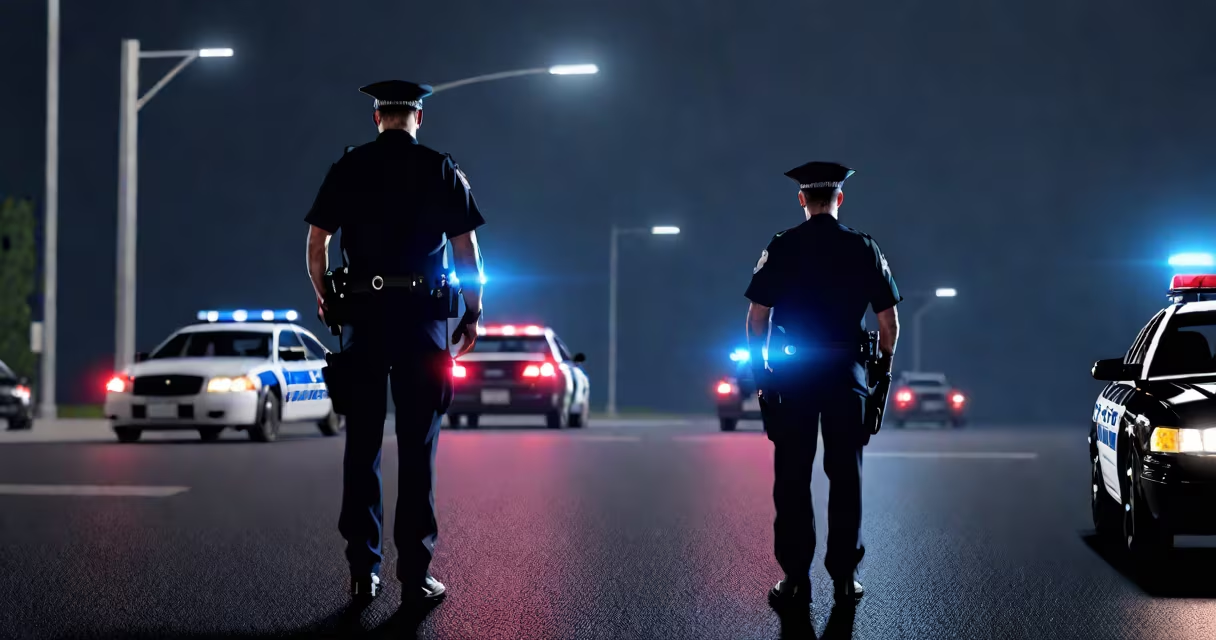
A police officer's role is to enforce laws, protect people and property, and maintain public order through daily patrols, investigations, and emergency responses. They serve as frontline enforcers of civil codes and first responders during crises.
Every day, police officers perform tasks rooted in legal authority granted by state and local governments. Their primary function is to prevent crime, respond to incidents, and assist individuals in distress. This includes stopping traffic violations, arresting suspects, gathering evidence, and testifying in court. Officers operate under strict protocols designed to balance public safety with constitutional rights.
The U.S. Department of Justice defines core responsibilities as "preventing crime, investigating offenses, and providing emergency services." These duties are carried out across urban centers, rural towns, and federal jurisdictions. Each officer undergoes standardized training in firearms, defensive tactics, de-escalation, and legal procedures before being sworn in.
When a call comes in-say, a report of a burglary-the responding officer follows a structured process. They secure the scene, collect physical evidence, interview witnesses, and document everything in an official report. If a suspect is identified, the officer may make an arrest, transport them to jail, and hand over custody to prosecutors.
During routine patrols, officers monitor neighborhoods for suspicious behavior, assist lost children, direct traffic, and mediate disputes. They often act as intermediaries between citizens and the justice system. For example, during a domestic disturbance, an officer assesses risk levels, separates parties, and determines whether to issue citations or make arrests based on threat assessment.
Each action is governed by department policy and constitutional standards. The Supreme Court ruled in Terry v. Ohio (1968) that officers may conduct brief stops and frisks if they have reasonable suspicion of criminal activity. This precedent shapes how officers interact with the public during field encounters.
Not all police officers do the same work. Roles vary by agency, jurisdiction, and specialization. The following table outlines common categories:
| Type | Duties | Examples |
|---|---|---|
| Patrol Officer | Responds to calls, conducts traffic stops, patrols assigned areas | City police departments, county sheriff's offices |
| Investigative Officer | Conducts criminal investigations, gathers evidence, prepares cases for prosecution | Homicide units, fraud divisions |
| SWAT Operator | Handles high-risk situations such as armed standoffs or hostage rescues | Federal Bureau of Investigation (FBI) Hostage Rescue Team, municipal SWAT units |
| Mounted Officer | Uses horses for crowd control, surveillance, and ceremonial duties | New York City Police Department Mounted Unit, Washington D.C. Metropolitan Police Department |
| Police Detective | Specializes in solving complex crimes like murder or financial fraud | Los Angeles Police Department Homicide Division |
Officers may also serve in specialized roles such as school resource officers, who work within schools to promote safety and build trust with students. According to the National Association of School Resource Officers, over 80% of U.S. school districts now employ at least one SRO.
Many people assume police officers spend most of their time chasing criminals or making arrests. In reality, less than 10% of an officer's time involves enforcement actions. A 2021 study by the Police Executive Research Forum found that 70% of patrol officer time is spent on non-criminal interactions-helping people with mental health crises, resolving family disputes, or assisting motorists with flat tires.
Another misconception is that all police officers carry guns. While many do, not all are authorized to use them. Some agencies require officers to complete additional training and certification before being issued a firearm. Others assign weapons only to those in specific roles, such as tactical teams or detectives working on violent crime cases.
There's also confusion about the difference between police officers and other law enforcement personnel. For example, federal agents like FBI special agents are not police officers. They investigate federal crimes-such as terrorism or cybercrime-but lack the general jurisdiction of local police. Similarly, correctional officers work inside prisons and do not engage in street-level law enforcement.
Consider Officer Maria Lopez, a 3-year veteran with the Portland Police Bureau. Her shift begins at 7 a.m. She checks her vehicle's equipment-radio, lights, dash cam, handcuffs, and pepper spray-before heading out.
At 8:15 a.m., she receives a dispatch about a man yelling in a park. She arrives within five minutes. The individual is homeless and experiencing a psychotic episode. Instead of using force, she uses de-escalation techniques learned in academy training. She sits calmly, speaks slowly, and contacts crisis intervention specialists. Within 20 minutes, mental health responders arrive and take the man to a treatment center.
Later that day, she responds to a hit-and-run accident involving a pedestrian. She secures the scene, directs traffic, treats minor injuries, and collects witness statements. She files a detailed report and later testifies in court during a follow-up hearing.
By shift's end, she logged 12 hours, responded to 17 calls, and spent 60% of her time on non-enforcement activities. Her role wasn't about catching criminals-it was about stabilizing situations, preserving dignity, and ensuring public safety.
Police officers are not just enforcers-they are public servants. Their presence in communities fosters stability. A 2022 report from the Urban Institute found that neighborhoods with consistent foot patrols reported a 15% drop in perceived fear of crime, even when actual crime rates remained unchanged.
Community policing-where officers build relationships with residents-is a proven strategy. In Camden, New Jersey, after dismantling its police department and rebuilding it with a focus on community engagement, violent crime dropped by 40% over five years. Officers now live in the neighborhoods they serve, attend local events, and participate in youth programs.
One key insight often missed: police officers are trained to make split-second decisions under pressure. But their training also emphasizes restraint. The National Institute of Justice reports that 80% of officers who use force do so in response to threats against themselves or others. Most use of force occurs during confrontations where the suspect is actively resisting or threatening harm.
Understanding the full scope of a police officer's role requires seeing beyond headlines. It's not just about arrests or gun use. It's about presence, judgment, communication, and service. When officers are properly trained and supported, they become essential pillars of public safety.