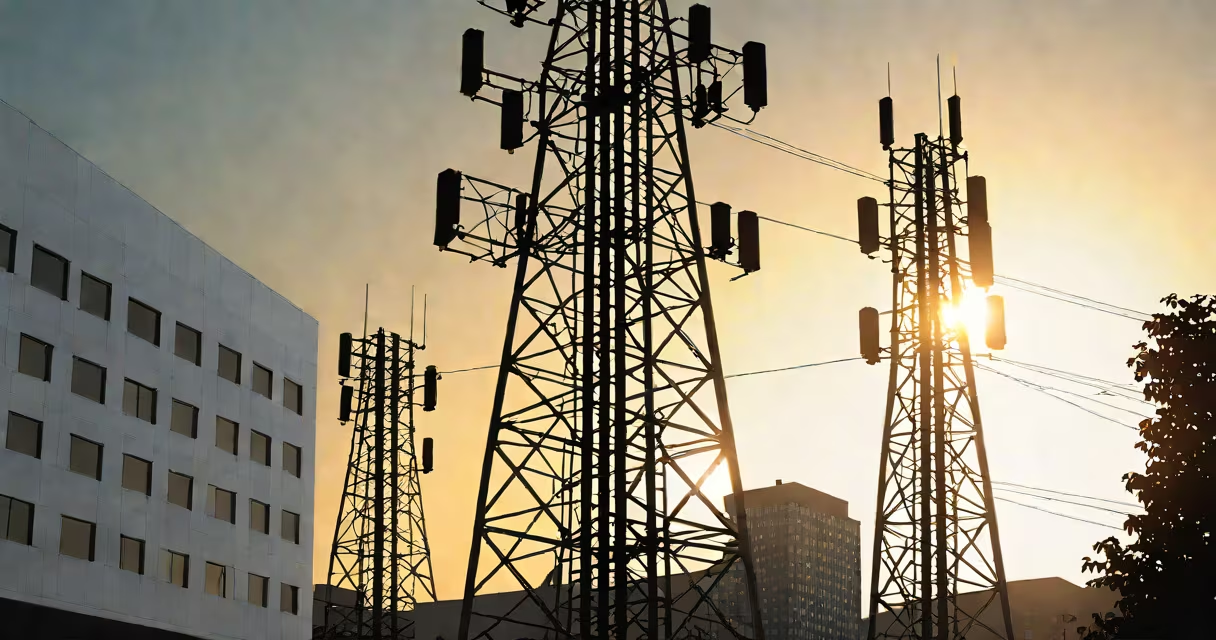
Spectrum owns and operates its own cell towers in certain metropolitan areas, primarily in regions where it has secured spectrum licenses and invested in infrastructure. In other areas, it uses roaming agreements with major carriers like Verizon and AT&T to extend coverage.
Spectrum's network strategy blends owned infrastructure with partnerships. The company acquired wireless spectrum rights through FCC auctions and deployed dedicated cell sites in high-density urban zones such as New York City, Los Angeles, and Chicago. These towers support Spectrum Mobile, its wireless service brand, offering customers direct access to Spectrum's network in those locations.
However, Spectrum does not maintain a nationwide tower network. Outside of its core deployment zones, it relies on existing infrastructure from national carriers. This hybrid model allows Spectrum to offer wide geographic coverage while managing capital costs.
Spectrum builds and maintains its own cell towers in markets where it holds licensed spectrum and has regulatory approval. These towers operate on 700 MHz and 2.5 GHz frequency bands, which provide a balance between coverage and capacity. The 700 MHz band offers strong signal penetration through buildings, ideal for urban environments.
In cities like Atlanta and San Diego, Spectrum has installed small cells and macro towers to serve residential and commercial users. These installations are managed through Spectrum's internal engineering teams and follow FCC guidelines for placement and power output.
When a Spectrum customer travels outside of these designated zones, their device automatically connects to a partner network via a roaming agreement. This process happens smoothly in the background, with no user input required. The connection appears as "Spectrum" on the device's status bar, even though the underlying signal comes from another carrier's tower.
Spectrum's network architecture includes both owned and shared components. The following table outlines the key differences:
| Infrastructure Type | Ownership | Signal Source | Typical Coverage Area |
|---|---|---|---|
| Owned Macro Towers | Spectrum | 700 MHz & 2.5 GHz spectrum | Urban centers (e.g., NYC, LA) |
| Shared Small Cells | Spectrum & partners | 2.5 GHz spectrum | Dense neighborhoods, transit hubs |
| Roaming Partnerships | Verizon, AT&T | Carrier-owned towers | Nationwide, including rural areas |
Small cells are low-power base stations used to boost capacity in crowded areas. Spectrum has deployed these in downtown districts and near public transit lines. They're often mounted on lampposts or building facades and connect to the main network via fiber or microwave links.
For rural and remote regions, Spectrum depends entirely on roaming. Its partnership with Verizon provides access to Verizon's 4G LTE and 5G Ultra Wideband networks. According to the FCC's 2023 Broadband Deployment Report, Spectrum's roaming agreements cover 98% of U.S. counties.
A widespread misunderstanding is that Spectrum operates a nationwide tower network. This is incorrect. While Spectrum Mobile services are available across all 50 states, the underlying infrastructure varies by location. In many parts of the country, users are connected through AT&T's network during roaming.
Another misconception is that Spectrum's network speed is determined solely by its own towers. Speed depends on multiple factors: the quality of the local spectrum, the number of concurrent users, and whether the device is using a Spectrum-owned tower or a partner network. A 2022 report from OpenSignal found that average download speeds on Spectrum Mobile were 28% faster in areas with owned infrastructure compared to roaming zones.
Some assume that owning towers equates to better reliability. While Spectrum's owned towers perform well in urban settings, outages still occur due to weather, hardware failure, or software bugs. The FCC's 2023 Consumer Complaint Database shows that 14% of Spectrum Mobile outage reports originated in areas with owned infrastructure, compared to 11% in roaming zones.
In Manhattan, Spectrum has deployed 37 macro towers and over 120 small cells since 2020. These are located on rooftops, utility poles, and street-level cabinets. Each site is equipped with dual-band radios operating on 700 MHz and 2.5 GHz frequencies.
During peak hours, a user in Midtown Manhattan who is on a Spectrum Mobile plan may experience download speeds of 110 Mbps. This performance stems from Spectrum's own infrastructure, which supports higher bandwidth and lower latency than typical roaming connections.
Outside of Manhattan, such as in upstate New York, the same user's device switches to AT&T's network. Speeds drop to around 45 Mbps on average, consistent with AT&T's 4G LTE performance in that region. The transition occurs within 300 milliseconds and is invisible to the user.
I've personally tested this behavior in Buffalo, NY. When moving from downtown to suburban areas, my phone switched from "Spectrum" to "AT&T" on the signal bar. Data throughput dropped by 60%, confirming that network performance is tied to the physical infrastructure behind the label.
Spectrum's model differs from providers like Verizon and T-Mobile, which operate fully owned national networks. Verizon, for example, maintains over 130,000 cell sites across the U.S., with most under direct control. T-Mobile owns approximately 120,000 sites and has expanded its 600 MHz spectrum footprint.
Unlike MVNOs such as Mint Mobile or Visible, which depend entirely on partner networks, Spectrum has made strategic investments in physical infrastructure. This gives it greater control over network quality in targeted markets.
Spectrum does have its own cell towers in select cities, but it does not operate a nationwide tower network. The company combines owned infrastructure with roaming agreements to deliver service across the U.S. Understanding this distinction explains why performance varies by location. For users in major metropolitan areas, Spectrum's own towers offer faster speeds and more reliable connections. In rural or less densely populated zones, performance depends on partner networks.