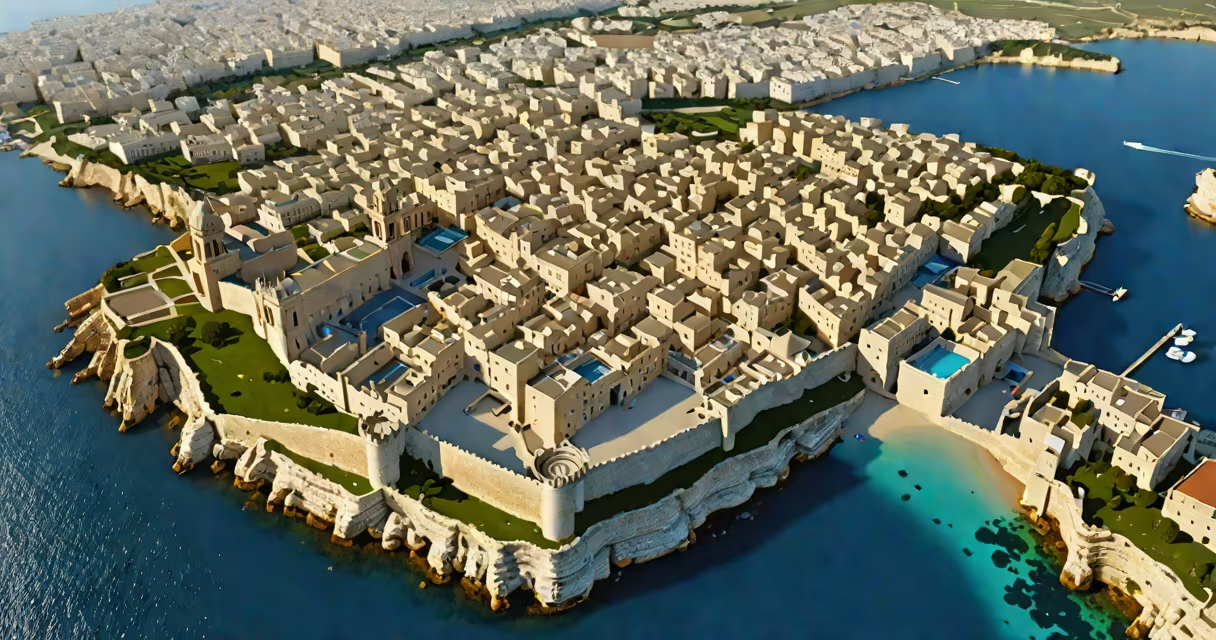
Malta is a sovereign island nation in the central Mediterranean Sea, consisting of three main islands-Gozo, Comino, and the largest, Malta-and a population of approximately 530,000 people. It is the smallest country in Europe by land area, covering just 316 square kilometers, yet it holds significant historical and strategic importance due to its location between North Africa and Southern Europe.
Malta's identity stems from millennia of human settlement. Archaeological evidence shows continuous habitation since at least 5900 BCE, making it one of the oldest continuously inhabited regions in Europe. The country's name derives from the Phoenician word "Maleth," meaning "safe harbor," reflecting its natural advantage as a maritime stopover.
Today, Malta functions as a parliamentary republic with English and Maltese as official languages. It joined the European Union in 2004 and adopted the euro in 2008. Its economy relies heavily on tourism, financial services, and information technology, with over 1.5 million tourists visiting annually-more than double the resident population.
Malta operates under a parliamentary democracy modeled on the British Westminster system. The president serves as ceremonial head of state, while executive power rests with the prime minister and cabinet. National elections occur every five years, with the most recent held in 2022, resulting in a majority for the Labour Party.
The economy is diversified but highly dependent on external factors. Tourism contributes around 12% of GDP, with major attractions including the Megalithic Temples of Ħaġrat and Mnajdra, the fortified city of Valletta, and the Blue Lagoon on Comino. The country also hosts numerous international film productions-over 40 projects were filmed there in 2023, including scenes for *The Witcher* and *Pirates of the Caribbean: Dead Men Tell No Tales*.
Electric vehicles make up 18% of new car registrations, one of the highest rates in the EU. The government mandates that all public transport buses be electric by 2025. Malta's energy mix includes solar, wind, and imported fossil fuels, with plans to achieve net-zero emissions by 2050.
Malta is composed of limestone bedrock formed during the Miocene epoch, approximately 5 to 20 million years ago. The terrain is arid and rocky, with limited natural freshwater sources. Rainfall averages 570 mm per year, concentrated between November and March. As a result, Malta relies on desalination plants and underground reservoirs to meet water demand.
Coastal areas feature rugged cliffs, sea caves, and sandy coves. The Dingli Cliffs on the western edge rise 250 meters above sea level-the highest point in the country. Marine biodiversity is rich: over 700 species of fish inhabit Maltese waters, including the endangered dusky grouper.
Urban development is dense. The capital, Valletta, covers just 0.8 square kilometers but houses 13,000 residents. The city was founded in 1566 after the Great Siege of Malta, when the Knights Hospitaller repelled Ottoman forces. Today, Valletta is a UNESCO World Heritage Site and home to the National Museum of Archaeology, which displays artifacts from the Bronze Age temple complex at Tarxien.
Malta comprises three main islands, each with distinct characteristics:
| Island | Area (km²) | Population | Key Features |
|---|---|---|---|
| Malta (main island) | 246 | 400,000 | Valletta, Mdina, St. Julian's, Marsaxlokk fishing village |
| Gozo | 67 | 39,000 | Ġgantija temples, Ta' Ċenċ cliffs, Qala village |
| Comino | 3 | 100 | Blue Lagoon, protected marine reserve, no permanent residents |
Despite their small size, the islands have distinct cultural identities. Gozo retains strong rural traditions, with many residents speaking Maltese exclusively. The island's dialect features archaic vocabulary preserved from medieval Sicilian, such as "kun" for "is" and "t'ħobbi" for "I love."
Comino is uninhabited except for seasonal staff managing the Blue Lagoon tourist site. Access requires a permit, and visitors must book through licensed tour operators. The lagoon's turquoise waters result from high calcium carbonate levels in the surrounding coral reefs, which reflect light in the visible spectrum.
Malta's strategic position has made it a flashpoint for centuries. Ancient Greeks called it Melita, and Romans ruled it from 218 BCE. The island became a Christian stronghold after Saint Paul's shipwreck in 60 CE, according to Acts 28:1-10. The Catholic Church remains dominant, with 90% of citizens identifying as Catholic, though secularism is rising among younger generations.
During World War II, Malta endured 15 months of intense bombing by Axis powers. Over 2,000 civilians died, and 90% of Valletta's buildings were damaged. The Royal Navy maintained a fleet presence, and Allied forces used the island as a base for operations in North Africa. In recognition, the George Cross was awarded to Malta in 1942-a medal still featured on the national flag.
A common misconception is that Malta is part of Italy. While geographically close-just 280 km from Sicily-Malta never belonged to the Italian state. It was ruled by the Kingdom of Naples, then Spain, the Knights of St. John, Britain, and finally gained independence in 1964. The Maltese language evolved from Siculo-Arabic, with heavy Italian and English influence.
Many assume Malta is a beach destination like the Greek or Spanish coastlines. But the island lacks extensive sandy beaches. Most coastal areas consist of pebbles, rock formations, or artificial stone steps. The longest stretch of sand is at Golden Bay, measuring just 180 meters in length.
Another error is equating Maltese cuisine with Italian food. While dishes like pastizzi (meat-filled pastries) and ftira (flatbread) resemble Italian staples, they are distinct. Pastizzi contain spiced minced beef or ricotta, baked in a flaky pastry with a hint of cinnamon. Fritters known as "imbuljati" are made with chickpea flour and fried in olive oil-uncommon in Italian cooking.
I once visited a local bakery in Rabat, where the owner showed me how pastizzi are still hand-made using wooden molds passed down through generations. He demonstrated folding techniques that take 12 seconds per pastry. This craftsmanship persists despite mass production in supermarkets.
What is Malta? It is a compact, historically layered nation where ancient temples stand beside modern skyscrapers, and where Maltese, English, and Italian coexist in daily life. It is a place where the past is not displayed-it is lived. From the 3,600-year-old Hypogeum burial chamber to the bustling nightlife of St. Julian's, Malta blends endurance and evolution.
For travelers seeking authenticity, consider visiting smaller towns like Żurrieq or Naxxar, where traditional festivals such as the Feast of the Assumption draw thousands. For those interested in retail, pull and bear malta offers urban fashion in locations across Valletta and St. Julian's, reflecting the country's blend of tradition and global trends.
Malta is not merely a destination. It is a living archive of Mediterranean resilience, shaped by conquest, faith, and adaptation.