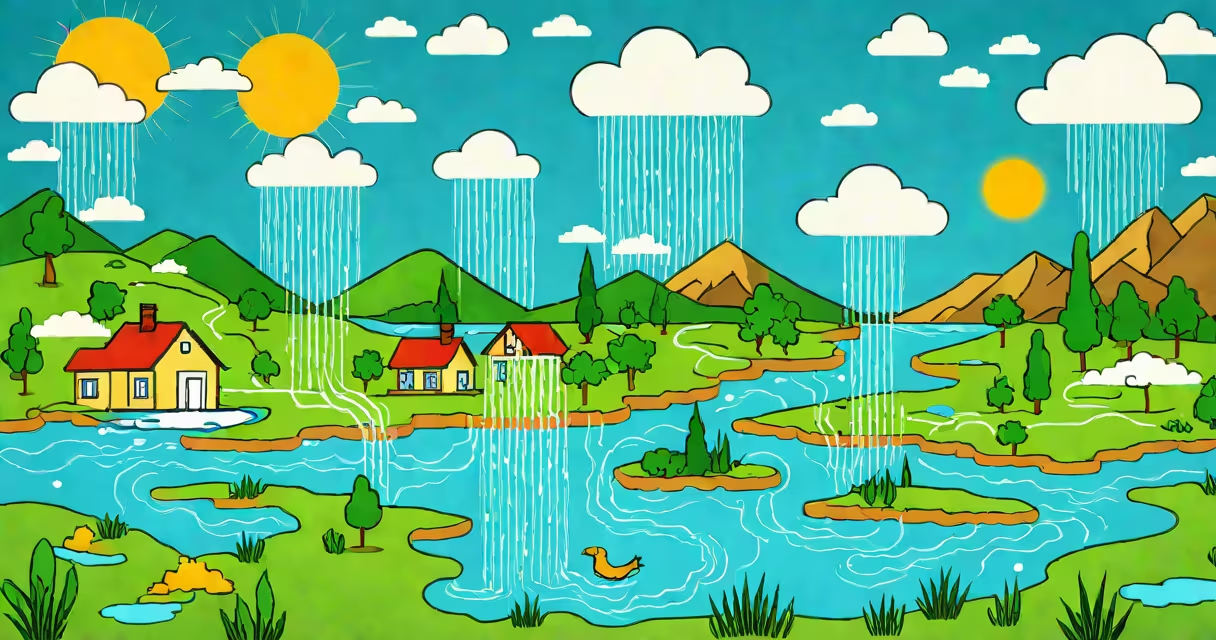
The meaning of water cycle refers to the continuous movement of water on, above, and below Earth's surface through processes like evaporation, condensation, precipitation, infiltration, runoff, and subsurface flow. This natural system redistributes fresh water globally and maintains climate stability.
Water evaporates from oceans, lakes, rivers, and soil when heated by sunlight. The vapor rises, cools, and condenses into clouds. When droplets grow large enough, they fall as precipitation-rain, snow, sleet, or hail. Some water flows over land as runoff, filling streams and rivers. Other portions seep into the ground, becoming groundwater. Eventually, all water returns to oceans or other bodies of water, restarting the cycle.
This process operates continuously and relies on solar energy to drive evaporation and gravity to pull water downward. The entire system maintains Earth's freshwater balance and supports ecosystems, agriculture, and human settlements.
Energy from the sun heats surface water, causing it to turn into invisible vapor-a process called evaporation. Over oceans, which cover 71% of Earth's surface, about 90% of atmospheric moisture originates from evaporation. As warm air rises, it expands and cools, reducing its ability to hold water vapor. This triggers condensation-the phase change from gas to liquid-and forms clouds.
When cloud droplets collide and merge, they grow heavy enough to fall under gravity. Precipitation occurs when these droplets reach a critical size. About 505,000 cubic kilometers of water fall annually as precipitation, according to the U.S. Geological Survey. Not all of this reaches the ground; some evaporates during descent, a phenomenon known as evaporation before impact.
Once on land, water follows several paths. A portion runs off across surfaces into rivers and lakes. Another portion infiltrates the soil, moving through pores and cracks until it reaches aquifers-underground layers of water-bearing rock. Infiltration rates depend on soil type, slope, and vegetation. For example, sandy soils allow faster infiltration than clay-rich soils.
The water cycle consists of six primary stages:
| Stage | Description | Example |
|---|---|---|
| Evaporation | Water turns from liquid to vapor due to heat. | Surface water in a desert lake vanishes under intense sun. |
| Transpiration | Plants release water vapor through their leaves. | A forest loses 10 liters of water per square meter daily via transpiration. |
| Condensation | Vapor cools and becomes liquid droplets. | Fog forms when warm, moist air meets cold ground. |
| Precipitation | Water falls from clouds as rain, snow, etc. | Monsoon rains deliver 1,500 mm of rain in Mumbai over 60 days. |
| Runoff | Surface water flows over land into rivers and oceans. | After a storm, water rushes down city streets toward drainage systems. |
| Infiltration & Groundwater Flow | Water soaks into soil and moves slowly underground. | Water from a mountain spring emerges 10 years later downstream. |
Transpiration-water released by plants-is often grouped with evaporation as evapotranspiration. Together, these processes account for nearly half of the moisture returning to the atmosphere in tropical regions.
The water cycle sustains life on Earth. Without it, freshwater would not replenish. Rivers, lakes, and aquifers depend on consistent inputs from precipitation and groundwater recharge. In arid zones like the Sahara, annual precipitation averages less than 100 mm, making water scarcity a constant challenge.
Human activities disrupt the cycle. Deforestation reduces transpiration, altering local rainfall patterns. Urbanization increases impervious surfaces, leading to higher runoff and flooding. In cities like Miami, sea level rise combined with increased runoff threatens coastal infrastructure.
Climate change intensifies the cycle. Warmer air holds more moisture-about 7% more per 1°C increase. This leads to stronger storms and prolonged droughts. The National Oceanic and Atmospheric Administration (NOAA) reports that extreme precipitation events have risen 30% since 1950 in the contiguous United States.
Many assume the water cycle is a closed loop with no net gain or loss. While water is conserved globally, local imbalances occur. For example, glaciers in Greenland lose mass faster than they accumulate snow, contributing to sea level rise. The ice sheet lost 260 gigatons of ice per year between 2002 and 2020, according to NASA's GRACE satellite mission.
Another myth is that all rain comes from ocean evaporation. While oceans contribute most, terrestrial sources-like soil moisture and plant transpiration-can generate significant local rainfall. In the Amazon Basin, up to 50% of rainfall originates from internal recycling of moisture, not oceanic input.
Some confuse the water cycle with the carbon cycle. Both involve cycling materials, but the water cycle focuses on H₂O movement through physical states and locations. The carbon cycle tracks carbon atoms through biological and geological processes. They interact-plants absorb CO₂ during photosynthesis while releasing water vapor-but they are distinct systems.
Consider the Mississippi River watershed, which drains 41% of the contiguous U.S. area. Rainfall over the central U.S. evaporates from soil and crops, rises, and condenses into clouds. These clouds move eastward and drop rain over the Midwest. Runoff from fields and forests feeds tributaries like the Missouri and Ohio Rivers.
Approximately 400 billion gallons of water flow into the Gulf of Mexico daily from the Mississippi. This volume exceeds the daily water use of 10 million people. The cycle here illustrates how land use affects water timing and quantity. Agricultural runoff contributes excess nitrogen, fueling algal blooms and dead zones in the Gulf.
I once observed a flash flood in a small town near the Arkansas River. After a week of steady rain, the ground was saturated. When another storm hit, water couldn't infiltrate. Runoff surged through culverts, overwhelming drainage systems. The event highlighted how changes in infiltration capacity alter cycle outcomes.
Scientific consensus confirms the water cycle's role in regulating Earth's temperature. By transporting latent heat from equatorial zones to poles, it balances global energy distribution. This mechanism prevents extreme temperature gradients and stabilizes long-term climate conditions.
The meaning of water cycle is not just a classroom concept-it's a living system that shapes landscapes, fuels economies, and defines survival. Every drop of rain, every stream, every glacier reflects its ongoing motion.