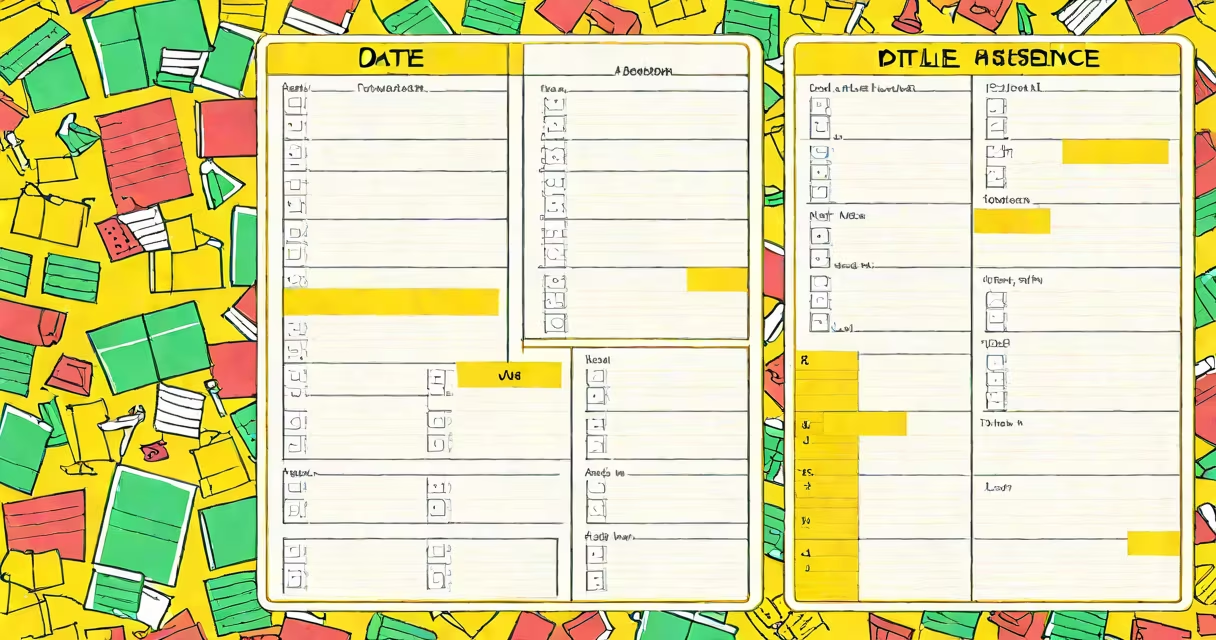
A feuille de presence is a French workplace attendance record used to document employee arrival and departure times, typically signed daily. It serves as a legal and administrative tool for verifying work hours, supporting payroll processing, and meeting labor law requirements under French employment regulations.
Used primarily in France and French-speaking regions, the feuille de presence functions as a physical or digital log where employees confirm their presence during scheduled shifts. Employers maintain these records to ensure compliance with labor laws, particularly those governing working hours, rest periods, and overtime. The document is not optional in many sectors-especially public administration, education, and healthcare-where strict documentation is mandated.
Each entry includes the employee's name, date, start and end times, and sometimes a supervisor's signature. Some versions include a column for "absence reason" or "late arrival." The form may be updated weekly or monthly depending on company policy, though daily logging is standard in regulated environments. Failure to complete a feuille de presence can result in disciplinary action or affect pay accuracy.
The feuille de presence operates as a time-tracking mechanism that relies on manual or semi-automated input. Employees physically sign in upon arrival and sign out when leaving. In larger organizations, supervisors collect and verify the sheets daily, then forward them to HR or payroll departments.
Some companies use digital versions hosted on internal systems, accessible via tablet or desktop. These versions still require a timestamped electronic signature or checkbox confirmation. Even in digital formats, the core function remains unchanged: to provide a verifiable record of actual work time.
For example, a schoolteacher in Lyon logs their presence at 8:05 a.m. and signs out at 4:30 p.m. on a Tuesday. This entry is verified by the principal and stored in the school's personnel file. The data feeds into the teacher's monthly payroll report and supports audits by labor inspectors.
While the basic structure remains consistent, feuilles de presence vary by sector and size of organization. The most common types include:
| Type | Use Case | Format | Frequency |
|---|---|---|---|
| Daily paper sheet | Small offices, clinics, schools | Printed form with rows for names and time slots | Daily |
| Monthly consolidated sheet | Public sector, government agencies | Pre-filled template with weekly columns | Monthly |
| Digital system integration | Large corporations, tech firms | Cloud-based app with login verification | Real-time |
Some institutions combine the feuille de presence with other documents. For instance, a hospital in Marseille uses a single form that tracks patient care hours and shift handover notes. This multi-use format reduces paperwork and aligns with national health authority guidelines.
French labor law requires employers to keep accurate records of working hours. Article L. 3131-1 of the French Labor Code mandates that employers retain proof of work duration for at least three years. The feuille de presence fulfills this obligation and protects both employer and employee in disputes over unpaid overtime or wrongful termination.
It also supports social security contributions. In France, employee benefits such as sick leave, maternity pay, and retirement credits depend on documented work history. Without a valid feuille de presence, an employee may lose eligibility for certain benefits.
For example, a warehouse worker in Nantes claimed he had worked 12 hours on a Saturday. His employer disputed the claim because no feuille de presence was signed. A labor inspector later ruled in favor of the worker based on email logs and camera footage-but only after the employer admitted they failed to enforce proper signing procedures. This case illustrates how the absence of a properly maintained feuille de presence can lead to financial penalties.
Many assume the feuille de presence is interchangeable with a timesheet. They are not. A timesheet records completed tasks or project hours, while a feuille de presence tracks physical presence during a shift. One can have a timesheet without a feuille de presence, but not vice versa in regulated roles.
Another misconception is that the form is only for salaried staff. In reality, it applies to all employees-including temporary workers, interns, and contractors-when they are on-site. The law does not distinguish between contract types in this context.
A lesser-known fact: French courts accept feuilles de presence as evidence in labor disputes even if they lack a supervisor's signature. According to a 2021 ruling by the Cour de cassation, a consistent pattern of employee entries-even without formal approval-can establish a credible timeline of work hours. This precedent strengthens the document's legal weight.
I once observed a small accounting firm in Bordeaux using a shared feuille de presence taped to a wall near the entrance. Each morning, employees wrote their names and arrival times in ink. After a month, the HR manager noticed discrepancies-some people were signing in late, others skipped days. When confronted, several admitted they didn't see the form as mandatory. The company later introduced a digital version with automatic alerts and reduced absenteeism by 40% within six weeks.
Confusion often arises between feuille de presence and related tools:
Under French law, a mere badge swipe without a signed statement does not meet the requirement for a "documentary proof of presence" as defined in Article L. 3131-1. The signed feuille de presence remains the gold standard.