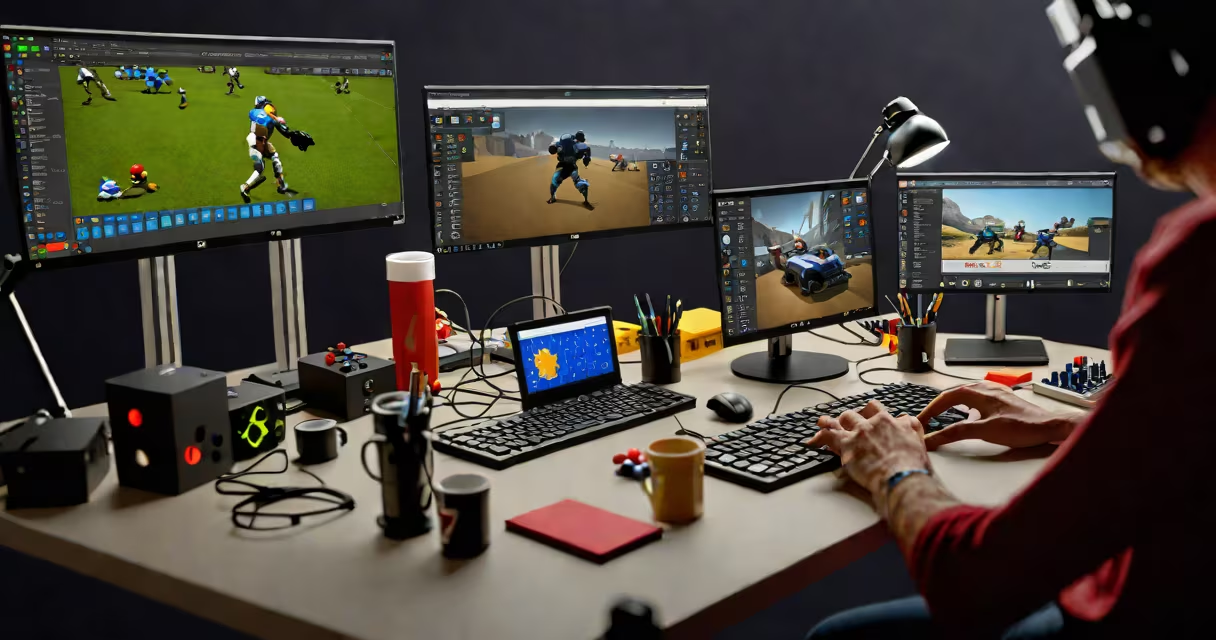
Game design programs are software applications that provide tools for creating video games, including environment modeling, character animation, scripting logic, and user interface layout. They integrate visual editors, physics engines, audio systems, and coding interfaces into a single workflow. These programs are essential for prototyping, testing, and deploying games across platforms.
At their core, game design programs combine asset creation, behavioral programming, and runtime simulation. A developer uses them to define how characters move, how puzzles resolve, and how players interact with the world. Unlike general-purpose design tools such as Photoshop or Blender, game design programs maintain a live feedback loop between editing and running the game in real time.
Major examples include Unity, Unreal Engine, Godot, and GameMaker Studio. Each supports multiple output formats-PC, mobile, consoles-and offers plugins for networking, AI behavior, and cloud save systems. The choice of program often depends on project scale, team size, and target platform.
These programs operate on a scene graph architecture, where all objects-characters, lights, cameras-are organized hierarchically within a virtual space. Changes to a character's animation or collision box update instantly in the preview window, enabling rapid iteration.
Behind the scenes, the program runs a game loop: it updates physics, processes input, renders frames, and handles audio every 16 milliseconds (60 frames per second). Developers attach scripts-written in C#, C++, or Python-to objects to control behavior. For example, a door script might check if the player has a key and open only when the condition is met.
Visual scripting tools like Blueprints in Unreal Engine allow designers to create logic without writing code. Nodes represent actions (e.g., "play sound," "teleport player") and are connected to form decision trees. This lowers the barrier to entry for non-programmers while maintaining performance.
Different programs serve distinct development workflows based on performance needs, team expertise, and deployment goals.
| Program | Best For | Language/Scripting | Performance Level |
|---|---|---|---|
| Unity | 2D/3D mobile and indie games | C#, JavaScript (via UnityScript) | High (optimized for mobile) |
| Unreal Engine | AAA titles, cinematic visuals | C++, Blueprints (visual) | Very high (ray tracing, changing lighting) |
| Godot | Open-source projects, lightweight 2D games | GDScript (Python-like), C# | Moderate (lightweight engine) |
| GameMaker Studio | 2D platformers, rapid prototyping | GML (custom language), drag-and-drop | High (optimized for 2D) |
Unity dominates indie development due to its cross-platform export system and large asset store. Unreal Engine powers many triple-A titles, including *Fortnite* and *Gears 5*, thanks to its advanced rendering pipeline. Godot appeals to developers who prefer open-source licensing and minimal overhead. GameMaker Studio remains popular among hobbyists and educators because of its intuitive drag-and-drop interface.
Game design programs are used across studios, educational institutions, and solo developers. A small team building a narrative-driven adventure game might choose Unity for its accessibility and support for VR integration. A university course teaching game mechanics may use Godot to avoid licensing fees and simplify debugging for students.
Professional studios rely on these programs to manage complex assets and collaborate across departments. For example, a level designer creates a maze in Unreal Engine, then exports it to a version control system. An animator adds facial expressions via motion capture data, and a programmer adds triggers for environmental events. All changes sync in real time through shared project files.
A common misconception is that game design programs are interchangeable. In reality, choosing the wrong tool can cause delays. A 2D puzzle game built in Unreal Engine may run slower than necessary due to unused 3D rendering features. Conversely, trying to simulate realistic physics in Godot requires custom code that would be built-in elsewhere.
Many assume that game design programs are only for coders. That's incorrect. Visual scripting systems allow designers to implement logic without writing syntax. In Unreal Engine, a designer can create a "player dies" event by connecting nodes: "On collision" → "Check health" → "Play death animation" → "Restart level." No code required.
Another misunderstanding is equating game design programs with game engines. While related, they're not synonymous. A game engine is the underlying structure that handles rendering, memory management, and input. A game design program is the interface layer that lets users build games using that engine. Unity is both a game engine and a design program. Godot is primarily a game engine with a built-in design environment.
One non-obvious fact: many game design programs include built-in debugging tools that log performance metrics during playtesting. In Unity, the Profiler window shows frame times, memory allocation, and CPU usage per component. During stress testing, a developer noticed that particle effects were consuming 40% of GPU time. By switching to a lower-poly model and reducing spawn rate, the frame rate improved from 24 FPS to 58 FPS on a mid-tier laptop.
I once observed a student prototype a rhythm game in GameMaker Studio. They used the built-in sprite editor to draw notes, then assigned timing values using a timeline-based event system. When the beat hit, a sound played and a visual cue appeared. The entire mechanic took under 30 minutes to implement-proof that accessible tools accelerate creative experimentation.
Understanding game design programs begins with recognizing they are not just tools for artists or programmers. They are collaborative platforms where mechanics, aesthetics, and user experience converge. Choosing the right one affects long-term scalability and team cohesion.
A multiplayer shooter, game design programs provide the foundation for turning ideas into playable experiences. Their role extends beyond coding-they shape how players feel, react, and remember a game long after it ends.