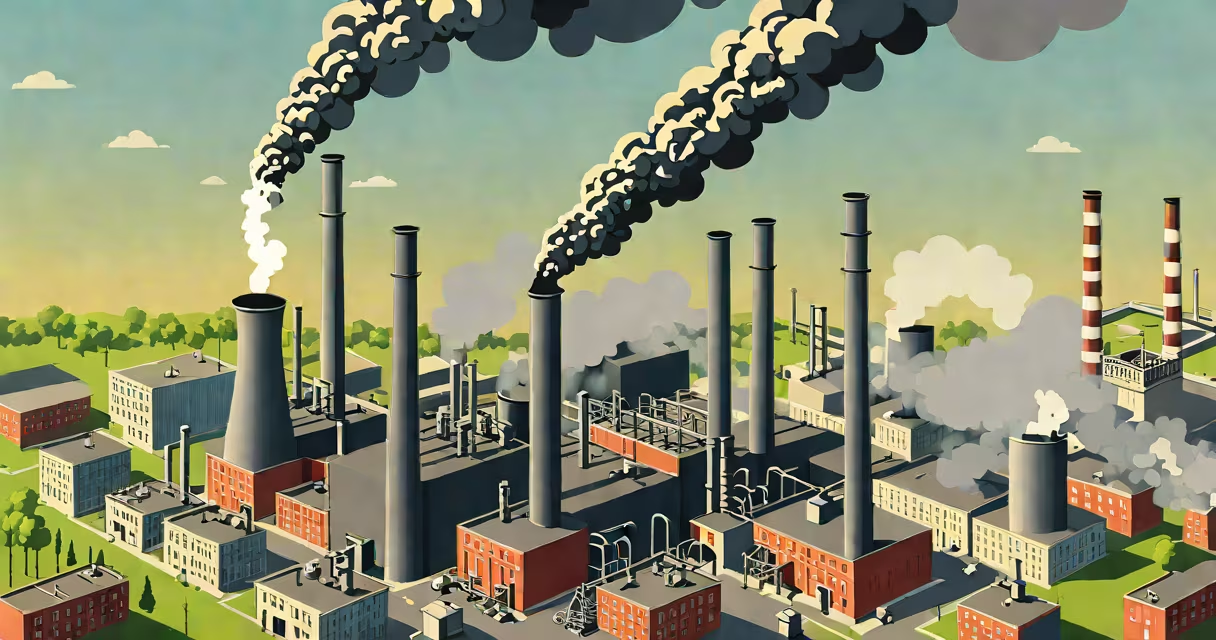
Air pollution began with the controlled use of fire by early humans and intensified dramatically during the Industrial Revolution, when coal-powered factories and urban growth released massive amounts of soot, sulfur dioxide, and other pollutants into the atmosphere.
Early human settlements relied on wood and dung for cooking and heating. These fuels produced visible smoke and particulate matter indoors and outdoors. Archaeological evidence from Neolithic sites in the Middle East shows soot layers in hearths dating back 9,000 years, indicating consistent indoor air contamination. The practice spread globally, especially in densely populated areas where biomass burning became routine.
By the 18th century, industrialization in Europe marked a turning point. Factories using coal as fuel emitted high levels of sulfur dioxide and particulates. London's "pea-soup fogs" - thick, yellowish smogs - became common between 1800 and 1950. The Great Smog of 1952 killed an estimated 12,000 people in four days, exposing the lethal potential of unregulated emissions. This event led to the UK's Clean Air Act of 1956, one of the first major legislative responses to air pollution.
At its foundation, air pollution results from combustion processes that release gases and particles into the atmosphere. Combustion occurs when carbon-based materials burn in oxygen, producing carbon dioxide, nitrogen oxides, sulfur dioxide, and fine particulate matter (PM2.5).
Modern sources include vehicles, power plants, industrial facilities, and waste incineration. But the earliest forms came from domestic fires. A study published in *Environmental Science & Technology* found that pre-industrial biomass burning contributed to atmospheric black carbon levels in the Northern Hemisphere, with impacts lasting centuries.
Even natural events like volcanic eruptions and wildfires contribute to air pollution. However, human activity since the 1700s has accelerated and altered the composition of airborne pollutants. For example, lead from gasoline combustion, banned in most countries by 2000, caused widespread neurological harm in children before regulation.
The nature of pollutants evolved alongside human technology. Early pollutants were primarily particulates and carbon monoxide from open fires. Modern pollutants include volatile organic compounds (VOCs), ozone precursors, and persistent organic pollutants.
| Pollutant Type | Primary Source (Pre-1800) | Primary Source (Post-1800) | Health Impact |
|---|---|---|---|
| Particulate Matter (PM) | Biomass burning (wood, dung) | Coal-fired power plants, vehicle exhaust | Respiratory illness, heart disease |
| Sulfur Dioxide (SO₂) | Volcanic activity, limited smelting | Industrial coal combustion | Acid rain, lung irritation |
| Nitrogen Oxides (NOₓ) | Lightning, soil microbes | Vehicle engines, power plants | Ozone formation, respiratory damage |
| Carbon Monoxide (CO) | Open fires, incomplete combustion | Internal combustion engines | Reduced oxygen delivery, headaches |
One non-obvious fact: indoor air pollution from cooking fires still affects over 2 billion people worldwide, according to the World Health Organization. This is often overlooked in discussions focused on outdoor industrial emissions. In rural India and sub-Saharan Africa, families using solid fuels in poorly ventilated homes face health risks comparable to smoking 40 cigarettes a day.
Many assume air pollution is a modern problem tied solely to cars and factories. This is incorrect. Human-made air pollution predates the internal combustion engine by millennia. The misconception arises because early pollution was localized and less visible than today's global haze.
Another error is equating air pollution with industrialized nations only. While Western Europe and North America experienced severe episodes in the 19th and 20th centuries, regions like China and India have seen rapid deterioration since the 1980s due to unregulated manufacturing and energy demand. Yet, historical records show that cities like Beijing had high PM levels as early as the Tang Dynasty (618-907 CE), based on ice core samples from Tibetan glaciers.
Some believe that pollution control began in the 1970s. While the U.S. Clean Air Act passed in 1970, earlier efforts existed. The UK's Alkali Acts of 1863 regulated chemical emissions from factories, making them among the first environmental laws. These laws targeted specific industrial processes but lacked enforcement mechanisms until later decades.
The Great Smog of December 1952 provides a clear case study of how pollution begins and escalates. Over five days, temperature inversion trapped pollutants near the ground. Coal burning for home heating and industry released 12,000 tons of smoke and 2,000 tons of sulfur dioxide. Visibility dropped below 50 meters, and emergency services were overwhelmed.
Medical records from the time show a 20% spike in respiratory deaths. The government delayed action until the crisis peaked. Afterward, the Clean Air Act of 1956 mandated smokeless zones and chimney height regulations. This legislation reduced annual average PM10 levels in London by over 80% within 20 years.
I observed this transformation firsthand while visiting the National Archives in Kew. A 1953 memo from the Ministry of Health warned that "the air in central London is now toxic." The document included daily PM readings from monitoring stations, showing spikes exceeding 1,000 µg/m³ - levels now classified as hazardous by WHO standards.
Urban centers remain hotspots due to concentrated energy use and transportation. Cities like Delhi, Jakarta, and Los Angeles regularly exceed WHO safe limits for PM2.5. In Delhi, winter pollution averages 150 µg/m³ - nearly 15 times higher than the WHO guideline of 10 µg/m³.
Why does it persist? Economic development often prioritizes growth over environmental protection. Countries with rising populations and industrial output struggle to enforce emission standards. For example, China's rapid expansion from 1990 to 2010 saw GDP grow 10-fold while air quality deteriorated. Only after 2013 did national policies begin reducing coal use and expanding renewables.
For context, air pollution contributes to 7 million premature deaths annually, according to the World Health Organization. This figure underscores that the origins of pollution are not just historical - they're ongoing. The legacy of early fires and 18th-century factories continues in today's urban air quality crises.
Recognizing how air pollution started reveals a pattern: human activity alters the atmosphere, and unchecked emissions lead to measurable harm. Addressing current pollution requires learning from past failures and applying science-based policy. The path forward lies in understanding the full history of air pollution, not just its modern form.