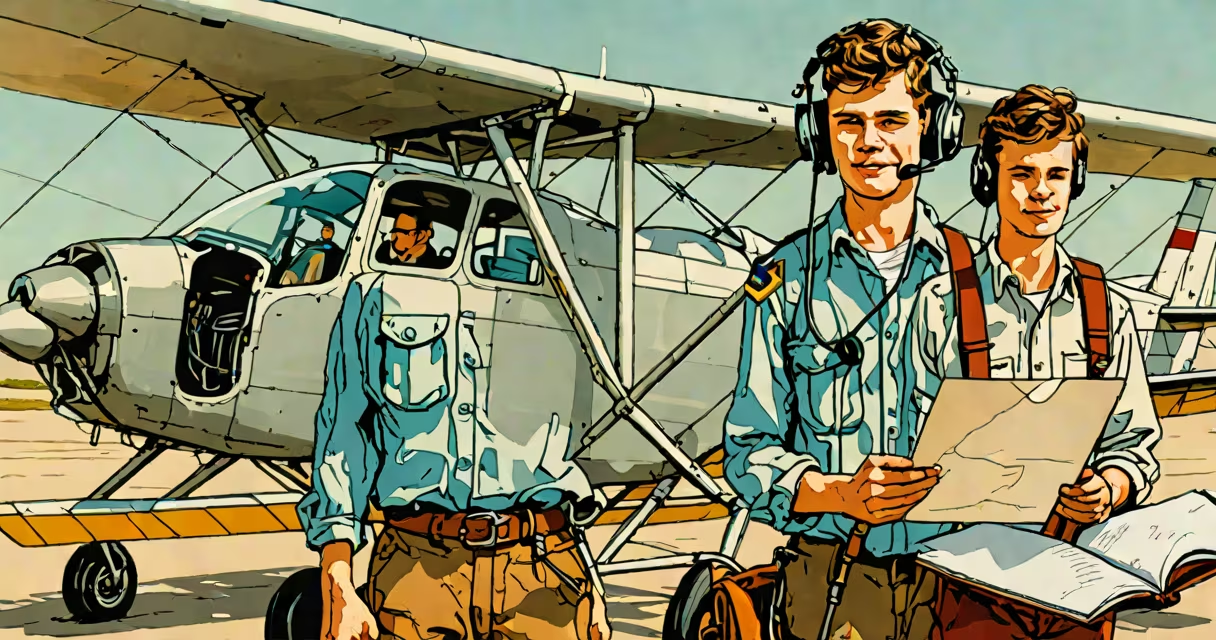
To become a pilot, you must complete a combination of formal education, flight training, and certification exams. The minimum requirement is a high school diploma or GED, but most aspiring pilots pursue college coursework or a degree in aviation science, aerospace engineering, or a related field. The Federal Aviation Administration (FAA) mandates specific flight hour totals and written exams for each license level.
The path begins with private pilot training, which requires a minimum of 40 hours of flight time under the FAA's Part 61 or Part 141 training programs. These hours include solo flights, cross-country navigation, and instrument flying practice. After earning a private pilot certificate, candidates progress through instrument rating, commercial pilot license (CPL), and eventually the airline transport pilot (ATP) certificate. Each stage demands increasing flight experience and theoretical knowledge.
While a bachelor's degree is not strictly required for a private pilot license, it becomes essential for airline careers. Airlines typically require a college degree, especially for applicants seeking positions with major carriers. The FAA recognizes both traditional academic paths and specialized aviation schools as valid routes to certification. All training must align with FAA standards and be conducted by certified flight instructors.
Pilot training follows a structured progression defined by the FAA. Each license builds on the last, requiring progressively more flight time, complex maneuvers, and regulatory knowledge. The process starts with ground school, where students study aerodynamics, weather patterns, navigation, airspace rules, and emergency procedures. This foundational knowledge is tested through written exams before any flight activity begins.
Flight training occurs in stages. After obtaining a student pilot certificate, trainees begin dual instruction with a certified flight instructor (CFI). They learn takeoffs, landings, stall recovery, and basic emergency handling. Once they demonstrate proficiency, they may fly solo. Progression to the private pilot license requires passing a practical exam, known as a checkride, administered by an FAA inspector or designated pilot examiner (DPE).
After earning a private pilot license, pilots pursue an instrument rating, allowing them to fly in low visibility using only instruments. This step adds about 40-60 hours of training focused on navigation systems, autopilot use, and instrument approaches. Without this rating, pilots cannot legally operate in instrument meteorological conditions (IMC), limiting their operational flexibility.
The FAA issues several license levels, each with distinct educational and flight hour requirements. The table below outlines the core milestones:
| License Type | Minimum Flight Hours (Part 61) | Required Education | Typical Career Path |
|---|---|---|---|
| Private Pilot (PPL) | 40 hours | High school diploma or GED | Recreational flying, flight instruction |
| Commercial Pilot (CPL) | 250 hours | High school diploma; college degree preferred | Flight instructing, charter operations |
| Instrument Rating (IR) | 40-60 hours additional | Private pilot license first | Enables flying in clouds and poor visibility |
| Airline Transport Pilot (ATP) | 1,500 hours (for airline employment) | Bachelor's degree required by most airlines | Major airline operations, captain roles |
Some pilots choose Part 141 training, which is a structured curriculum offered by FAA-approved flight schools. These programs often allow faster completion due to standardized syllabi and scheduled evaluations. Part 141 schools also require a higher level of academic oversight, making them ideal for students pursuing a college degree alongside flight training.
Training institutions, both public and private, deliver pilot education across the United States. Universities with aviation programs-such as Embry-Riddle Aeronautical University, Purdue University's School of Aviation and Transportation Technology, and the University of North Dakota-offer integrated degree and licensing pathways. These programs combine classroom learning with flight training, often leading to a bachelor's degree in aviation science or aeronautics.
Major airlines like Delta, American, and United require a bachelor's degree for new hire applicants. According to the U.S. Bureau of Labor Statistics, 70% of airline pilots hired between 2020 and 2023 held at least a four-year degree. This standard ensures consistent academic preparation in subjects like physics, mathematics, and meteorology-critical for decision-making during flight operations.
Regional and cargo carriers may accept applicants with fewer flight hours and no degree, but they still require FAA certification. For example, a pilot working for a regional airline under a 14 CFR Part 135 operation must hold a commercial pilot license and instrument rating, but may not need the 1,500-hour ATP requirement until transitioning to a major carrier.
Many assume that becoming a pilot requires a degree in aviation or engineering. While such degrees are beneficial, they are not mandatory. The FAA allows individuals to earn a private pilot license with only a high school diploma. However, this route limits job opportunities. Most commercial and airline positions require a college degree, even if the major is unrelated to aviation.
A frequent error is confusing the commercial pilot license (CPL) with the airline transport pilot (ATP) certificate. The CPL permits flying for compensation, such as teaching or operating charter flights. The ATP is required to serve as a pilot-in-command on scheduled passenger flights. The ATP requires 1,500 flight hours, a bachelor's degree, and passing a rigorous written and practical exam.
Another misconception is that online courses replace flight training. While online ground school modules are widely used, they do not substitute for hands-on flight experience. The FAA mandates actual flight time with a certified instructor. Even advanced simulators used in training cannot replicate the sensory feedback of real-world turbulence, wind shear, or engine response.
Consider Alex, a 20-year-old from Texas who began flight training at a local Part 141 flight school. He enrolled in a Bachelor of Science in Professional Flight program while completing his private pilot license. Over 18 months, he logged 120 hours of flight time, including 40 hours of solo flying. He passed the FAA written exam for the private pilot certificate with a score of 94%.
He then pursued his instrument rating, adding another 50 hours of training focused on instrument approaches and navigation systems. After passing the instrument checkride, he secured a position as a flight instructor at the same school. Over the next two years, he accumulated 800 flight hours, including 300 hours of dual instruction and 100 hours of cross-country flights.
With 800 hours logged, Alex applied to a regional airline. He completed a multi-engine rating and a type rating for the Embraer E175. After passing the airline's hiring assessment, he was hired as a first officer. His process took five years from start to first airline assignment, demonstrating the cumulative nature of flight experience and education.
As someone who trained at a university-affiliated flight center, I've seen how structured curricula reduce dropout rates. Students who follow a blended academic and flight schedule complete their CPL in 18-24 months, compared to 30+ months for those managing training independently. The integration of theory and practice improves retention and performance.
What education is required to become a pilot varies by career goal. Private flying requires minimal formal education beyond a high school diploma. Commercial and airline careers demand significant flight time, academic preparation, and continuous professional development. The FAA sets the baseline, but individual ambition and institutional support determine success.