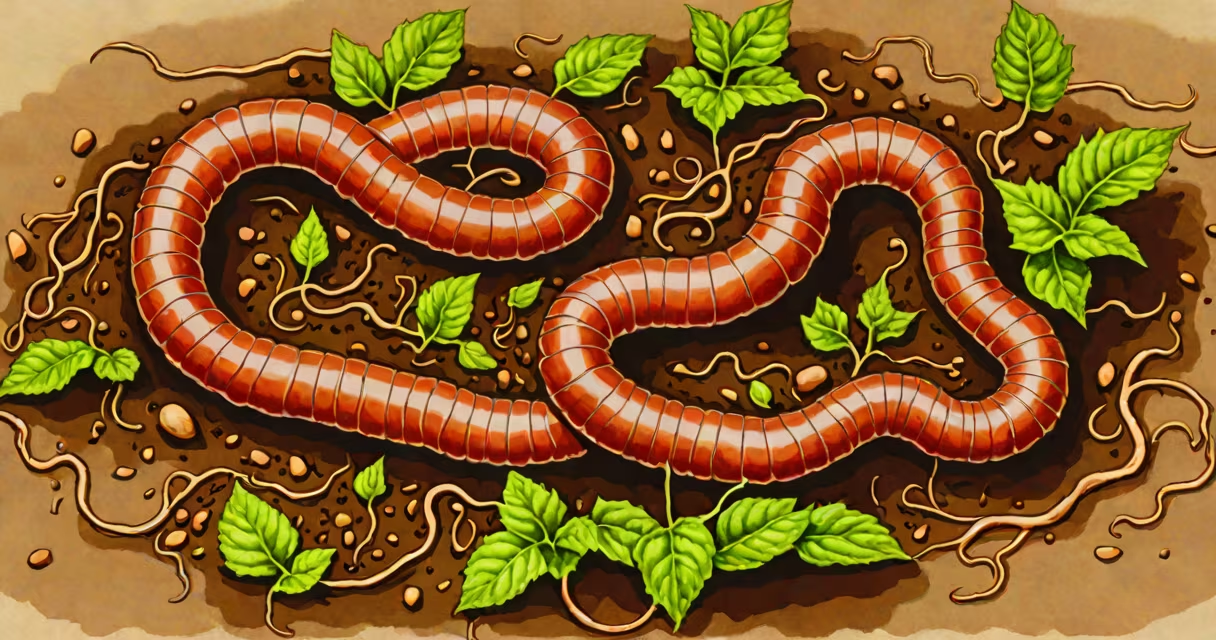
Earthworms reproduce sexually through mutual sperm exchange, even though each individual possesses both male and female reproductive organs. They form temporary connections during mating, transfer sperm to each other's seminal receptacles, and later lay fertilized eggs in protective cocoons.
Worms are hermaphrodites-each animal has functional male and female reproductive systems. This doesn't mean they self-fertilize. Instead, they require a partner to swap sperm. The process begins when two worms align head-to-tail, matching their clitella-the thickened, ring-like segments near the front of their bodies. This alignment allows them to exchange sperm through specialized ducts.
After mating, the worms separate. Over the next few days, each worm produces a cocoon-a tough, jelly-like structure secreted from the clitellum. As the cocoon slides off the worm's body, it picks up sperm stored in the seminal receptacles. Fertilization occurs inside the cocoon. The developing embryos grow within it, feeding on nutrients stored in the cocoon's walls. After 2-3 weeks, tiny juvenile worms hatch and emerge into the soil.
Each earthworm has a complex internal system. The male organs include testes located in segments 10 and 11, and sperm ducts that lead to openings on segment 15. Female structures consist of ovaries in segment 13, oviducts, and a single genital pore on segment 14. The clitellum, which appears as a swollen band around the middle of the body, plays a central role in reproduction by secreting the cocoon material.
Sperm transfer happens through reciprocal exchange. When two worms mate, each deposits sperm into the other's seminal receptacles-specialized sacs that store sperm until fertilization. Neither worm fertilizes its own eggs during mating. This prevents inbreeding and increases genetic diversity. A single mating event can result in multiple cocoons over several days.
Research from the University of California, Riverside confirms that earthworms can store sperm for up to 6 months. This allows them to produce viable offspring long after mating, especially in environments where finding a partner is difficult. The storage capacity varies by species-Lumbricus terrestris can retain sperm for 150 days under lab conditions.
Not all worms reproduce the same way. While most common earthworms are hermaphroditic and rely on cross-fertilization, other species differ in reproductive strategy.
| Worm Type | Reproduction Method | Fertilization Type | Example Species |
|---|---|---|---|
| Common Earthworm | Sexual, reciprocal sperm exchange | External (within cocoon) | Lumbricus terrestris |
| Planarian Flatworm | Sexual or asexual (fission) | Internal | Dugesia japonica |
| Parasitic Nematode | Sexual, separate sexes | Internal | Ascaris lumbricoides |
Planarians, for example, are free-living flatworms capable of both sexual reproduction and asexual fission. When cut in half, each fragment can regenerate into a complete worm. This ability makes them valuable in regeneration research. In contrast, parasitic nematodes like Ascaris have distinct male and female individuals and reproduce via internal fertilization.
A key distinction often missed: hermaphroditism does not imply self-fertilization. In earthworms, self-fertilization is biologically impossible due to timing and anatomical barriers. The sperm must come from another individual. This ensures genetic mixing, which enhances adaptability in changing environments.
Earthworms live in moist soil, where oxygen diffuses through the skin. Their reproductive cycle is tightly linked to environmental conditions. Mating peaks in spring and fall when soil moisture is high and temperatures range between 10°C and 20°C. Dry or frozen soil halts activity. In laboratory settings, earthworms stop reproducing below 5°C or above 30°C.
Reproducing via cocoons offers survival advantages. The cocoon protects embryos from desiccation, predators, and microbial infection. Cocoons can remain dormant for months in dry soil. When rain returns, they hatch. This strategy allows populations to persist through seasonal droughts.
One study published in Soil Biology & Biochemistry tracked Lumbricus terrestris in a controlled field experiment. Researchers found that in fertile, well-aerated soil, each worm produced an average of 3.2 cocoons per year. In compacted soil, production dropped to 0.8 cocoons per year. Soil pH also mattered-cocoons failed to develop at pH below 5.0.
Many assume worms reproduce by splitting in two. That's fission, a form of asexual reproduction seen in planarians and some annelids-but not in earthworms. Earthworms cannot regenerate entire individuals from body fragments. If severed, the head end may survive briefly, but it won't regrow a new tail. The tail end dies.
Another myth: worms are solitary and don't need partners. In reality, they actively seek mates. They detect each other using chemical signals released through mucus. A 2018 study in Journal of Experimental Biology showed that earthworms move toward pheromone trails laid by potential mates. Mating success increased by 70% when worms were placed in a corridor with a trail from a conspecific.
I once observed this behavior while setting up a compost bin. Two worms emerged from the soil and began circling each other. After about 15 minutes, they aligned and formed a tight loop. Within hours, each had secreted a cocoon. I collected one and watched it under a microscope. Inside, four tiny worms wriggled-each about 2 mm long. The entire process took less than a week from mating to hatching.
Understanding how worms reproduce reveals their ecological importance. By breaking down organic matter and aerating soil, they improve nutrient cycling. Their reproductive strategy ensures population stability even in variable climates. Without this balance, soil health would decline rapidly.
Earthworms reproduce through sexual exchange, not self-fertilization. The process involves mutual sperm transfer, cocoon formation, and internal fertilization. This method supports genetic diversity and resilience in natural ecosystems. Knowing how do worms reproduce clarifies their role in soil biology and conservation.