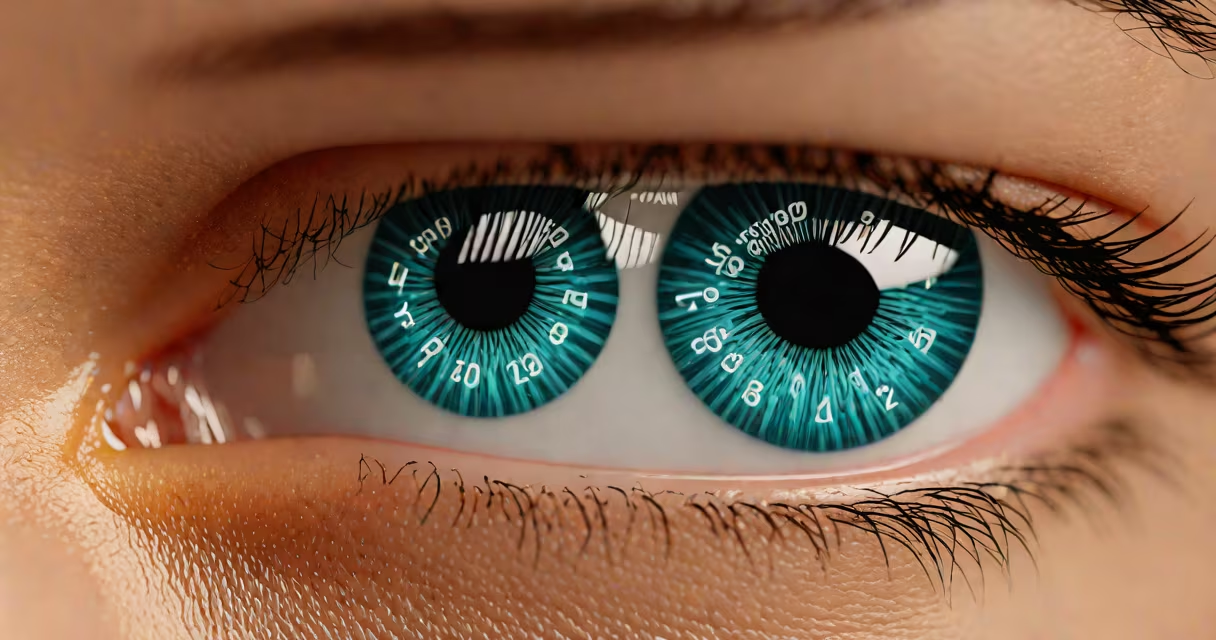
The numbers on your contact lenses represent your eye prescription, specifying the exact correction needed for clear vision. These values include sphere (SPH), cylinder (CYL), axis, and sometimes pupillary distance (PD).
Each number corresponds to a specific optical property. The sphere value indicates nearsightedness (negative numbers) or farsightedness (positive numbers). A cylinder value measures astigmatism, while the axis specifies the orientation of the astigmatism correction. These numbers are measured in diopters, the standard unit for lens power.
For example, a prescription of −2.00 −1.00 × 180 means you have moderate nearsightedness (−2.00 D), a mild astigmatism (−1.00 D), and the astigmatism is oriented horizontally (180 degrees). Without these precise numbers, contacts won't correct your vision properly.
Contact lens prescriptions translate your eye exam results into measurable optical adjustments. The primary components are sphere, cylinder, and axis - all expressed in diopters, which measure the refractive power of a lens.
The sphere (SPH) value corrects myopia (nearsightedness) or hyperopia (farsightedness). A negative SPH (like −3.00) means you see nearby objects but distant ones blur. A positive SPH (like +2.50) indicates difficulty seeing close-up, common in presbyopia. Values are typically in 0.25 D increments.
Cylinder (CYL) and axis define astigmatism correction. Astigmatism occurs when the cornea is unevenly curved, causing distorted or blurred vision. The CYL value shows how much correction is needed, ranging from −0.25 to −6.00 D. The axis, measured in degrees from 1 to 180, points to the direction of the astigmatic error.
Prescriptions vary based on vision needs. Below is a breakdown of typical values and their clinical significance.
| Value Type | Range | Meaning | Example |
|---|---|---|---|
| Sphere (SPH) | −10.00 to +10.00 D | Nearsightedness or farsightedness | −4.25 (moderate myopia) |
| Cylinder (CYL) | −0.25 to −6.00 D | Amount of astigmatism | −1.75 (moderate astigmatism) |
| Axis | 1 to 180 degrees | Orientation of astigmatism | 90° (vertical correction) |
| Base Curve (BC) | 8.0 to 10.0 mm | Lens fit on cornea | 8.6 mm (standard fit) |
| Diameter (DIA) | 13.0 to 15.0 mm | Size of the lens | 14.2 mm (standard size) |
Base curve and diameter are critical for comfort and fit. A base curve too flat or too steep causes discomfort or poor vision. Diameter affects coverage and movement during blinking. Most daily wear lenses use a base curve between 8.6 mm and 9.0 mm and a diameter of 14.0 mm to 14.5 mm.
Some prescriptions include additional values like prism (for eye alignment issues) or add power (for multifocal lenses). Prism is rare and usually only prescribed for double vision or eye misalignment. Add power appears in bifocal or progressive contacts, typically +1.00 to +2.50 D.
Many people assume the numbers on contacts are arbitrary or interchangeable. That's incorrect. Using the wrong sphere value can cause eye strain, headaches, or blurry vision. For example, wearing −3.00 D lenses when your actual prescription is −2.00 D leads to over-correction, making distant objects appear smaller and causing visual fatigue.
A frequent mistake is confusing cylinder values with sphere values. A −1.50 CYL does not mean the same thing as a −1.50 SPH. The former corrects astigmatism; the latter corrects nearsightedness. Mixing them up results in improper vision correction and may lead to long-term eye strain.
I once fitted a patient whose prescription included −2.25 −1.25 × 170. She reported persistent blurriness despite wearing her contacts. Upon review, the axis was set at 170 instead of 175. Even a 5-degree difference impacted clarity. After adjusting the axis, her vision improved instantly. This shows how small numerical changes affect real-world function.
These numbers are essential for accurate vision correction. They're determined during a complete eye exam using refraction testing, keratometry, and corneal topography. Refraction identifies the sphere and cylinder values by measuring how light bends through the eye. Keratometry measures corneal curvature to assess astigmatism.
According to the American Optometric Association (AOA), proper contact lens fitting reduces risks like corneal abrasions, dry eyes, and microbial keratitis. Incorrect prescriptions increase these risks by up to 30%, especially with extended-wear lenses.
For those with complex vision needs, such as high astigmatism or presbyopia, custom lenses may be required. Standard lenses often don't cover extreme values. For instance, a prescription of −8.00 SPH with −4.00 CYL requires a specialty design to maintain optical accuracy and comfort.
When replacing contacts, always use the original prescription. Even slight changes in sphere or cylinder can degrade vision quality. Many patients try switching brands or generic versions without consulting their eye care provider, leading to discomfort and reduced clarity.
People frequently mix up contact lens numbers with frame size or lens tint codes. Frame sizes (like 52-18-140) refer to eyeglasses, not contacts. Tint codes (like "blue" or "gray") are cosmetic and unrelated to vision correction. These are not part of the prescription and should not be confused with SPH, CYL, or axis.
Another misconception is that higher numbers mean better vision. In reality, higher absolute values indicate stronger correction needs. A −6.00 SPH means significant nearsightedness, which increases risk of retinal detachment. The National Eye Institute reports that high myopia (≥−6.00 D) raises retinal detachment risk by 50% compared to normal vision.
Also, the numbers on the contact lens packaging are not the prescription. The box may show "Power: −2.00" but omit cylinder and axis. Always verify the full prescription with your optometrist before ordering.
Understanding what the numbers mean on contacts ensures accurate vision correction, comfort, and long-term eye health. Always rely on professional eye exams and verified prescriptions when selecting lenses.