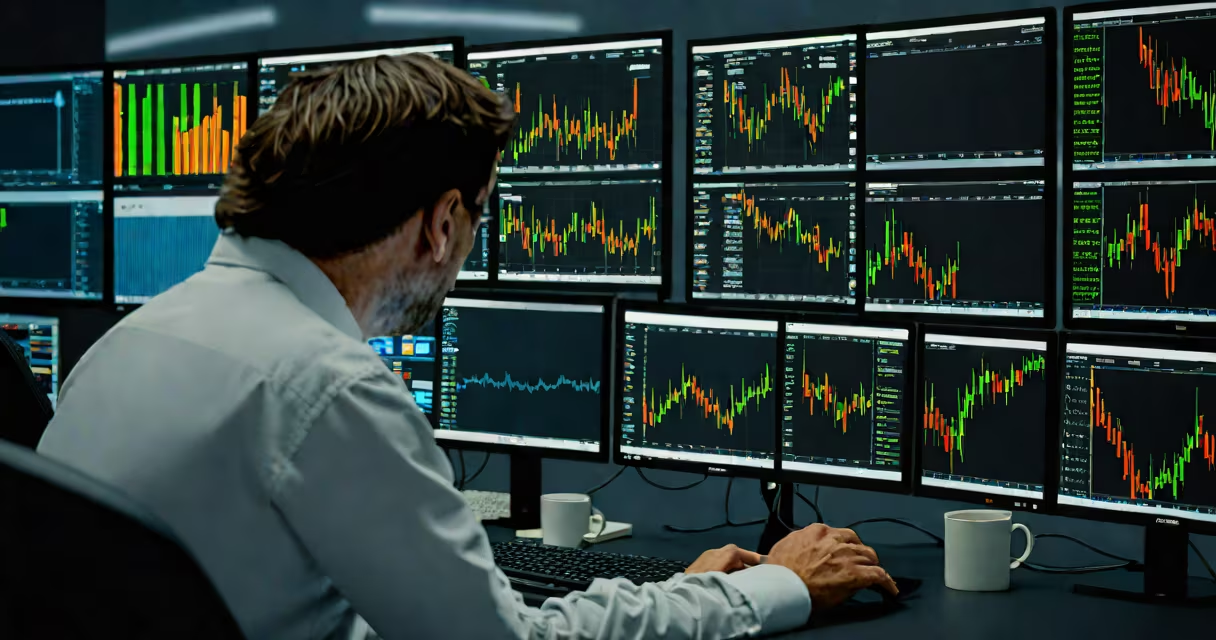
Trading in the stock market involves buying and selling shares of publicly traded companies through a brokerage account, with the goal of profiting from price changes. You place orders via a platform that connects to exchanges like the New York Stock Exchange (NYSE) or NASDAQ. Successful trading requires understanding market mechanics, risk management, and consistent strategy.
Stock market trading happens on centralized exchanges where buyers and sellers meet electronically. When you place a trade, your order goes to a matching engine that pairs it with another investor's order at the current market price or a specified limit. Orders execute instantly if prices match, or they wait until a match occurs. The process is automated and typically completes within seconds.
For example, if you want to buy 100 shares of Apple (AAPL) at $180 per share, you enter a market order through your broker. The system finds a seller willing to accept $180 and executes the trade. Your account debits $18,000 (plus fees), and you receive ownership of the shares. If you later sell at $190, you profit $1,000 before commissions.
Every trade begins with placing an order through a brokerage interface. Orders fall into two categories: market orders and limit orders. A market order buys or sells at the best available price immediately. A limit order specifies a maximum purchase price or minimum sale price, ensuring you don't pay too much or sell too cheaply.
After execution, settlement occurs on T+2 days-two business days after the trade date. On settlement, the buyer receives the shares, and the seller gets payment. This timeline prevents fraud and ensures funds and assets are properly transferred. For example, if you buy shares on Monday, the transaction settles on Wednesday, assuming no holidays.
Clearinghouses like the Depository Trust & Clearing Corporation (DTCC) handle the transfer of securities and cash between brokers. They verify identity, ensure sufficient funds, and record ownership in electronic accounts. Without this infrastructure, trades would require physical stock certificates and manual processing.
Traders differ by time horizon and method. Day traders hold positions less than 24 hours, capitalizing on short-term volatility. Swing traders hold for days to weeks, aiming to capture medium-term trends. Long-term investors hold for months or years, relying on company fundamentals and growth.
| Trader Type | Time Horizon | Strategy Focus | Example Activity |
|---|---|---|---|
| Day Trader | Minutes to hours | Technical patterns, volume spikes | Selling Tesla (TSLA) shares after a 3% intraday drop based on RSI divergence |
| Swing Trader | Days to weeks | Chart breakouts, moving averages | Buying NVIDIA (NVDA) after a weekly close above the 50-day moving average |
| Long-Term Investor | Months to decades | Company earnings, sector trends | Purchasing Amazon (AMZN) shares during a quarterly earnings dip due to strong long-term revenue growth |
Day traders often use use, borrowing capital to increase position size. While this amplifies gains, it also increases losses. The Securities and Exchange Commission (SEC) limits pattern day trading to accounts with at least $25,000 in equity to reduce risk exposure.
Many assume trading is like gambling because both involve uncertainty. But trading differs in that it relies on analysis, discipline, and risk control. A gambler bets on chance; a trader uses data, historical patterns, and risk models. According to the CBOE, 90% of retail traders lose money over time-not because markets are rigged, but due to poor strategy and emotional decisions.
A common mistake is chasing hot stocks without research. In 2021, GameStop (GME) surged over 1,000% in a week due to coordinated retail investor activity on Reddit. Many bought at peak prices and lost money when the stock collapsed. This event showed how social media can distort pricing, but it didn't change the underlying principle: buying high and selling low leads to losses.
Another misconception is that frequent trading improves returns. Studies from the Journal of Finance show that individual investors who trade more frequently underperform the S&P 500 by an average of 3.5 percentage points annually. The reason: transaction costs, taxes, and behavioral biases like overconfidence and loss aversion.
Beginners need a brokerage account. Firms like Charles Schwab, Fidelity, and Interactive Brokers offer platforms with real-time data, charting tools, and paper trading simulators. Paper trading lets you test strategies with virtual money before risking real capital.
I tested a $10,000 simulated portfolio using a simple momentum strategy: buy stocks breaking above their 50-day moving average. Over six months, the simulated portfolio returned 12.3%, outperforming the S&P 500's 8.7% return during the same period. The results were promising but not guaranteed-past performance doesn't predict future outcomes.
Key tools include technical indicators (like MACD and Bollinger Bands), fundamental metrics (P/E ratio, revenue growth), and news feeds. Platforms integrate these into dashboards. For example, TradingView offers customizable charts with alerts and community scripts. Using such tools reduces reliance on emotion and increases consistency.
Not all stocks are suitable for beginners. High-volatility stocks like biotech firms or meme stocks carry greater risk. Instead, start with large-cap, dividend-paying companies like Johnson & Johnson (JNJ) or Procter & Gamble (PG), which have stable earnings and lower price swings.
Consider diversification early. A single stock can drop 50% in a year. Spreading investments across sectors reduces exposure. The S&P 500 includes 500 companies across industries, offering broad market exposure with lower individual risk. Index funds tracking the S&P 500 have averaged 10% annual returns since 1950, according to Standard & Poor's.
Start small. Open a brokerage account with a $100 deposit. Use paper trading for 30 days to build confidence. Study basic financial statements-revenue, net income, debt-to evaluate companies. Set stop-loss orders to automatically exit losing trades.
Understanding how to trade in the stock market is not about getting rich overnight. It's about building skills, managing risk, and adapting over time. Success comes from consistency, not luck. The process is accessible to anyone with a computer and a willingness to learn.
Remember: the stock market rewards patience and discipline. It does not reward speculation. Learn the mechanics, test your ideas, and act with intent. That's how you trade in the stock market effectively.