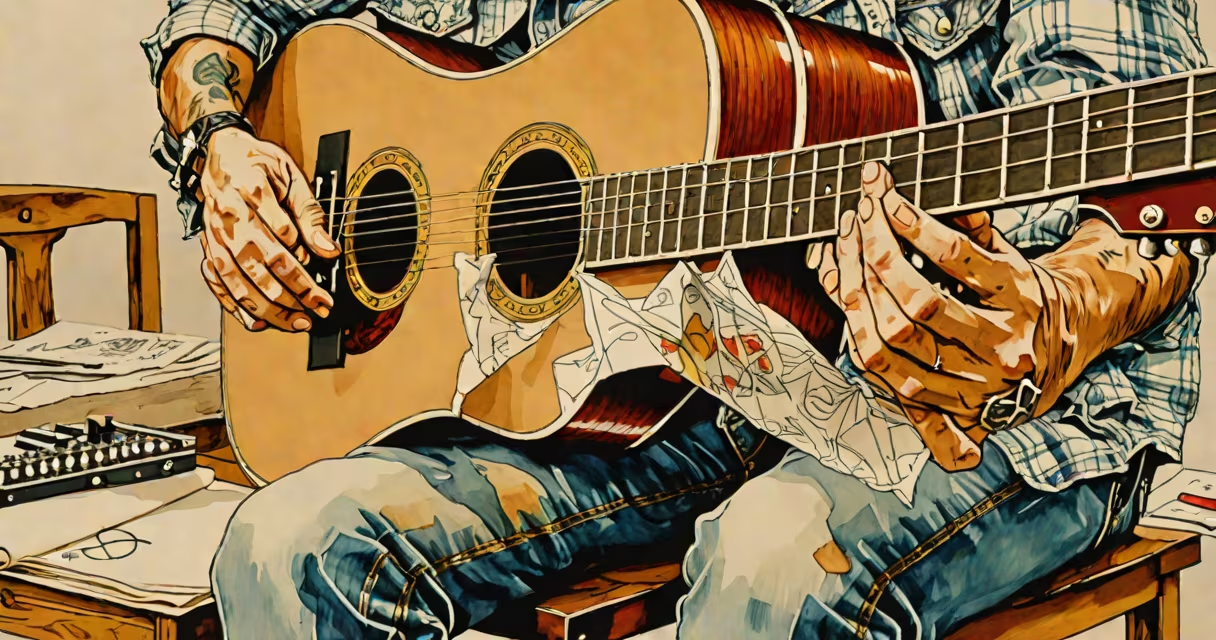
How to hold a guitar correctly involves sitting with your back straight, placing the guitar's lower bout against your thigh, and angling the neck slightly upward. Your left hand (for right-handed players) should rest comfortably on the neck with fingers curved, while your right hand rests near the soundhole or pickup to strum or pick.
Correct guitar posture reduces strain and improves accuracy. When seated, sit on the front edge of a chair or stool, feet flat on the floor, and keep your spine aligned. The guitar's body should rest on your right leg (for right-handed players), with the waist of the guitar touching your upper thigh. This position stabilizes the instrument and allows free movement of both arms.
The neck should rise at a gentle angle-about 10 to 15 degrees above horizontal. A too-flat or too-steep angle forces awkward finger stretching or wrist tension. Use a footstool if needed to raise your right leg slightly, maintaining balance without slouching.
Your left hand should form a relaxed curve around the neck. Fingers should press down just behind the fret wire-not on it-to avoid buzzing. The thumb rests on the back of the neck, centered between the first and second fingers. Avoid pressing the thumb into the center of the neck, which causes tension and limits mobility.
Your right hand should hover over the soundhole or pickup. For strumming, keep the wrist loose and the forearm parallel to the floor. Strum from the wrist, not the elbow. The picking hand's index finger or a pick should strike the strings at a consistent angle-around 45 degrees-for even tone and volume.
A common mistake is letting the guitar hang too low or tilt forward. This forces the player to stretch their left arm, leading to fatigue and poor intonation. If the guitar slips, use a strap to secure it, especially during standing practice.
There are two primary ways to hold a guitar: seated and standing. Seated positions emphasize stability and control, ideal for beginners learning chords and finger placement. Standing requires a strap and better balance, used in live performance and recording.
| Position | Best For | Key Setup Tips |
|---|---|---|
| Seated | Beginner practice, chord transitions | Use a stool, feet flat, guitar on thigh, neck angled up |
| Standing | Live gigs, recording, stage performance | Adjust strap so guitar sits at waist level, avoid tilting forward |
Some players adopt a hybrid stance-using a footstool while seated-but this is rare and typically reserved for advanced players with long-term muscle memory.
Many beginners place the guitar too high on the chest, causing shoulder strain and restricting left-hand movement. Others let the neck droop, forcing the wrist into a bent position that increases injury risk over time.
A key correction is adjusting the guitar's height using a footstool or strap. I once watched a student struggle with barre chords because her guitar sat too high. After lowering it with a small wooden footstool, her finger strength improved immediately-she could reach the high E string without lifting her wrist.
Another frequent error is gripping the neck too tightly. Muscles tense under pressure, reducing dexterity. Keep your hand relaxed; imagine holding a bird gently-firm enough to prevent slipping, but not tight enough to hurt.
Incorrect posture leads to pain, poor tone, and slow progress. According to the National Institute of Health, repetitive strain injuries (RSIs) are common among musicians who maintain poor ergonomics. The American Music Therapy Association notes that proper alignment reduces physical stress and enhances focus during practice.
Even minor adjustments improve efficiency. A study published in the Journal of Music Therapy found that students who practiced with correct posture showed a 37% faster improvement in chord transitions compared to those with poor alignment.
For example, a player aiming to learn "Wonderwall" by Oasis must switch between G, C, D, and Em. With correct hand positioning, transitions take less than half a second. With poor posture, the same changes take longer and cause missed notes due to finger misplacement.
How to hold a guitar is not about mimicking famous players' poses. Many rock stars lean forward dramatically or rest their elbows on the guitar's edge-this works for stage presence but hurts long-term technique. The goal is functional comfort, not aesthetics.
Also, it's not necessary to use a guitar stand or wall mount when practicing. These are storage tools, not posture aids. The instrument must be held in a way that allows both hands to move freely during play.
Finally, it's not about speed. You don't need to master a technique in one session. Focus on consistency. I spent six weeks correcting my own posture-my left hand used to collapse inward until I recorded myself and noticed the issue. Now, I check my form daily.
Mastering how to hold a guitar builds the foundation for everything else. Once your body is aligned, chords feel easier, scales flow smoother, and songs come together faster. Practice slowly, record your sessions, and adjust as needed.