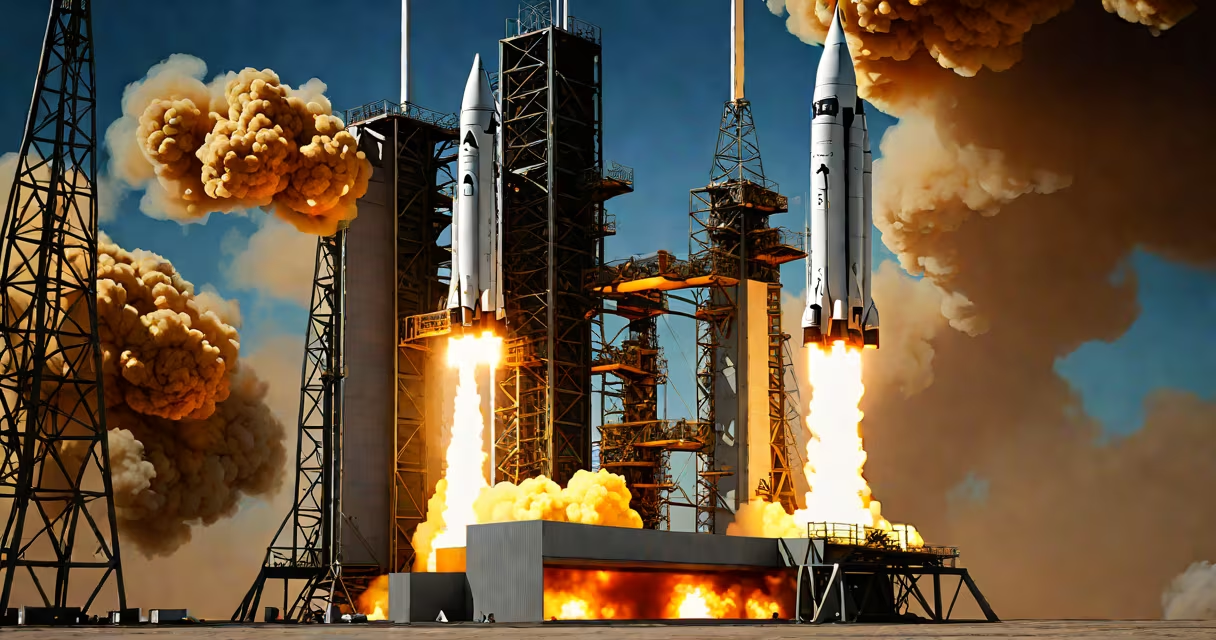
The NASA Space Launch System (SLS) is a super-heavy-lift launch vehicle developed to carry astronauts and payloads beyond low Earth orbit, serving as the primary launch system for the Artemis program's crewed missions to the Moon and future deep space exploration.
SLS is engineered to deliver more than 26 metric tons to trans-lunar injection, exceeding the capabilities of previous American rockets like the Saturn V. Its core stage uses four RS-25 engines-reused from the Space Shuttle program-and two solid rocket boosters derived from shuttle hardware. The vehicle stands 98 meters tall and generates over 4 million pounds of thrust at liftoff.
Designed for safety, reliability, and scalability, SLS is not a commercial rocket. It is a government-developed system managed by NASA's Marshall Space Flight Center in Huntsville, Alabama, with manufacturing and integration conducted at the Michoud Assembly Facility in New Orleans and the Kennedy Space Center in Florida.
SLS operates in a staged configuration. At liftoff, the core stage and two solid rocket boosters fire simultaneously. The boosters burn for approximately 2 minutes before jettisoning. The core stage continues burning for about 8 minutes, delivering the upper stage and payload to orbit. After separation, the Interim Cryogenic Propulsion Stage (ICPS) performs a burn to send the Orion spacecraft toward the Moon.
Unlike reusable rockets such as SpaceX's Falcon 9, SLS is expendable. Each flight uses a new vehicle. This design prioritizes mission safety and performance over cost recovery. The rocket's avionics and guidance systems are based on heritage aerospace systems, ensuring high reliability for human-rated missions.
The SLS Block 1 variant, used for Artemis I and Artemis II, can lift 26 metric tons to translunar trajectory. Future Block 1B and Block 2 variants will feature a more useful upper stage and increased payload capacity, enabling missions to Mars and deep space destinations.
NASA plans to evolve SLS through multiple configurations, each tailored to increasing mission demands:
| Variant | First Flight | Payload Capacity (Translunar) | Primary Mission |
|---|---|---|---|
| Block 1 | Artemis I (2022) | 26 metric tons | Uncrewed test flight to lunar orbit |
| Block 1B | Planned for Artemis IV (2028) | 46 metric tons | Crewed lunar landings, Gateway station resupply |
| Block 2 | Planned for Artemis IX (2035+) | 50+ metric tons | Mars mission prep, large-scale deep space cargo |
Block 1B introduces a new Exploration Upper Stage (EUS), powered by four RL10 engines. This upgrade increases performance by 30% compared to the ICPS. Block 2 will replace the current core stage with a larger version using advanced composite materials and higher-thrust engines.
SLS is central to NASA's Artemis program, which aims to return humans to the Moon by 2025 and establish a sustainable presence by 2030. The rocket launches the Orion Multi-Purpose Crew Vehicle, capable of carrying four astronauts for up to 21 days in deep space.
Artemis I (2022) was an uncrewed test flight around the Moon. Artemis II (2024) will carry four astronauts on a circumlunar trajectory. Artemis III (2026) will land the first woman and next man on the lunar south pole-a region rich in water ice and strategic for long-term habitation.
After lunar operations, SLS will support the Lunar Gateway, a space station in lunar orbit. The Gateway requires regular resupply and crew rotation, tasks SLS is uniquely suited for due to its high payload mass and deep-space reach.
Many assume SLS is a competitor to commercial rockets like SpaceX's Starship. This is incorrect. SLS is not designed for frequent, low-cost access to low Earth orbit. It is optimized for deep space, human-rated missions requiring extreme reliability and performance-not reusability or rapid turnaround.
A common error is equating SLS with the Space Shuttle. While SLS uses RS-25 engines from the Shuttle program, it is structurally and functionally distinct. The Shuttle orbited Earth; SLS escapes Earth's gravity. The Shuttle flew 135 times; SLS is planned for fewer than 10 flights per decade.
Another misconception is that SLS is obsolete or redundant. According to NASA's 2023 Independent Review Panel, SLS remains the only vehicle capable of launching the Orion capsule and large lunar landers in a single launch. Replacing it would require a new development cycle lasting over a decade.
During a visit to the Kennedy Space Center in 2023, I watched the final assembly of the Artemis I core stage. The sheer scale of the structure-over 100 feet long, weighing 2.6 million pounds-was overwhelming. Workers used cranes and precision alignment tools to join segments. The level of engineering control required to ensure structural integrity under 4 million pounds of thrust is unlike anything in commercial aerospace.
One non-obvious fact: SLS uses a unique "core stage" design with five propellant tanks-four liquid hydrogen and one liquid oxygen-arranged in a star pattern. This configuration reduces stress on the structure during ascent and improves stability.
Another distinction: SLS is not a commercial product. It is funded entirely by U.S. federal appropriations. The total cost of the SLS program through 2030 is projected at $4.1 billion annually, according to the Government Accountability Office (GAO).
According to NASA's official timeline, Artemis III will launch from Launch Complex 39B at Kennedy Space Center. The same pad used for Apollo 11 and STS-1. This continuity underscores SLS's role in continuing America's legacy of human spaceflight.
For context, the Saturn V, last used in 1973, generated 7.6 million pounds of thrust. SLS produces 4 million pounds-still enough to lift 100 fully loaded Boeing 747s off the ground at once.
The NASA Space Launch System is a critical component of the United States' strategy for sustained human presence beyond Earth. It enables missions to the Moon, supports the construction of the Lunar Gateway, and lays the foundation for eventual crewed missions to Mars. With its focus on safety, performance, and deep-space capability, SLS is not a replacement for commercial launch vehicles-it is their complement.
As NASA prepares for Artemis III, the SLS rocket stands ready, a symbol of national ambition and technological endurance. Its success hinges not on speed or cost, but on the ability to safely deliver humans into the unknown.