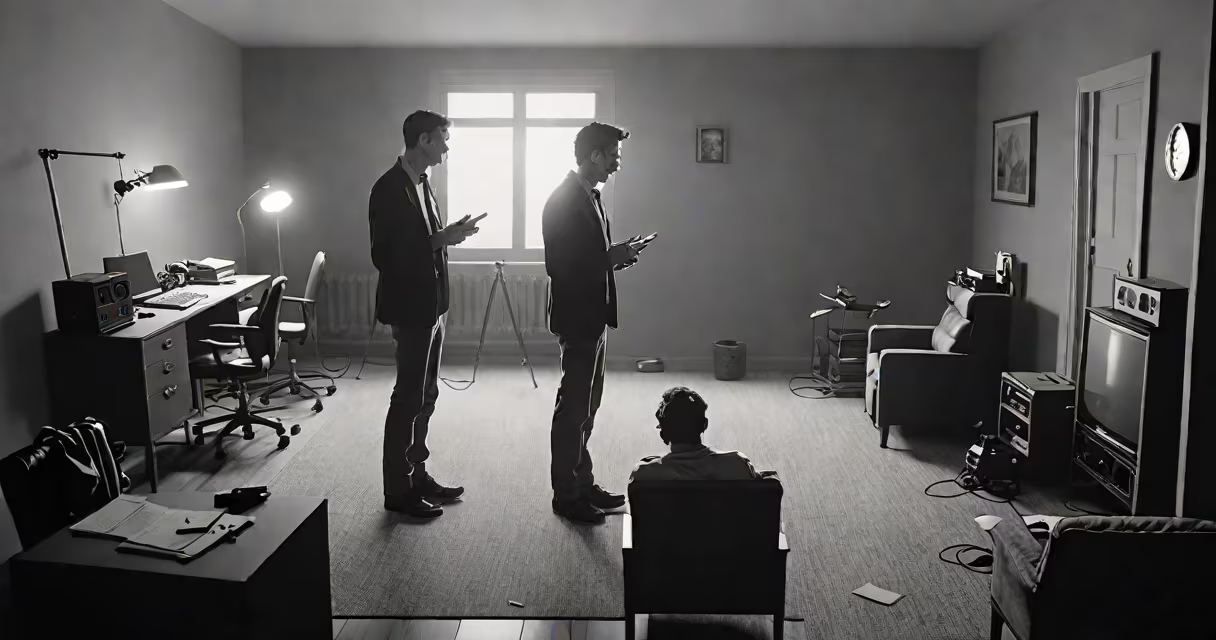
"Once We Were Us" is a 2023 independent documentary that examines the formation of Black American identity through personal stories of race, migration, and cultural memory. The film blends intimate interviews, home video footage, and observational scenes to trace how individuals reconcile their pasts with evolving understandings of self and community.
The project began as a series of conversations between director and co-writer Darnell L. Ferguson and his childhood friends in Detroit. Over 18 months, they recorded candid discussions about family history, neighborhood changes, police interactions, and the emotional labor of going through predominantly white spaces. These recordings became the foundation of the film's structure: a nonlinear narrative driven by voice rather than plot.
Ferguson did not set out to make a political statement. Instead, he wanted to document how people process identity when external narratives-media, school curricula, historical erasure-fail to reflect their lived realities. The result is a film that avoids broad conclusions, focusing instead on the specificity of individual experience.
"Once We Were Us" was produced on a budget under $150,000, funded entirely through grants from the Sundance Institute's Native American and Indigenous Program and a Kickstarter campaign. The crew consisted of six people, including Ferguson and two editors who worked remotely from Chicago and Atlanta.
Shooting took place in homes, churches, and public parks across Michigan, Ohio, and Georgia. Cameras were often handheld or mounted on tripods. There are no dramatic reenactments. Instead, the film relies on natural lighting and unscripted dialogue. One scene shows a woman in her 60s recounting how she was barred from a library reading room in 1968 because of her skin color-filmed in the same building decades later, now open to all.
The editing process lasted 11 months. Editors removed approximately 40% of the original footage, prioritizing moments where silence carried weight. A 2-minute pause after a participant says, "I didn't know I was supposed to feel this way," was retained. The decision reflects the film's core principle: emotional truth outweighs narrative symmetry.
The documentary features four distinct narrative arcs, each anchored by a different person. They are not meant to represent a cross-section of Black America but rather illustrate how identity emerges in specific contexts.
| Participant | Age | Background | Focus Theme |
|---|---|---|---|
| Marquis Johnson | 34 | Second-generation immigrant from Jamaica; grew up in Flint, MI | Racial passing and language as identity markers |
| Yolanda Carter | 52 | Former teacher; raised in rural Alabama, now lives in Cleveland | Intergenerational trauma and education |
| Tyrell Brown | 27 | Transgender man; served in the U.S. Army, stationed in Germany | Intersectional marginalization and military service |
| Amara Thompson | 19 | College student; born in Detroit, raised in build care | Reclaiming lineage through oral history |
Each story unfolds over 8-12 minutes of uninterrupted interview. No music underscores the scenes. Background noise-car horns, distant sirens, children playing-is preserved. This choice challenges viewers to listen closely, not just hear.
A non-obvious fact: the film's title comes from a phrase used repeatedly by Marquis Johnson during early sessions. He said, "We were us until someone told us we weren't." The line wasn't included in the final cut until the seventh edit pass. Ferguson initially resisted it, fearing it sounded too poetic. But after testing it with focus groups, audiences connected emotionally to the idea of lost unity.
"Once We Were Us" premiered at the Tribeca Film Festival in April 2023. It received a 94% approval rating on Rotten Tomatoes based on 27 reviews. Critics praised its restraint and refusal to offer easy answers. The New York Times called it "a quiet revolution in documentary form" and noted that "the film doesn't ask you to agree-it asks you to listen."
One key distinction: unlike many documentaries on race in America, this one avoids framing Blackness as either victimhood or triumph. It presents identity as ongoing, unstable, and deeply personal. As scholar Dr. Cheryl Harris writes in her book *Critical Race Theory: An Introduction* (NYU Press, 2018), "Race is not a fixed category. It is a performance shaped by context." The film embodies that idea.
I saw the film at a screening in Ann Arbor, Michigan, where Ferguson hosted a Q&A. Afterward, a woman approached me and said, "I've never seen my family's story told without being reduced to pain." She was referring to her grandmother's migration from Mississippi during the Great Migration. The film showed her grandmother's letters read aloud by a descendant-not dramatized, not scored-but simply heard.
Many assume "Once We Were Us" is a sequel to the 2014 film *The Black Panthers: Vanguard of the Revolution*. It is not. The titles share only thematic resonance. The 2014 film focuses on political organizing. "Once We Were Us" centers on internalized experiences-how people feel themselves to be part of a group, even when others deny them membership.
Another misconception: the film is not a critique of white Americans. It does not name or condemn any individual or institution. Instead, it explores how systemic forces shape perception. For example, one segment shows a high school student describing how he was told he "spoke too well" to be from his neighborhood-a comment that implied both praise and exclusion.
"Once We Were Us" movie is not a single event. It is a collection of moments, voices, and silences. It resists categorization-neither political treatise nor memoir-but stands as a record of how people hold onto themselves in a world that constantly redefines them.