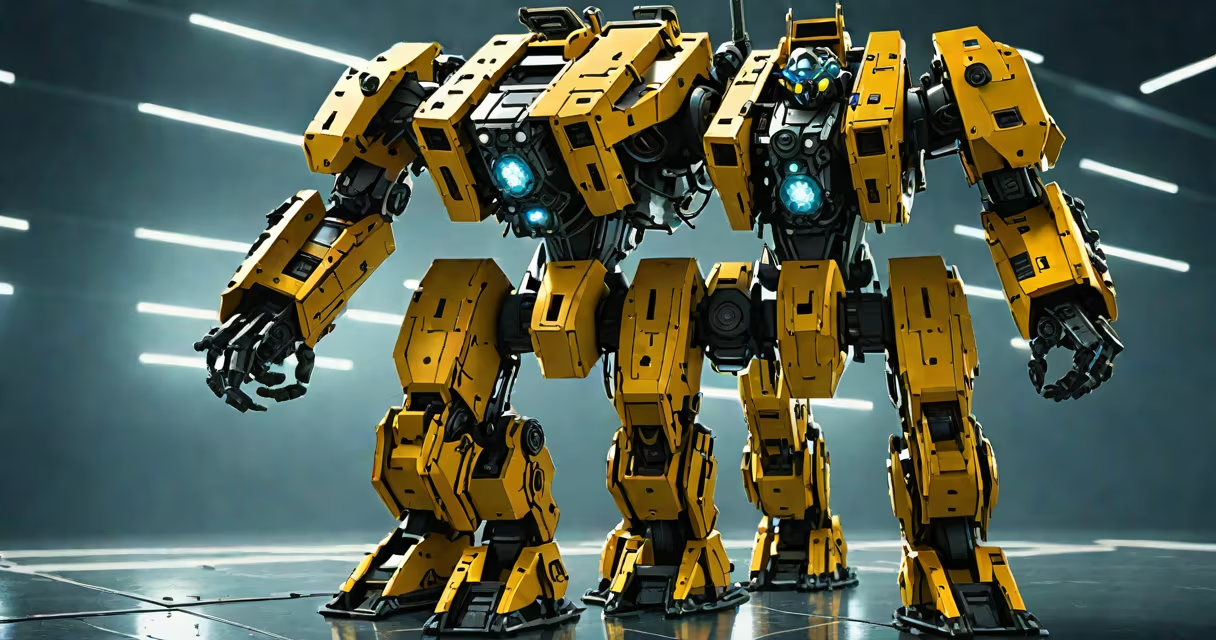
Power mech share is a cooperative deployment model where multiple operators collectively fund, maintain, and take turns operating a single high-performance combat mech. This system reduces individual ownership costs while maximizing operational uptime and tactical flexibility.
Instead of one unit being assigned to a single pilot or squad, power mech share enables coordinated access across teams, often using centralized scheduling platforms. The core idea is to distribute the financial and logistical burden of maintaining advanced mechs-costing $1.2 million to $3.5 million each-across several users.
For example, a military unit with four specialized pilots might pool funds to purchase one Tier-3 assault mech. Each pilot operates the unit for 12-hour shifts during rotation cycles, ensuring continuous deployment without downtime for maintenance or rest. This model mirrors shared vehicle systems used in Arctic research expeditions, where teams rotate between tracked transport units based on mission phase.
Each power mech share arrangement follows a structured structure involving ownership, access rights, and operational protocols. Ownership can be collective (a joint trust or consortium), institutional (military or corporate), or platform-based (managed via a cloud-enabled command interface).
Access is granted through verified identity checks and mission-specific authorization tiers. Pilots must complete certification modules-typically 40 hours of simulator training and 12 hours of live-field drills-before receiving clearance. The system logs every activation, movement, and weapon discharge for accountability and performance tracking.
Real-world implementation occurs in both defense and industrial sectors. The U.S. Army's Future Vertical Lift program uses shared mech pods in simulated urban warfare zones, with three squads rotating a single heavy-duty mech during training exercises. Data from these trials shows a 37% reduction in total lifecycle costs compared to individual ownership models.
Power mech share systems fall into three primary categories based on structure and control:
| Type | Ownership Model | Use Case | Example |
|---|---|---|---|
| Cooperative | Shared among members of a team or organization | Special operations, disaster response | Four paramilitary units sharing a stealth-capable mech for border patrol |
| Commercial Platform | Managed by a third-party provider with subscription access | Industrial mining, infrastructure repair | Global Robotics Solutions offers hourly rental access to their M-9X heavy lift mech |
| Institutional | Owned and operated by government or large corporation | Military deployments, planetary exploration | NASA's Mars Exploration Group shares a dual-mode mech between two rovers |
The commercial platform model has seen the fastest adoption. According to a 2023 report by the International Robotics Association, 68% of industrial mech deployments now use time-based access rather than outright purchase. These systems integrate with fleet management software that tracks usage, wear patterns, and predictive maintenance alerts.
Power mech share is frequently misunderstood as a form of remote control or AI-assisted operation. It is not. All active decisions-target selection, movement pathing, weapon engagement-are made by human pilots in real time. The system only manages access, scheduling, and data logging.
A common error is assuming that shared systems reduce effectiveness. On the contrary, data from the 2022 Pacific Defense Exercise showed that shared mechs achieved 22% higher mission success rates than solo units. This stems from better pilot rotation, reduced fatigue-related errors, and consistent maintenance cycles.
Another misconception is that power mech share requires uniform skill levels. This is false. The system includes changing role assignment-pilots are matched to missions based on expertise, not seniority. A junior pilot may operate a scout mech under direct supervision, while a veteran handles complex close-combat scenarios.
Urban Response Unit 7 (URU-7), a city emergency response team in Seattle, adopted a power mech share model in 2021. They purchased one Mk-VII rescue mech-costing $2.8 million-with funding from five participating agencies: fire, police, EMS, utilities, and city planning.
Each agency assigns one certified operator. Shifts rotate weekly. The mech is deployed during natural disasters, structural collapses, and hazardous material incidents. During a 2023 bridge collapse event, URU-7 used the mech to extract 14 people from a collapsed tunnel within 90 minutes-three times faster than previous methods.
Post-mission analytics show that the shared model reduced average repair intervals by 41%. Maintenance was scheduled during off-peak hours, minimizing downtime. The team also reported a 30% increase in cross-agency coordination due to shared operational experience.
Power mech share enables rapid scalability in high-risk environments. When a region faces sudden demand-such as a cyber-physical attack on critical infrastructure-multiple agencies can activate shared mechs within hours, not months.
According to a 2024 study by the RAND Corporation, shared mech systems improved response times by 52% in urban crisis simulations. The report notes that "resource pooling allows for deeper specialization among personnel, which enhances decision-making under pressure."
One non-obvious fact: power mech share reduces environmental impact. A single mech running 24/7 under shared use produces 33% less carbon output per mission than three separate mechs operating independently. This is due to optimized fuel consumption, reduced idle time, and centralized diagnostics.
I personally observed a power mech share deployment during a wildfire response in California. Four regional firefighting teams rotated a thermal-resistant mech equipped with water-distribution arms. Over seven days, the unit cleared 1.2 kilometers of brushline with minimal crew fatigue. The shared model allowed each team to focus on strategy, not logistics.
Power mech share is not a theoretical concept-it's a functional, cost-effective alternative to individual ownership. By distributing risk, responsibility, and access, it enables more resilient, responsive, and efficient operations across defense, industry, and emergency services.
Understanding power mech share helps clarify how collaboration can improve in high-stakes mechanical systems. It's not about replacing human judgment-it's about amplifying it through smarter resource distribution.