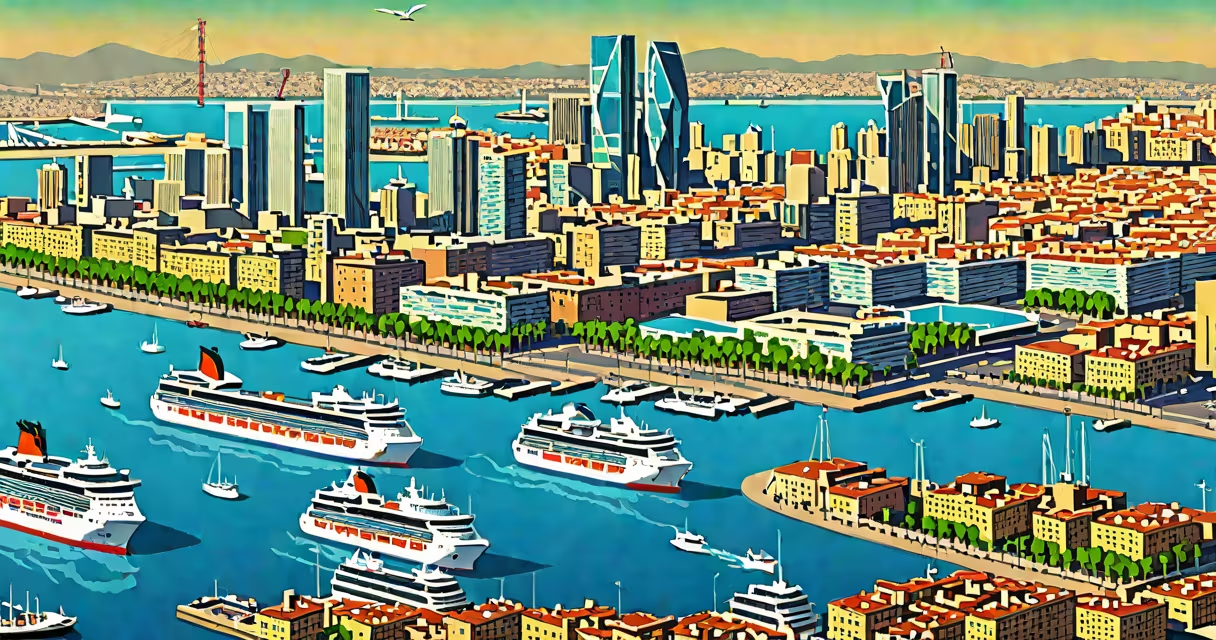
The puerto de barcelona is Spain's largest seaport and a major Mediterranean maritime hub, handling over 3 million TEUs (twenty-foot equivalent units) annually and serving as a critical node for international trade, cruise tourism, and regional logistics.
Located along the northeastern coast of Spain, the port operates under the authority of the Consorcio de Puertos de Cataluña, a public consortium managing infrastructure and services. It spans approximately 12 kilometers of coastline and includes specialized terminals for containerized freight, bulk cargo, roll-on/roll-off vehicles, and passenger vessels. The port's strategic location between Northern Europe and North Africa makes it a preferred transit point for goods moving through the Strait of Gibraltar and the western Mediterranean.
Container throughput reached 3.1 million TEUs in 2023, according to data from the World Shipping Council and the Spanish Ministry of Transport. This volume places the puerto de barcelona among the top 20 container ports in Europe. The port's efficiency stems from automated stacking cranes, integrated digital systems for vessel scheduling, and direct rail connections to inland distribution centers in France, Germany, and Italy.
Operations at the puerto de barcelona are divided into zones based on function. The Moll de la Fusta handles general cargo and Ro-Ro (roll-on/roll-off) traffic, while the Terminal de Contenedores de Barcelona (TCB) manages containerized freight. The port's central command center uses real-time tracking via GPS and RFID to monitor vessel arrivals, cargo movements, and equipment status.
Ships enter through the Port of Barcelona's designated maritime channels, which are regularly maintained by the Spanish Navy's hydrographic service. The average turnaround time for a container ship is 36 hours, including customs clearance and berth allocation. The port's digital platform, PortNet, allows shipping lines and logistics providers to access manifests, schedule inspections, and coordinate loading operations through a single interface.
A 2022 study by the University of Barcelona found that 68% of container traffic originates from Asia and transits through the Suez Canal before reaching the Mediterranean. From there, 42% of those containers are rerouted to Central and Eastern Europe via rail, reducing road congestion and lowering carbon emissions by an estimated 15% compared to truck-only transport.
The port features five main terminals, each designed for specific cargo types:
| Terminal | Cargo Type | Annual Capacity (TEUs) | Special Features |
|---|---|---|---|
| TCB (Container Terminal) | Standard containers | 2.3 million | Automated stacking cranes, 24/7 operations |
| Moll de la Fusta | Ro-Ro, heavy machinery | 450,000 | Dedicated ramps, climate-controlled storage |
| Terminal de Pasajeros | Cruise passengers | Over 2 million | Direct metro access, multilingual staff |
| Terminals de Graneles | Bulk cargo (grain, chemicals) | 1.2 million tons | Specialized silos, environmental controls |
| Port de l'Estació | Intermodal transfers | Unspecified | Rail link to Madrid and Lyon |
Each terminal integrates with the port's centralized energy grid, which runs on 92% renewable electricity sourced from nearby wind farms and solar installations. The port's sustainability initiative, "Barcelona Green Port," aims to achieve net-zero emissions by 2030, aligning with EU Green Deal targets.
Many confuse the puerto de barcelona with the nearby Costa Brava coastal towns or the historic port of Palma de Mallorca. Unlike Palma, which focuses on leisure and yachting, the puerto de barcelona is a commercial and industrial port. It also differs from the port of Valencia, which handles more agricultural exports and has lower container volumes.
A common error is assuming that all cruise ships dock at the same terminal. In reality, the Terminal de Pasajeros accommodates large vessels (up to 250,000 GT), while smaller cruise liners use the Marina de la Ribera. During peak season (June-September), the port processes up to 12 cruise ships per day, requiring coordinated crew and passenger movement through dedicated lanes.
One non-obvious fact: the port's name is officially "Port de Barcelona" in Catalan, the regional language. While signage uses both Catalan and Spanish, official documents and maritime records reference the port using the Catalan form. This linguistic duality reflects Catalonia's autonomy in administrative matters, even within national infrastructure.
In 2021, I visited the port during a logistics audit for a European freight company. I observed a Maersk container ship unload 1,200 TEUs in under 18 hours. The process began with a pilot boat guiding the vessel into Berth 12, followed by automated cranes transferring containers to rail shuttles. All movements were tracked via a digital dashboard showing real-time progress and delays.
Another example: in 2023, the port hosted the inaugural Mediterranean Trade Forum, drawing representatives from 27 countries. Attendees discussed supply chain resilience after disruptions caused by the Red Sea crisis. The event highlighted how the puerto de barcelona serves as a buffer zone for rerouting shipments from Asia to Europe, reducing dependency on the Suez Canal.
For context, the port's annual economic impact totals €12 billion, supporting over 110,000 jobs in logistics, maintenance, and maritime services. This figure includes indirect employment in retail, hospitality, and transportation sectors linked to port activity.
The puerto de barcelona is not a tourist destination in the traditional sense, though it hosts guided tours and educational programs. Its primary role remains commercial and logistical. Misunderstandings often arise because the port's modern architecture and proximity to the city center create a visual impression of leisure space. However, operational zones remain restricted to authorized personnel and cargo vehicles.
Understanding the puerto de barcelona requires distinguishing between its public-facing areas and its core operational infrastructure. The port is a high-efficiency machine, not a scenic waterfront. Its success lies in coordination, automation, and integration with regional and global networks.