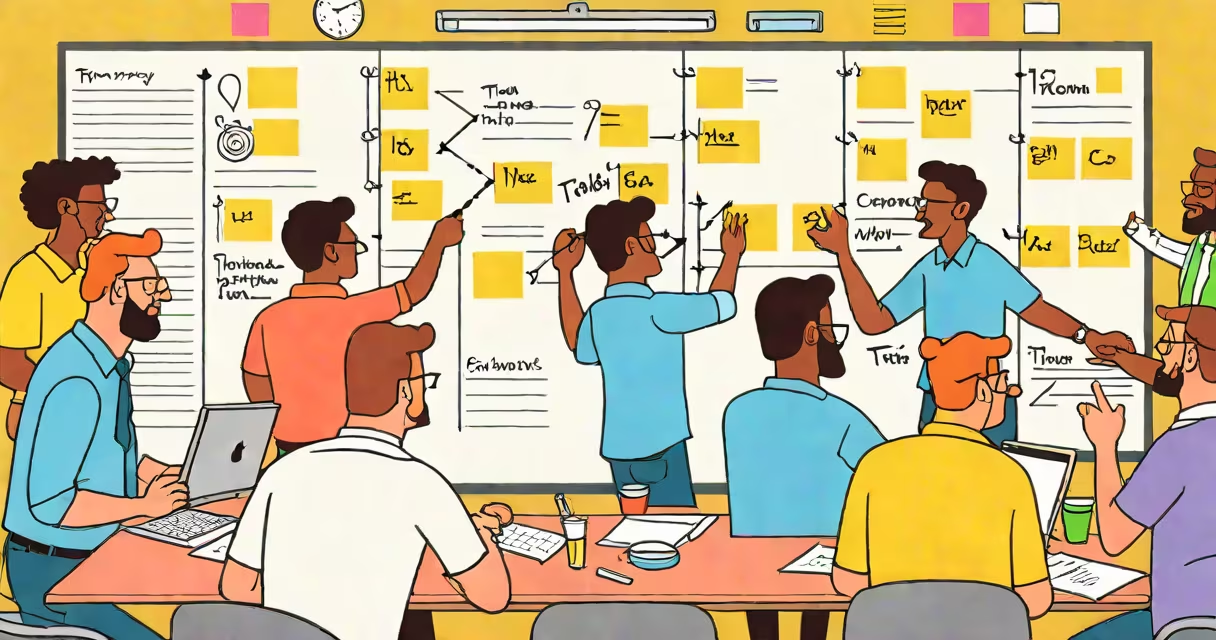
The purpose of Scrum is to enable teams to deliver working software in short cycles, adapt quickly to changing requirements, and continuously improve through inspection and adaptation. It's a structure for managing complex product development, especially in software engineering, where predictability and responsiveness are critical.
Scrum operates through time-boxed iterations called sprints, typically lasting two to four weeks. Each sprint begins with a planning session where the team selects work from the product backlog-a prioritized list of features, enhancements, and bug fixes. The team commits to completing a set of items during the sprint, then meets daily for 15-minute stand-up meetings to synchronize progress and address blockers.
At the end of each sprint, the team demonstrates the completed work to stakeholders in a review meeting. A retrospective follows, where the team reflects on what went well, what didn't, and how to improve in the next cycle. This rhythm ensures continuous delivery and rapid feedback, reducing the risk of building features that don't meet user needs.
Scrum relies on three core roles: the Product Owner, the Scrum Master, and the Development Team. The Product Owner manages the product backlog, ensuring it reflects business priorities and customer value. The Scrum Master enforces Scrum rules, removes impediments, and facilitates meetings. The Development Team-a cross-functional group of engineers, designers, and testers-owns the work and delivers increments of potentially shippable software.
For example, a fintech startup developing a mobile banking app uses Scrum to release new features every two weeks. During Sprint 5, the team selects "biometric login" and "transaction history export" from the backlog. They break tasks into smaller units, estimate effort using story points, and track progress on a physical board. Daily stand-ups reveal a dependency on a third-party API, which the Scrum Master resolves within hours. At the sprint review, stakeholders test the new features and request minor UI adjustments. These changes are added to the backlog and scheduled for the next sprint.
This process prevents large-scale failures. Without Scrum, the team might spend six months building a feature only to find users don't want it. With Scrum, they validate assumptions early and pivot quickly.
Scrum's structure includes five formal events and three artifacts. Events are time-boxed to ensure focus and efficiency:
Artifacts provide transparency:
| Artifact | Description | Owner |
|---|---|---|
| Product Backlog | A changing list of features, enhancements, and bugs ranked by business value. Updated continuously. | Product Owner |
| Sprint Backlog | Items selected from the product backlog for the current sprint. Breakdown of tasks and estimates. | Development Team |
| Increment | The sum of all completed backlog items from the current and previous sprints. Must be potentially shippable. | Development Team |
These elements work together to create a predictable yet adaptive workflow. The product backlog evolves based on stakeholder input, while the sprint backlog remains stable during the sprint to avoid scope creep.
Many assume Scrum is a methodology or a rigid process. It's not. Scrum is a lightweight structure with defined roles, events, and artifacts-but it doesn't prescribe how to build software. Teams choose their tools, coding standards, and testing practices. Scrum only defines *when* and *how often* decisions are made, not *what* to decide.
Another mistake is treating the Scrum Master as a project manager. The Scrum Master is a servant-leader who coaches the team, removes obstacles, and protects the team from external interference. They don't assign tasks or track individual performance. Their role is to uphold Scrum principles, not manage output.
A less obvious but critical point: Scrum doesn't guarantee success. A team can follow all Scrum ceremonies and still fail if the product backlog lacks clear priorities or if stakeholders don't participate in reviews. According to the Scrum Guide (2020), "Scrum is not a process, technique, or recipe." Its effectiveness depends on team discipline, psychological safety, and organizational support.
Research from the Standish Group's CHAOS Report (2022) found that projects using Agile methods-including Scrum-had a 64% higher success rate than traditional waterfall projects. Projects using Scrum specifically reported a 50% reduction in late deliveries and a 40% increase in stakeholder satisfaction.
At Spotify, Scrum-like squads operate independently but align through a larger structure called "Squads, Tribes, Chapters, and Guilds." Each squad functions as a Scrum team, owning a feature area. They run two-week sprints, hold retrospectives, and demo features weekly. This model helped Spotify scale rapidly while maintaining innovation velocity.
Even non-software teams adopt Scrum. A university library used Scrum to redesign its online catalog system. The team held biweekly sprints, involved students in usability tests, and reduced implementation time by 35% compared to past projects. Feedback loops caught navigation issues early, avoiding costly redesigns later.
The purpose of Scrum is not to replace project management. It's not about tracking hours or assigning blame. It's not a tool for micromanaging developers. Scrum doesn't eliminate planning-it shifts planning from upfront design to iterative refinement.
Some confuse Scrum with Kanban. While both use visual boards and limit work in progress, Kanban focuses on continuous flow and doesn't use fixed-length sprints. Scrum emphasizes time-boxed cycles and regular reflection. Using Kanban for steady-state operations and Scrum for new feature development is common in hybrid environments.
As someone who ran a Scrum team for a healthcare SaaS platform, I saw firsthand how the structure prevented burnout. Before Scrum, we had monthly releases with unclear goals. After adopting two-week sprints, team morale improved. We shipped faster, caught bugs earlier, and reduced post-release firefighting by 60%. The key wasn't the structure itself-it was the culture of accountability and shared ownership it enabled.
Understanding the purpose of Scrum means recognizing it as a mechanism for human coordination under uncertainty. It's not about perfection. It's about learning, adapting, and delivering value consistently. When implemented correctly, it turns chaos into clarity.